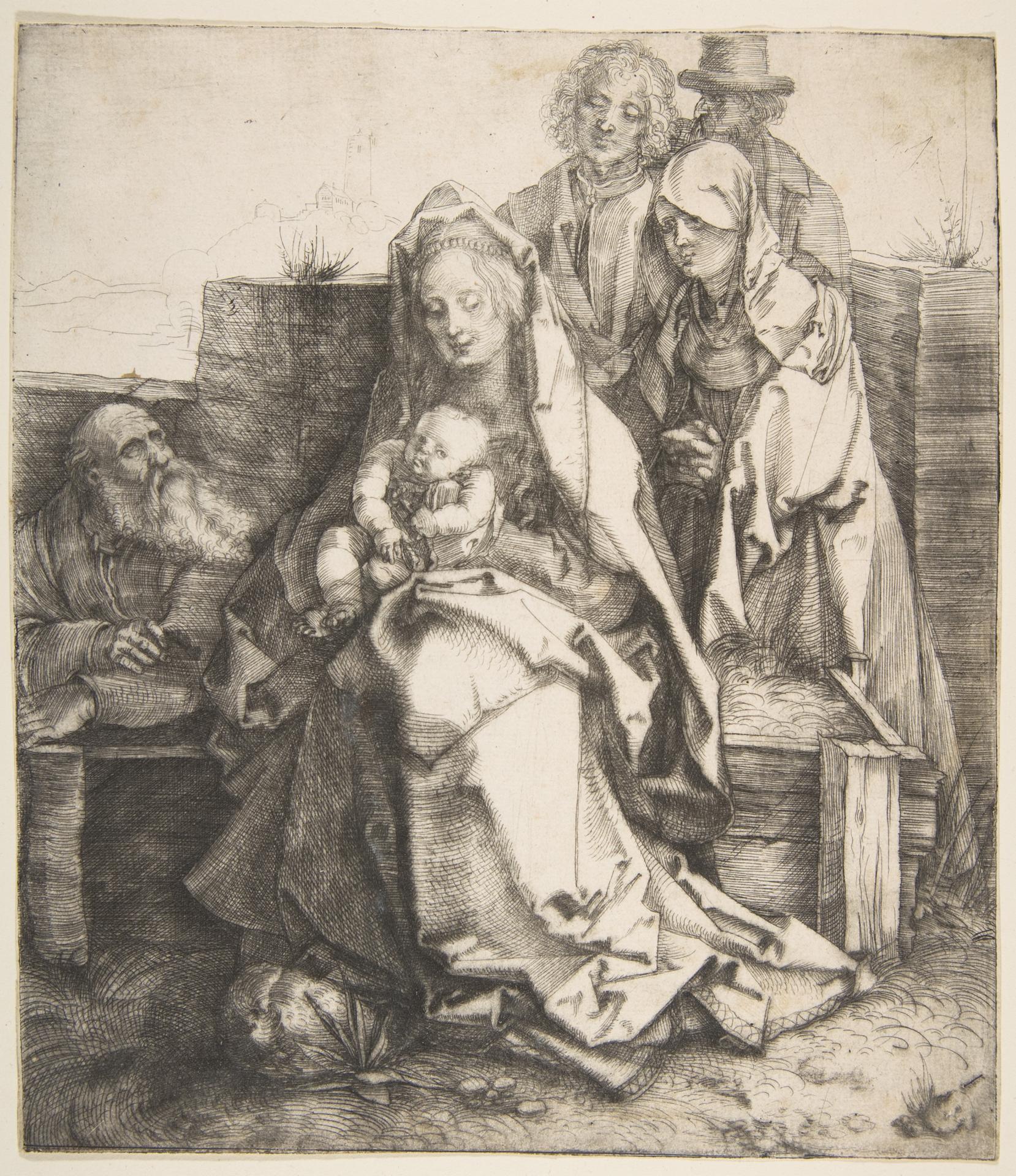
The Holy Family
Original title: The Holy Family
kurzbeschreibung
The Holy Family is a drypoint print by Albrecht Dürer, dated to 1512–13. It depicts the Virgin Mary seated with the infant Jesus on her lap, accompanied by Saint Joseph and other figures in a scene that evokes the Adoration of the Shepherds. The work showcases Dürer's masterful linework in the medium of drypoint.
Description
The composition centers on Mary, who sits holding the Christ Child, with Joseph beside her as an older man. To the right stands a figure wearing an apron, likely a shepherd, while additional figures appear in the background. The arrangement is balanced, with the holy pair at the focal point, and the monochrome print relies on fine, precise lines to define forms and textures.
Context
Dürer created this drypoint around 1512–13, during a period when he was experimenting with intaglio techniques beyond his more common engravings. The subject of the Holy Family was popular in Northern Renaissance art, reflecting contemporary devotional practices. This print is one of only a few drypoints Dürer produced, making it a notable example of his technical range.
Impact
The print has a quiet, intimate atmosphere, drawing the viewer into the domestic scene. Dürer's delicate lines lend a sense of tenderness and reverence, while the detailed background adds depth without distracting from the central figures. The overall effect is one of serene piety, characteristic of his religious works.
Technique
The work is executed in drypoint, a technique where the artist scratches directly into a metal plate with a needle, creating a burr that holds ink for rich, velvety lines. Dürer employed this method to achieve fine, expressive strokes, though the softness of the lines differs from his more controlled engravings. The print is monochromatic, relying entirely on line and tone.
AI-generated description text
Source: Metropolitan Museum of Art · Public domain (CC0)