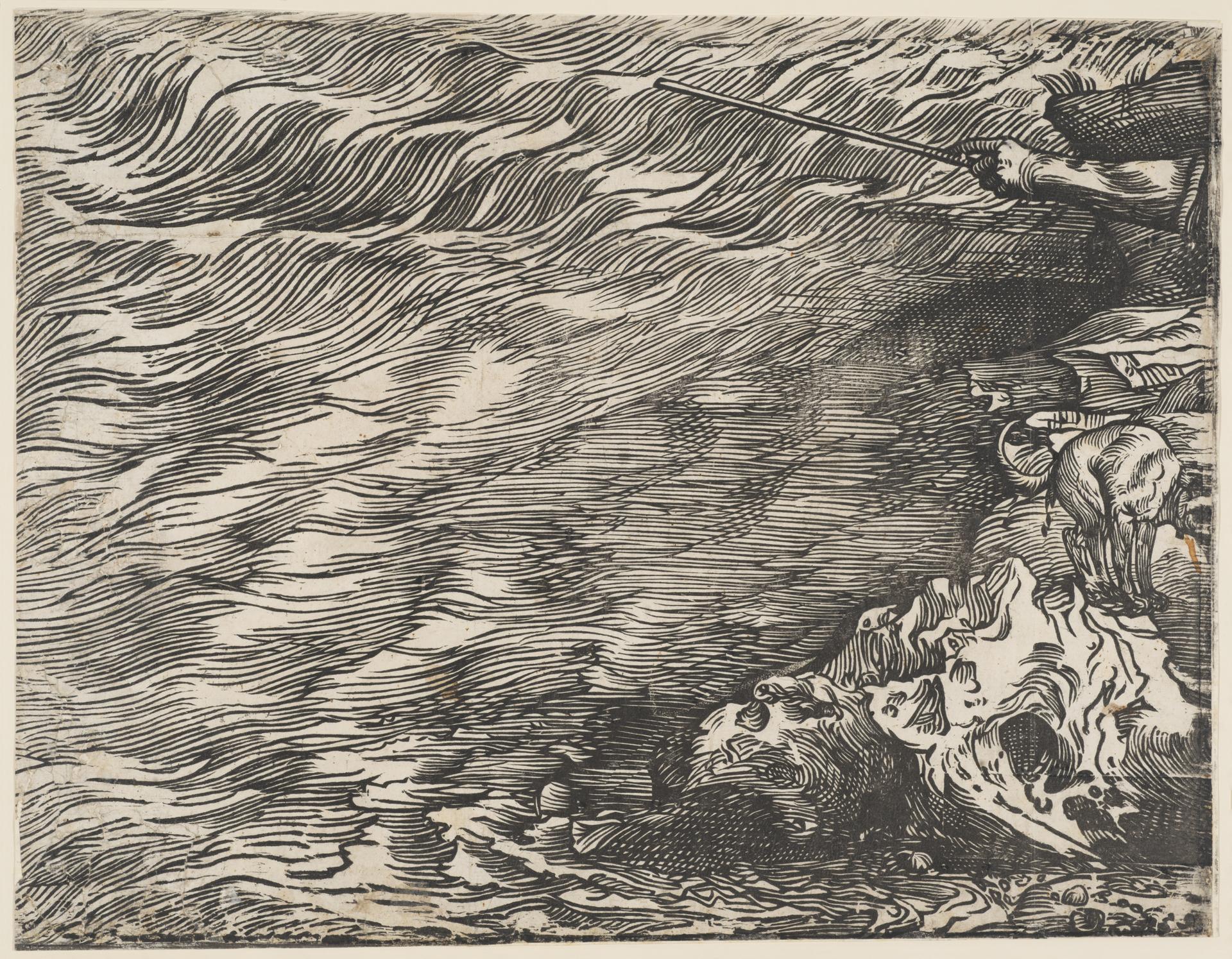
The Submersion of Pharoah's Army in the Red Sea, from twelve blocks: 'Block I, below Block H', showing the sea and a dog defecating
Original title: The Submersion of Pharoah's Army in the Red Sea, from twelve blocks: 'Block I, below Block H', showing the sea and a dog defecating
kurzbeschreibung
A fragment of the biblical story of Pharaoh's army drowning in the Red Sea: in this woodcut, made around 1514–15 and published in 1549, Titian (Tiziano Vecellio) focuses entirely on the water and on a dog squatting on a rocky ledge.
Description
In the foreground a dog crouches on a cliff and is in the act of defecating. Behind it the sea spreads out, its waves formed from fine, closely spaced lines that give them movement and depth. At the upper right a hand with a long object, probably a stick, dips into the water. The sheet remains black on white, as is usual for a woodcut; the lines are precise and keep their motion.
Context
The print belongs to a series of twelve blocks with which Titian tells the biblical events around the parting of the Red Sea. They were made in Venice, where woodcut flourished in the early sixteenth century. The work did not go to press until 1549—much later than the designs, which points to a late printing.
Impact
The powerful movement of the waves, made almost physical by the dense lines, dominates the sheet. To this is added a strange contrast: the great biblical scene and, in front of it, the everyday dog. It provokes and stays in the memory.
Technique
To make the woodcut, the motif was cut into a wooden block and then pulled onto paper. Bringing out the texture of the water and the details of the dog requires fine lines and dense hatching—craftsmanship of high precision.
AI-generated description text
Source: Metropolitan Museum of Art · Public Domain (CC0 1.0)