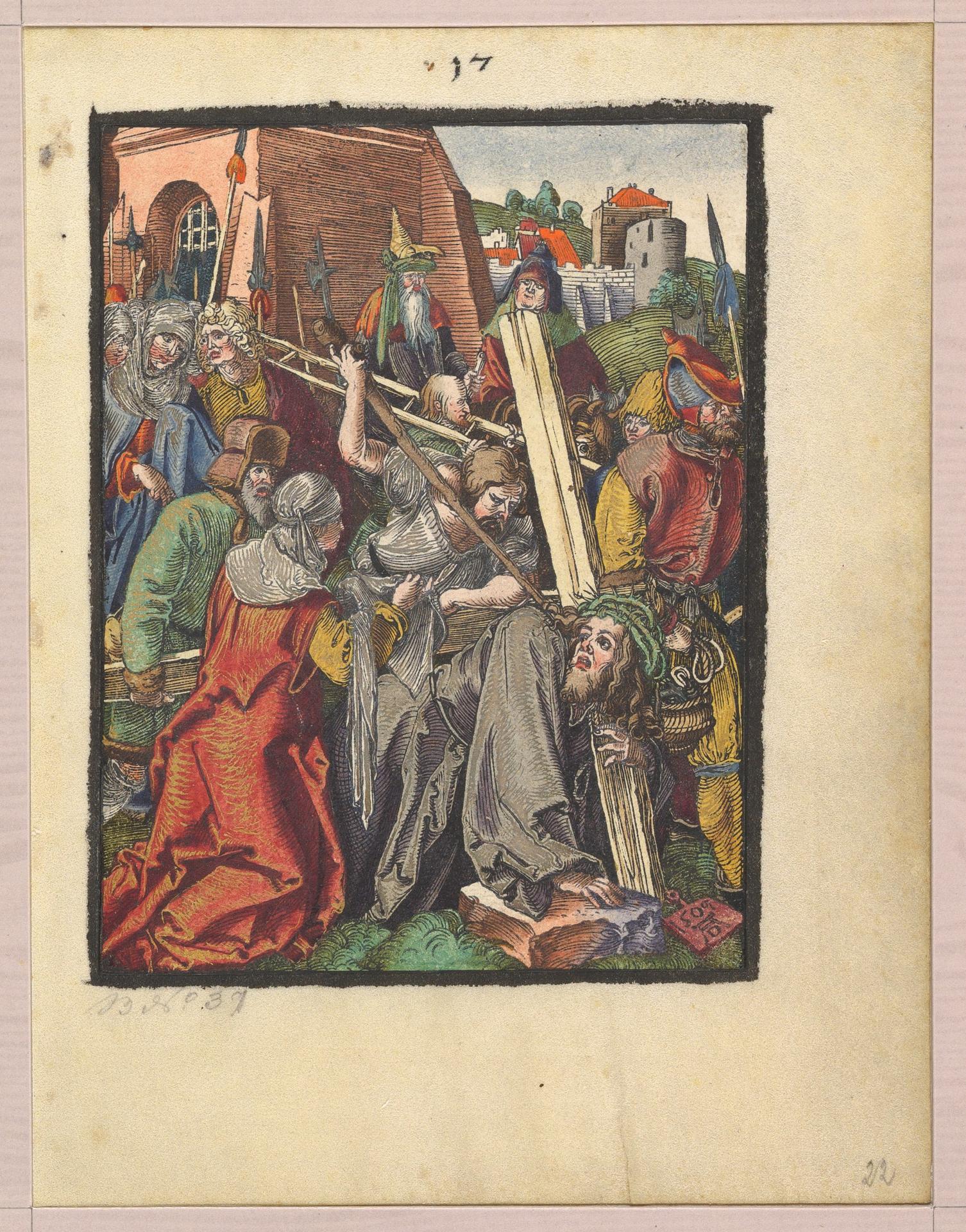
The Bearing of the Cross, from "The Small Woodcut Passion"
Original title: The Bearing of the Cross, from "The Small Woodcut Passion"
kurzbeschreibung
This hand-colored woodcut by Albrecht Dürer, dated 1509–10, depicts Christ carrying the cross on the way to his crucifixion. Part of Dürer's 'Small Woodcut Passion' series, it combines intricate linework with vivid, applied color to convey the emotional weight of the scene.
Description
The central figure of Christ, wearing a crown of thorns and a pained expression, struggles beneath the weight of the cross, gripping its beam with one hand. He is surrounded by soldiers with spears and shields, as well as onlookers in medieval garments of red, blue, and green. In the background, a city with a castle and other buildings rises, while the overall light is even, with no visible shadows, suggesting a daylight or interior setting. The composition is dense with figures and architectural detail, typical of late Gothic narrative art.
Context
Dürer created the 'Small Woodcut Passion' between 1509 and 1511, a series of 37 woodcuts illustrating the Passion of Christ. This particular print was hand-colored after printing, a common practice in the early 16th century to enhance the visual appeal for a broader audience. The series was highly popular and contributed to Dürer's reputation as a master printmaker, reaching viewers who could not afford painted altarpieces.
Impact
The vivid colors and expressive faces draw the viewer into the sorrowful procession, creating a sense of immediacy and empathy. The detailed background and varied reactions of the figures add depth, making the scene feel both intimate and monumental. The overall effect is one of solemnity and reverence, inviting contemplation of Christ's suffering.
Technique
The work is a woodcut, a relief printing process where the image is carved into a wooden block, inked, and pressed onto paper. Dürer's precise and dynamic linework demonstrates his mastery of the medium, capturing fine details and emotional expression. The hand-coloring, applied with water-based pigments, adds layers of color that enrich the composition without obscuring the underlying print.
AI-generated description text
Source: Metropolitan Museum of Art · Public domain (CC0)