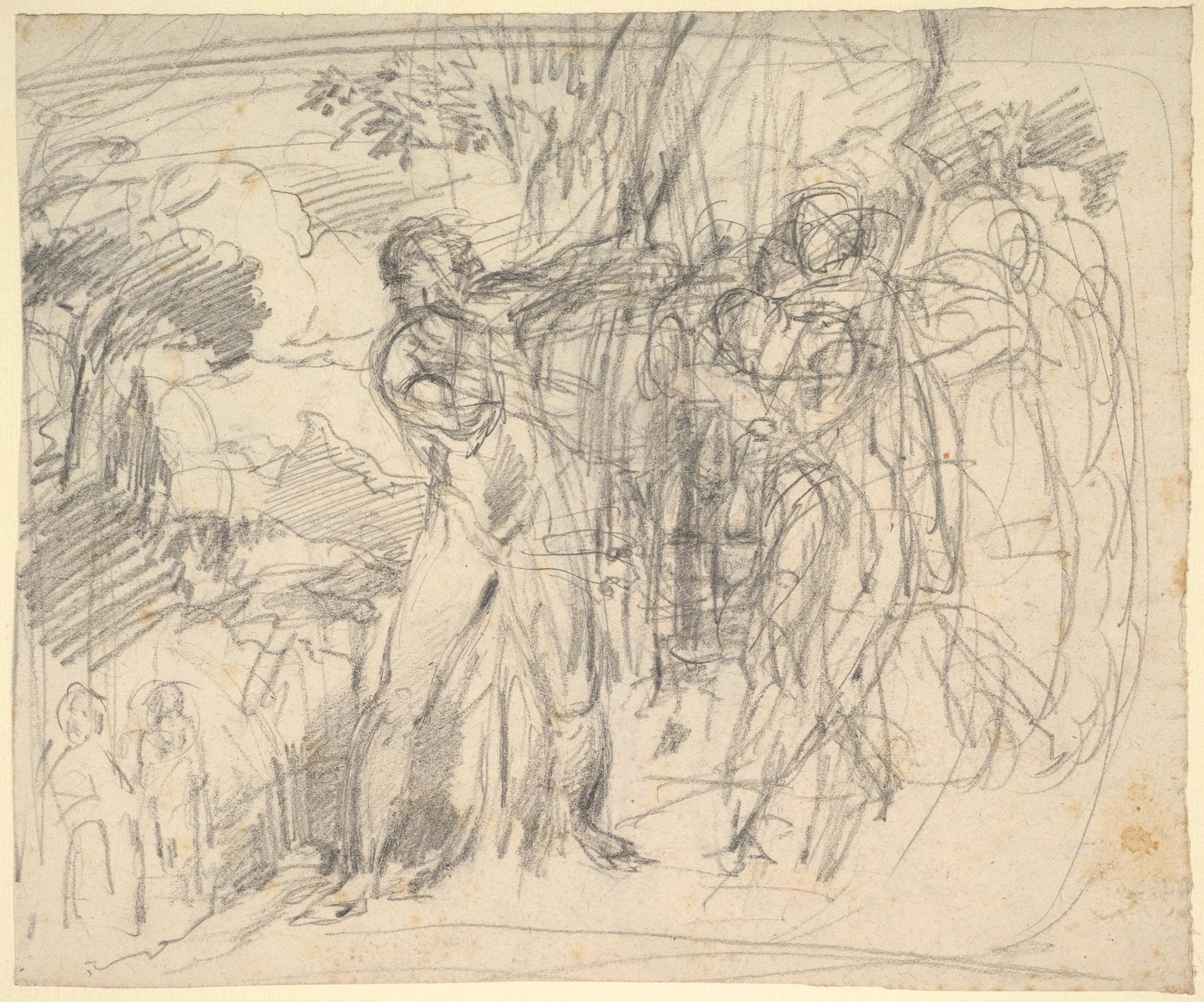
Compositional Study for "Comus–The Measure" (recto); Studies of a Man's Right Leg, after Titian, and a Profile, for "Comus–The Measure" (verso)
Original title: Compositional Study for "Comus–The Measure" (recto); Studies of a Man's Right Leg, after Titian, and a Profile, for "Comus–The Measure" (verso)
kurzbeschreibung
What sets this sheet by George Richmond apart from related depictions is that it is not a pure figure study: made before 1864, it pairs a compositional sketch for the painting 'Comus – Das Maß' with a crowded scene set in natural surroundings. Drawn in black chalk on paper, it points back to John Milton's masque.
Description
In the foreground a man in classical drapery turns to the left, an object in his hand, while a bundle of plants partly hides his face. Further back, more figures in antique dress move through a wooded landscape of trees and shrubs. On the left two smaller figures interact, enlivening the layout. Greys, distinct hatching and lines of varying weight build up shading and a sense of movement.
Context
Richmond made this study as preparatory work for his painting 'Comus – Das Maß', which draws on John Milton's masque 'Comus'. The sheet dates from before 1864, when Richmond was working in London as a portrait and history painter. Studies after Titian appear on the reverse, suggesting an engagement with the Italian Renaissance.
Impact
What distinguishes this drawing from comparable works is its lively, almost theatrical arrangement of figures within a natural setting. The delicate hatching gives the sheet a calm yet dynamic presence and draws the viewer into the narrative world of the masque.
Technique
Black chalk on paper allows fine lines and soft shading. Hatching with strokes of varying strength creates depth and volume, and the reverse carries further studies in the same technique.
AI-generated description text
Source: Metropolitan Museum of Art · Public Domain (CC0 1.0)