The Rhinoceros
Original title: The Rhinoceros
kurzbeschreibung
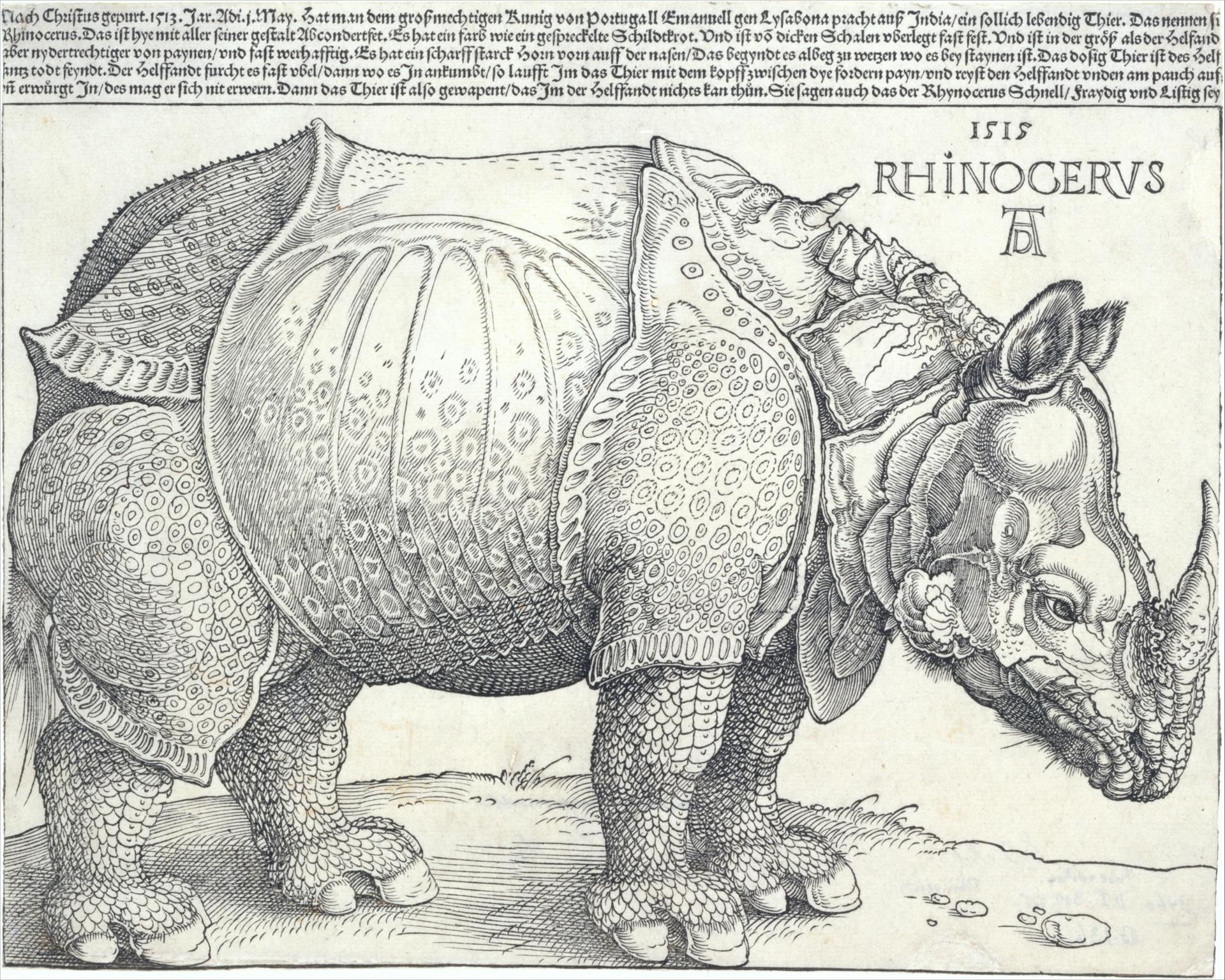
Albrecht Dürer's woodcut from 1515 depicts a rhinoceros in profile, based on a written description and a sketch of an Indian rhinoceros that arrived in Lisbon that year. The print, created with a detailed and precise hand, shows the animal with armored plates and a prominent horn, and includes a text band with the title 'RHINOCERUS' and the date.
Description
The rhinoceros is shown in side view, facing left, with its body covered in overlapping scale-like plates and a single horn curving upward from its snout. The creature stands on a simple ground line with a few scattered marks, while a text band above contains the title and descriptive text. The composition is uncluttered, focusing entirely on the animal, and the monochrome woodcut has even lighting with strong outlines and fine hatching.
Context
Dürer created this woodcut after seeing a sketch and description of a live Indian rhinoceros that was sent as a gift to King Manuel I of Portugal and later exhibited in Lisbon. Dürer never saw the animal himself, so his depiction includes imaginative elements like the scale-like armor and a small horn on the back, which were not present in the real animal. The print became widely popular and was copied extensively, shaping European perceptions of rhinoceroses for centuries.
Impact
The image conveys a sense of exotic wonder and power, as the rhinoceros appears both armored and formidable. The detailed textures and confident lines draw the viewer's eye across the animal's body, while the minimal background emphasizes its imposing presence. The print's clarity and precision give it a documentary quality, even though it is partly imaginative.
Technique
This is a woodcut, a relief printing technique where the design is carved into a wooden block, inked, and pressed onto paper. Dürer's use of fine cross-hatching and varied line weights creates a sense of volume and texture, allowing for a high level of detail in the animal's armor-like skin. The monochrome palette is typical of the medium, relying on line and tone rather than color.
AI-generated description text
Source: Metropolitan Museum of Art · Public domain (CC0)