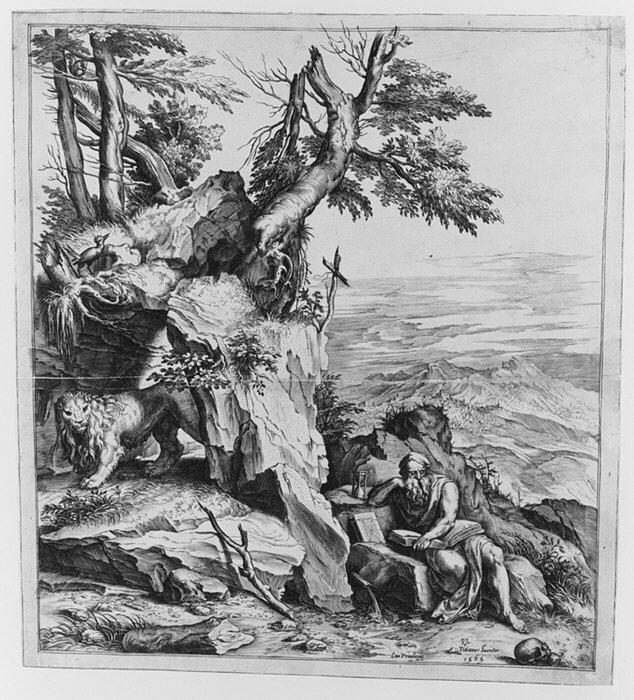
St Jerome in the Desert (1565, Met-Objekt 2178)
Original title: St Jerome in the Desert
kurzbeschreibung
Cornelis Cort made this engraving in 1565, showing Saint Jerome in the wilderness. The Church Father sits on a rock in a wide landscape, reading, with a lion for company. The print measures 32.1 × 26.9 cm and is executed in the engraving technique.
Description
In the right foreground, Saint Jerome has settled on a rock, completely absorbed in his reading; a calm lion stands close beside him. A mighty oak dominates the middle ground as a large tree, surrounded by other trees and boulders. Beyond, a broad, flat plain stretches out, bounded by mountains at the horizon. Light falls evenly across the scene, without harsh shadows, and the rendering remains in black and white with fine lines and careful hatching. The layout feels balanced, with saint and lion in the front center.
Context
The Dutchman Cornelis Cort (1533–1578) worked as an engraver, producing mainly reproductive prints after paintings and drawings. This sheet was made in Rome in 1565, where Cort was engaging with Italian art. Saint Jerome was highly popular in the Renaissance, revered both as a scholar and as a penitent. The engraving belongs to a series of saint depictions that Cort executed after models by Italian artists.
Impact
At first the print feels quiet and collected; the balanced arrangement and even light contribute to this. The precise linework brings out details of nature and clothing clearly and gives the view great accuracy. The extensive landscape in the background creates a mood of solitude and inner reflection.
Technique
In engraving, lines are cut into a copper plate with a burin. This allows very fine and exact lines, enabling high detail in printed graphics. Printing was done with black ink on paper, producing the typical black-and-white image.
AI-generated description text
Source: Metropolitan Museum of Art · Public Domain (CC0 1.0)