The Adoration of the Trinity (1566, Met-Objekt 2177)
Original title: The Adoration of the Trinity
kurzbeschreibung
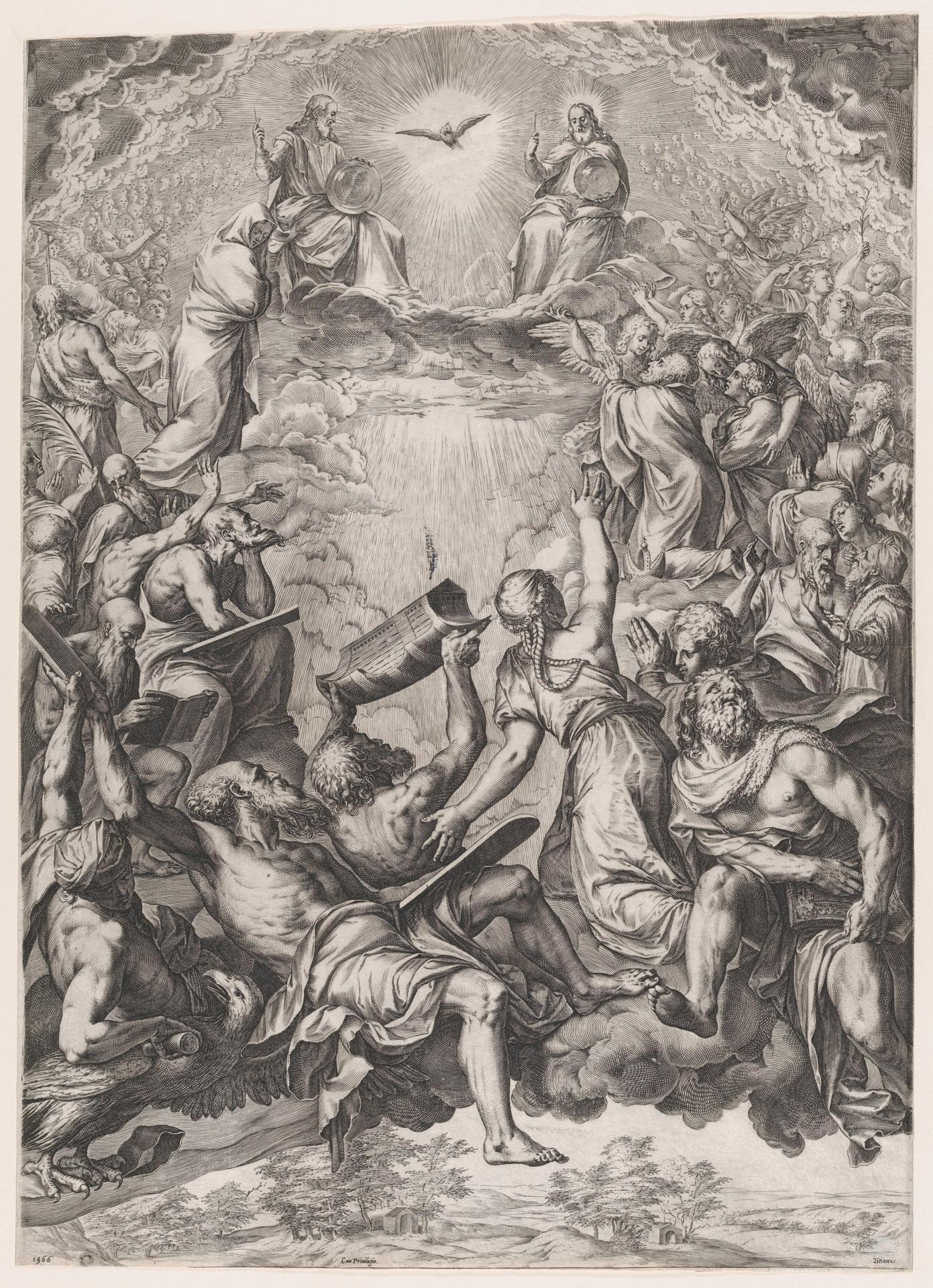
Issued in 1566, this copperplate engraving by Cornelis Cort takes the veneration of the Trinity as its subject. God the Father, Christ and the Holy Spirit in the form of a dove appear within a heavenly sphere. Beneath them a crowd presses together, holding books and scrolls in reverence and raising their hands.
Description
Three figures enthroned on clouds anchor the middle of the sheet, a symbol of the triune God that includes the dove. Bright light falls from above and cuts through the whole scene. Below the layer of cloud a crowd stirs; some clutch books or scrolls, others stretch their arms upward. The garments point to the Renaissance, while clouds and light lend the image an otherworldly mood. Restlessness drives the layout: the figures turn in every conceivable direction.
Context
Through the middle of the sixteenth century the Netherlandish engraver Cornelis Cort worked in Italy, where he became known above all for reproductive prints. His sheet of 1566 falls in a period when religious subjects were widespread in printmaking and often served as models for devotional images. Cort collaborated with Titian, among others, and this left its mark on his style. Stylistically the work belongs to Mannerism, a tendency marked by exaggerated proportions and restless figures.
Impact
Bright light and moving figures together produce a mood that feels solemn yet never settles. Dense hatching gives the print depth and draws the eye into the heavenly realm. Elongated proportions and sweeping gestures heighten the expression of adoration.
Technique
For an engraving, lines are cut into a copper plate and then transferred to paper with printing ink. Tonal steps from light to dark come from how closely and in which direction the strokes are laid, modelling light and shadow. Crisp, deliberate lines record the folds of drapery and the features of faces, as is characteristic of this printing process.
AI-generated description text
Source: Metropolitan Museum of Art · Public Domain (CC0 1.0)