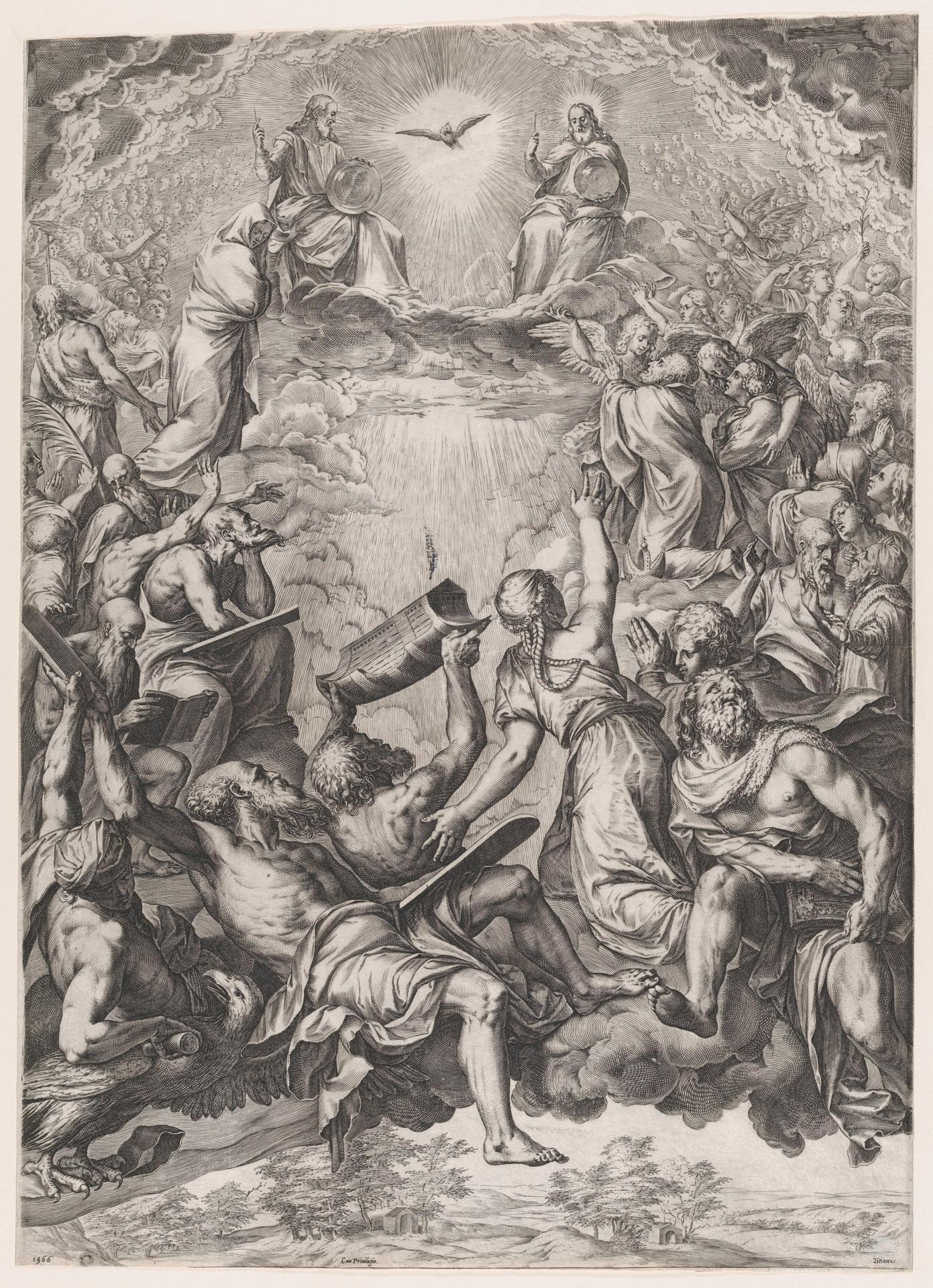
The Adoration of the Trinity (1566, Met-Objekt 2176)
Original title: The Adoration of the Trinity
kurzbeschreibung
Cornelis Cort made this engraving in 1566. It presents a heavenly vision centred on the Trinity, surrounded by a crowd of worshippers. The print takes up the religious imagery of the Renaissance and spreads it through the medium of print.
Description
Three divine figures sit enthroned on high within a radiant ring of light: God, Jesus Christ and the Holy Spirit. They wear biblical robes and hold crosses and arrows as symbols. Below them a multitude of people presses together in lively poses; some carry books and arrows, pointing to prophets or religious roles. The layout is symmetrical, and a strong contrast of light and dark emphasises the middle. Fine lines and hatching shape the detailed execution typical of Renaissance printmaking.
Context
The Dutchman Cornelis Cort worked in Italy from the second half of the sixteenth century and was influenced by artists there. In 1566, the year this print was made, religious subjects were widespread in printmaking. Cort became known for reproductive engravings after Italian masters, which explains the style. The Trinity was one of the central motifs of sixteenth-century Catholic art, especially in the context of the Counter-Reformation.
Impact
Symmetry and the contrast of light give the sheet a solemn, elevated mood that stresses the divine nature of the scene. The animated poses of the figures below create tension and make the veneration of the Trinity vivid. The central light draws the viewer's eye to the heavenly event.
Technique
Engraving is an intaglio process in which lines are cut into a metal plate and then printed. Precise, fine lines and hatching allow a detailed rendering of figures and light effects. The strong contrast of light and dark comes from the varying density and spacing of the lines.
AI-generated description text
Source: Metropolitan Museum of Art · Public Domain (CC0 1.0)