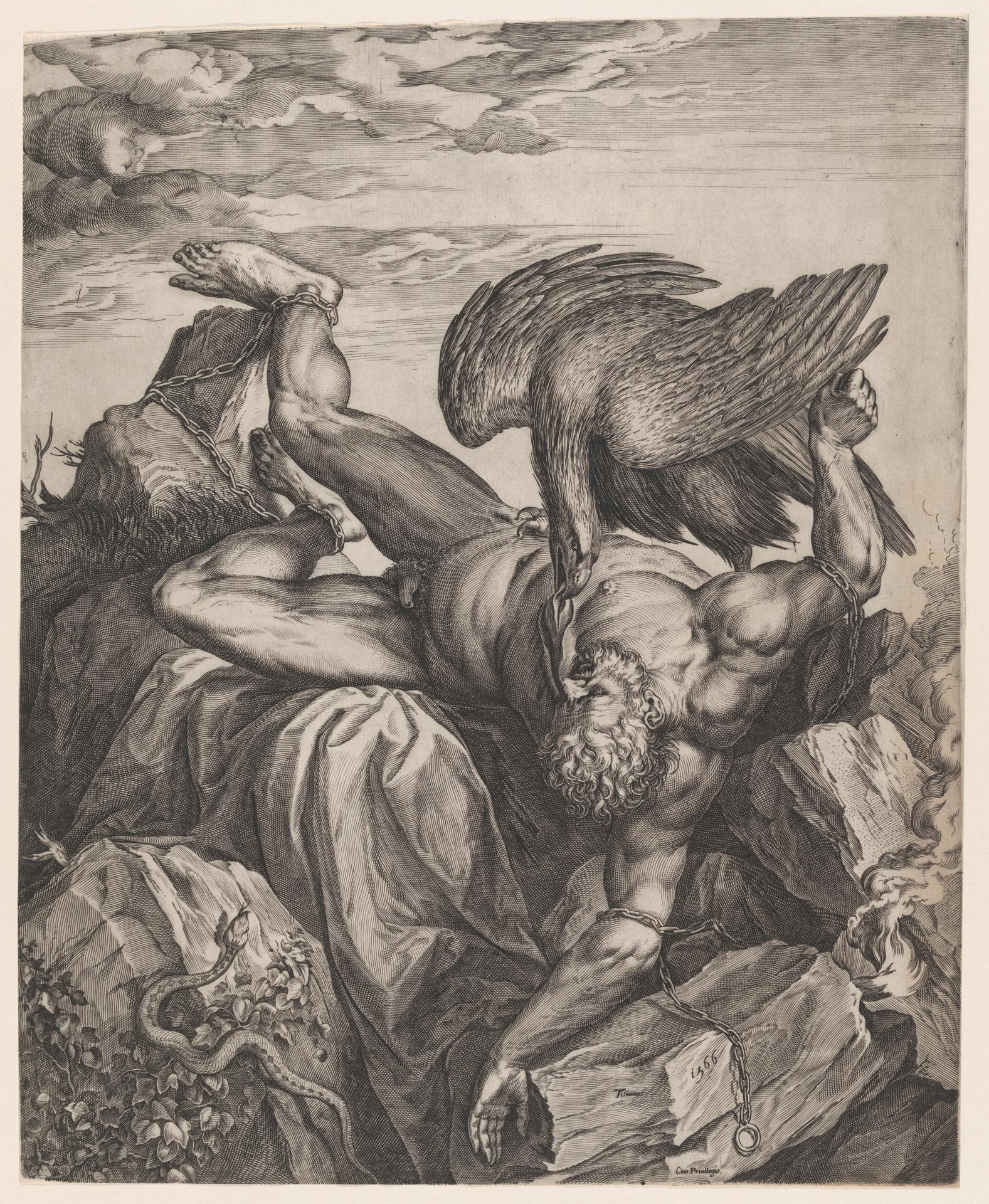
Tityus Punished in Hell
Original title: Tityus Punished in Hell
kurzbeschreibung
Cornelis Cort made this engraving in 1566, showing the giant Tityus bound to a rock in the underworld as punishment. An eagle pecks at his liver, and a snake coils on the ground. The print is the first of three states and belongs to Renaissance printmaking.
Description
Tityus appears muscular and bearded, chained to the rock. A large eagle with spread wings digs its talons into his body. Clouds and a wooded strip suggest the background, while a snake curls along the bottom edge. Gray tones dominate the image, with sharp, dense lines defining anatomy and feathers.
Context
The Dutchman Cornelis Cort engraved for publishers such as Hieronymus Cock and also worked in Italy. The story of Tityus's punishment comes from Greek mythology and was seen in the Renaissance as a model of eternal torment. The print was made in 1566, when Cort was in Rome producing antique and mythological subjects for collectors; it belongs to a series from his collaboration with Italian artists.
Impact
The viewer's gaze is caught first by the eagle swooping diagonally and by Tityus's contorted body, their tension carrying across the image on a diagonal. The fine linework gives the scene an almost sculptural physicality that makes the harshness of the punishment palpable. Because there is no color, the contrasts of light and dark stand out all the more clearly.
Technique
A burin was used to cut the lines into the copper plate, from which the print was then taken. The first of the three states comes from an early printing phase and stands out for its especially clear, strong lines. This method allows for graded shading and precise details, such as the muscles, the feathers, and the scales of the snake.
AI-generated description text
Source: Metropolitan Museum of Art · Public Domain (CC0 1.0)