Tantalus
Original title: Tantalus
kurzbeschreibung
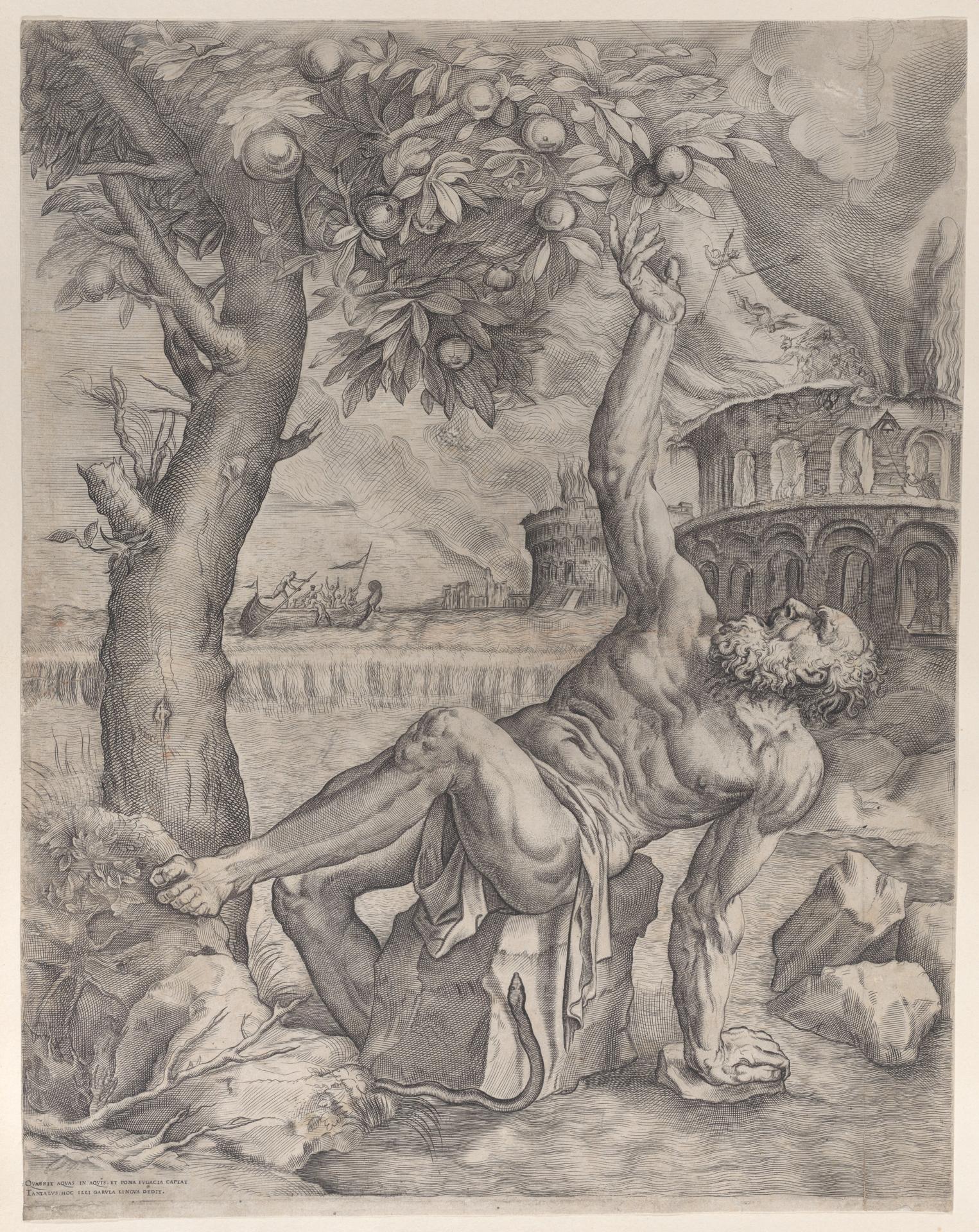
Giulio Sanuto's engraving Tantalus, made around 1557–70, presents the mythical king in his endless torment. This impression is the second of two states and places the figure within a restless landscape.
Description
In the foreground Tantalus strains upward in a contorted pose, his powerful torso stretched out while one hand reaches for an apple hanging from a branch. Pain marks his face, and loose drapery slips across one of his legs. Further back a second man lies on the ground, also grasping for fruit. Beyond them opens a river landscape with a boat and ancient buildings, among them a Roman Colosseum. The arrangement feels irregularly disposed, and the clouds in the sky add to the somber mood.
Context
Tantalus is one of the figures of Greek myth condemned for his transgressions to suffer everlasting hunger and thirst in the underworld. Sanuto, a Venetian engraver, issued this print in an era of strong demand for printed images on mythological subjects. The motif follows the traditional iconography of Tantalus known from ancient literature.
Impact
Strong contrasts of light and dark and Tantalus's tense posture give the sheet a forceful immediacy. The gloomy surroundings and the agonized expression let the viewer feel the figure's suffering almost physically.
Technique
A metal plate was worked with a burin, so that the lines stand as incised grooves in the copper. Sanuto used thin, precisely placed strokes and dense hatching to bring out space and shadow — a process characteristic of Renaissance printmaking.
AI-generated description text
Source: Metropolitan Museum of Art · Public Domain (CC0 1.0)