Holy Family
Original title: Holy Family
kurzbeschreibung
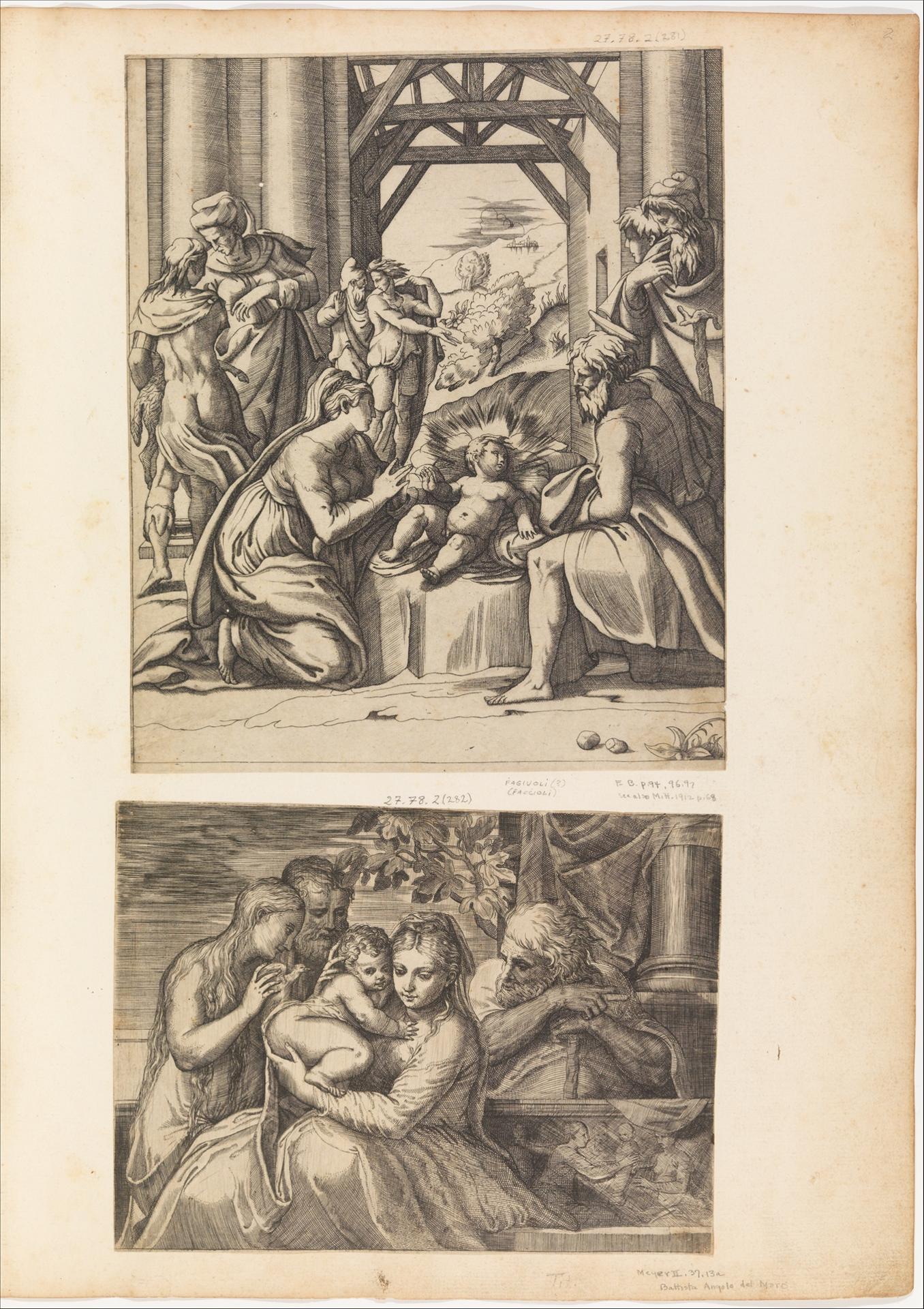
Dating from the second half of the sixteenth century, Battista Angolo del Moro's engraving "Holy Family" brings together two episodes from the life of the Holy Family: the Nativity of Christ above, and below the Holy Family with the Christ Child. The print is executed in engraving.
Description
The sheet is divided into two registers. In the upper one Mary kneels on a bench, holding the newborn Jesus, while Joseph stands beside her. Other figures in the background look in various directions. An interior with columns and a wooden frame encloses the scene and opens a view to the outside. Below, Mary and Joseph hold the child, and Joseph carries something in his hand. Columns and foliage also define the setting here. Both parts are monochrome, with the fine, precise linework typical of engravings.
Context
Battista Angolo del Moro, an Italian copperplate engraver and draughtsman of Mannerism, worked mainly in Venice and Verona. Many reproductive prints after works by prominent contemporaries come from his hand. The exact date of this work is unknown; it was probably made in the second half of the sixteenth century. Such devotional images were widespread at the time and served private piety.
Impact
Clearly ordered and calm, with figures arranged symmetrically, the print feels balanced and solemn. Precise linework yields a high level of detail and rewards close looking. A quiet devotion emanates from the work, characteristic of religious printmaking of the period.
Technique
In copperplate engraving, lines are cut into a metal plate and then printed on paper. This method allows very fine and precise reproduction of detail, as seen in the garments and the background architecture. The monochrome execution is typical of printmaking and emphasizes the contrasts between light and shadow.
AI-generated description text
Source: Metropolitan Museum of Art · Public Domain (CC0 1.0)