Tarquin and Lucretia
Original title: Tarquin and Lucretia
kurzbeschreibung
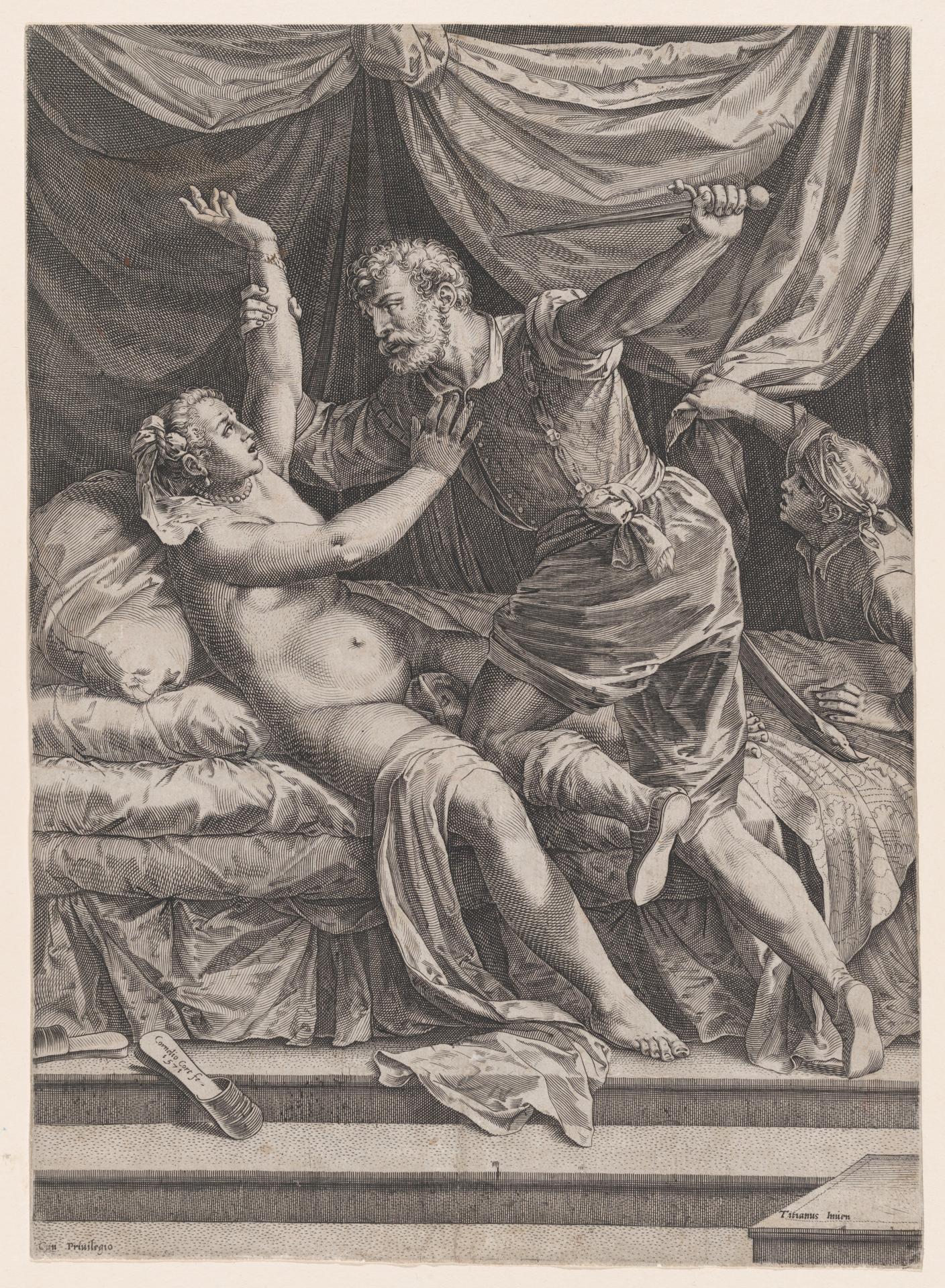
What sets Cornelis Cort's 1571 engraving of Tarquin and Lucretia apart from related prints is how directly it drives toward the moment of threat: Tarquin steps up to Lucretia as she lies on the ground, weapon already drawn. The sheet survives in its first state and takes up a well-known subject drawn from history and myth.
Description
Barefoot and plainly dressed, Tarquin levels a weapon at the reclining Lucretia. She raises one arm to fend him off, her clothing loosened and falling, her body resting on a couch. Behind the pair another woman reacts in dismay. Curtains frame the action and heighten its intimacy. The arrangement feels restless, the bodies tightly bound to one another, while the hatching builds a strong contrast of light and dark.
Context
Cort, an engraver from the Netherlands, worked in Italy during the second half of the sixteenth century. The story of Tarquin and Lucretia comes from Roman legend and was often pictured in the Renaissance. His print of 1571 probably follows a design by another artist, as was typical of how he worked. It belongs to a series of engravings on historical and mythological subjects.
Impact
Tarquin's menacing stance and Lucretia's gesture of resistance produce a tension that passes straight to the viewer. Deep shadows and the framing curtains heighten the drama. One is drawn into the emotional conflict without any hint of resolution.
Technique
The lines of this engraving were cut into the metal plate with a burin. In the first state, delicate lines and precise shading bring out the physical presence of the figures. Printing in black and white lets the process model light and shade through strokes of varying density.
AI-generated description text
Source: Metropolitan Museum of Art · Public Domain (CC0 1.0)