Hercules at the Crossroad
Original title: Hercules at the Crossroad
kurzbeschreibung
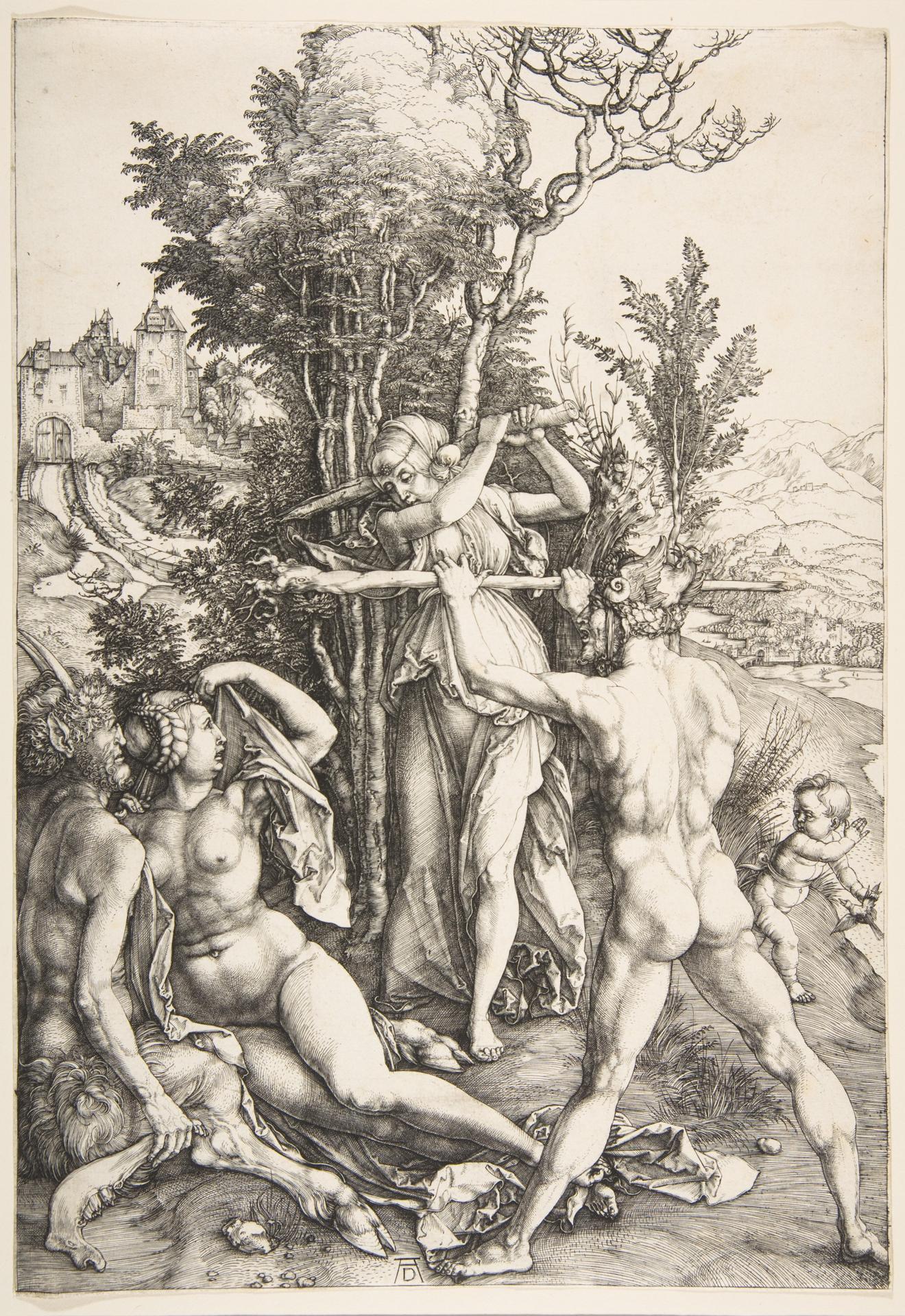
Albrecht Dürer's engraving 'Hercules at the Crossroad' (ca. 1498) depicts the mythological moment of Hercules choosing between virtue and vice. The scene features Hercules confronted by a figure holding a staff, with a seated woman and a male companion nearby. This is the second state of the engraving, showcasing Dürer's mastery of line and tone.
Description
The composition centers on Hercules, a muscular nude figure, who is threatened by a woman (Omphale) holding a staff in an exaggerated, theatrical pose. To the left sits another woman, likely a nymph, while a nude man on the right stands in a dynamic stance. In the background, trees, a castle, and a mountainous landscape frame the scene, with a small child figure visible at the far right. The engraving is monochromatic, using fine lines and cross-hatching to create depth and light, emphasizing the figures' muscular forms.
Context
Created around 1498, this engraving reflects Dürer's engagement with classical mythology and Renaissance humanism. The subject of Hercules at the crossroads was popular in humanist circles, symbolizing moral choice. Dürer, who had traveled to Italy, was influenced by Italian Renaissance art and the revival of antiquity. This work is part of Dürer's early print series and demonstrates his growing technical skill in engraving.
Impact
The dramatic interaction between Hercules and Omphale draws the viewer's eye, creating a sense of tension and narrative. The detailed rendering of muscles and the contrast between light and shadow give the figures a sculptural, three-dimensional quality. The monochrome palette and intricate linework evoke a sense of classical gravitas and intellectual depth.
Technique
This is an engraving, a technique where lines are incised into a metal plate, inked, and then printed. Dürer employs fine, precise lines and cross-hatching to model forms and suggest texture. The second state indicates that the plate was reworked after an initial printing, refining details and tonal contrasts.
AI-generated description text
Source: Metropolitan Museum of Art · Public domain (CC0)