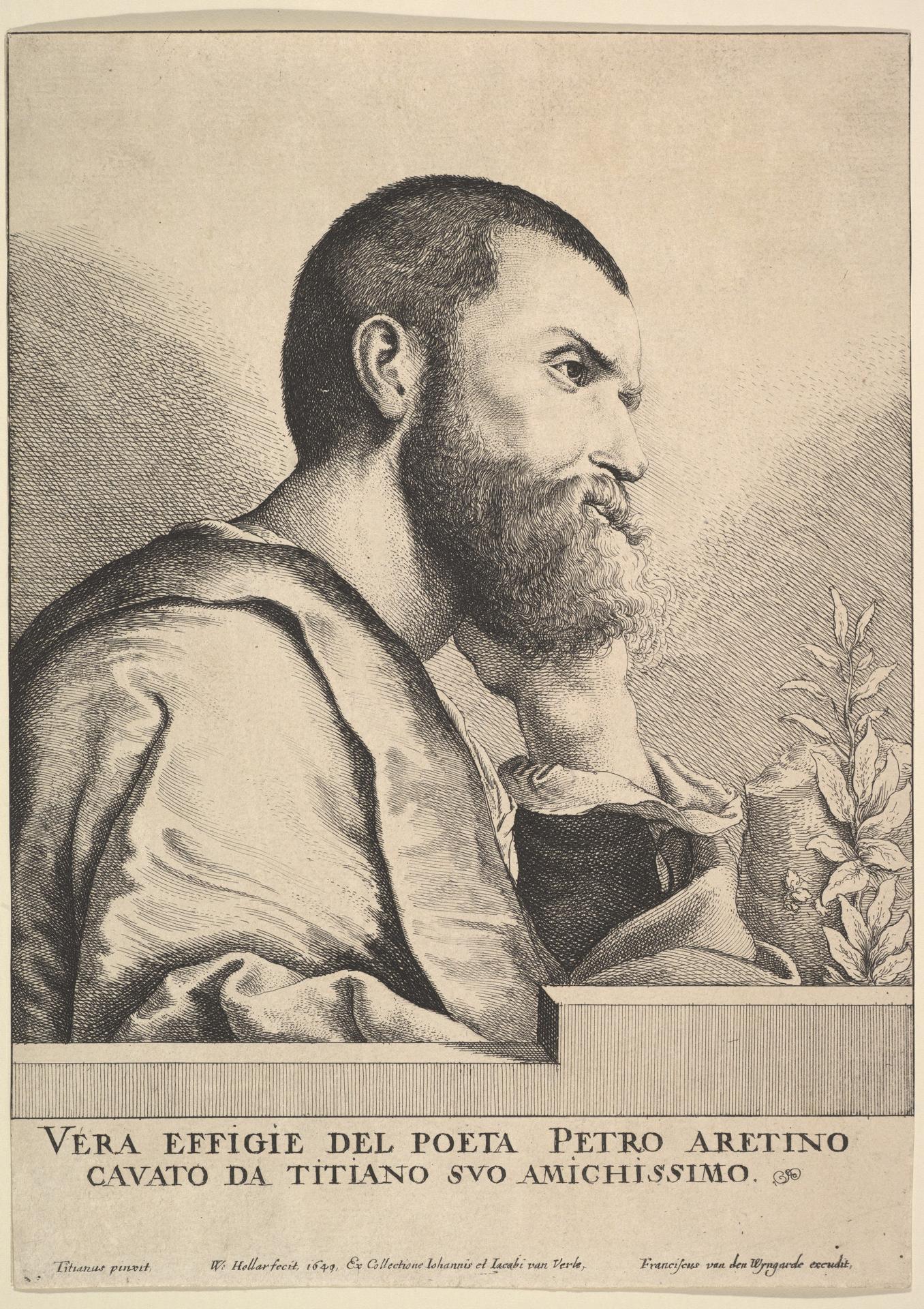
Pietro Aretino (1649)
Original title: Pietro Aretino
kurzbeschreibung
Wenceslaus Hollar etched this portrait of the Italian writer Pietro Aretino in 1649. The print follows a model by Titian, as the inscription along the lower margin makes clear. This upright sheet measures 25.3 × 18.2 cm.
Description
A bearded man with short hair appears in plain clothing, its folds and shadows recorded with care. The dark, restrained ground throws the sitter's face forward. At the right stands a bunch of flowers, shaded just as finely. Across the bottom runs a band of lettering: 'VERA EFFIGIE DEL POETA PETRO ARETIMO CAVATO DA TITIANO SVO AMICHISSIMO', followed by several smaller lines.
Context
The Bohemian printmaker Wenceslaus Hollar, active in the seventeenth century, made this sheet in 1649 as a reproductive engraving after a painting by Titian. Titian portrayed his close friend Aretino several times; the original dates from around 1545. Hollar, who worked in Antwerp and later in London, was known for his faithful copies of well-known works of art. The inscription stresses both the authenticity of the likeness and the friendship between painter and model.
Impact
The dark background and careful handling of shadow give the etching a grave, dignified mood. The portrait feels direct and personal, helped by the sitter's steady gaze. Plain dress and a strong face lend the sheet a presence that has not dated.
Technique
Only one state of this etching exists, so a single printed version was ever made. In the process, the drawing is scratched through an acid-resistant layer on a copper plate, which is then bitten and printed. Hollar used fine lines and hatching to model light and shade and to convey the texture of beard, hair and cloth.
AI-generated description text
Source: Metropolitan Museum of Art · Public Domain (CC0 1.0)