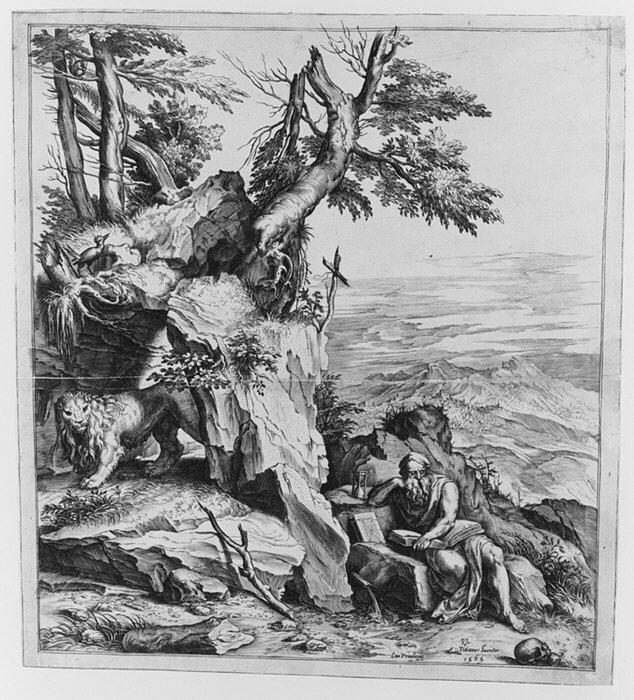
St Jerome in the Desert (1565, Met-Objekt 2142)
Original title: St Jerome in the Desert
kurzbeschreibung
Saint Jerome, Church Father and scholar, sits in a rocky wilderness absorbed in a book, the lion tamed by him in legend standing at his side. Cornelis Cort engraved the scene in copper in 1565, joining the theme of penance with that of learning.
Description
Jerome forms the still center of the sheet: crouched on a rock, his upper body bent over the open book. The lion stands beside him, its gaze turned away. Trees and mountains rise in receding tiers behind the figure. Light falling from above picks out the texture of stone and foliage. Everything stays black and white, in keeping with the viewing habits of Renaissance printmaking.
Context
The Netherlander Cornelis Cort (1533–1578) specialized in reproductive engravings after Italian models. During the 1560s he worked in Italy, at times alongside Titian. Saint Jerome was among the most common subjects of the sixteenth century, held up as a model of penitence and scholarship. Cort's sheet of 1565 probably arose in this Italian setting and helped carry religious imagery to a wide audience.
Impact
Quiet and inwardness define the print's effect. The saint's firm seated posture and the lion's calm presence convey constancy. Precise linework brings out stone and vegetation in detail and draws the eye into the depth of the sheet, evoking devout withdrawal in the solitude of the desert.
Technique
For a copper engraving the lines are cut into a metal plate with a burin, which is then printed. The method allows finely graduated hatching that models shadow and surface in three dimensions. Printing was in black and white, which heightens the graphic play of lines.
AI-generated description text
Source: Metropolitan Museum of Art · Public Domain (CC0 1.0)