Underweysung der messung mit dem zirckel un richt scheyt
Original title: Underweysung der messung mit dem zirckel un richt scheyt
kurzbeschreibung
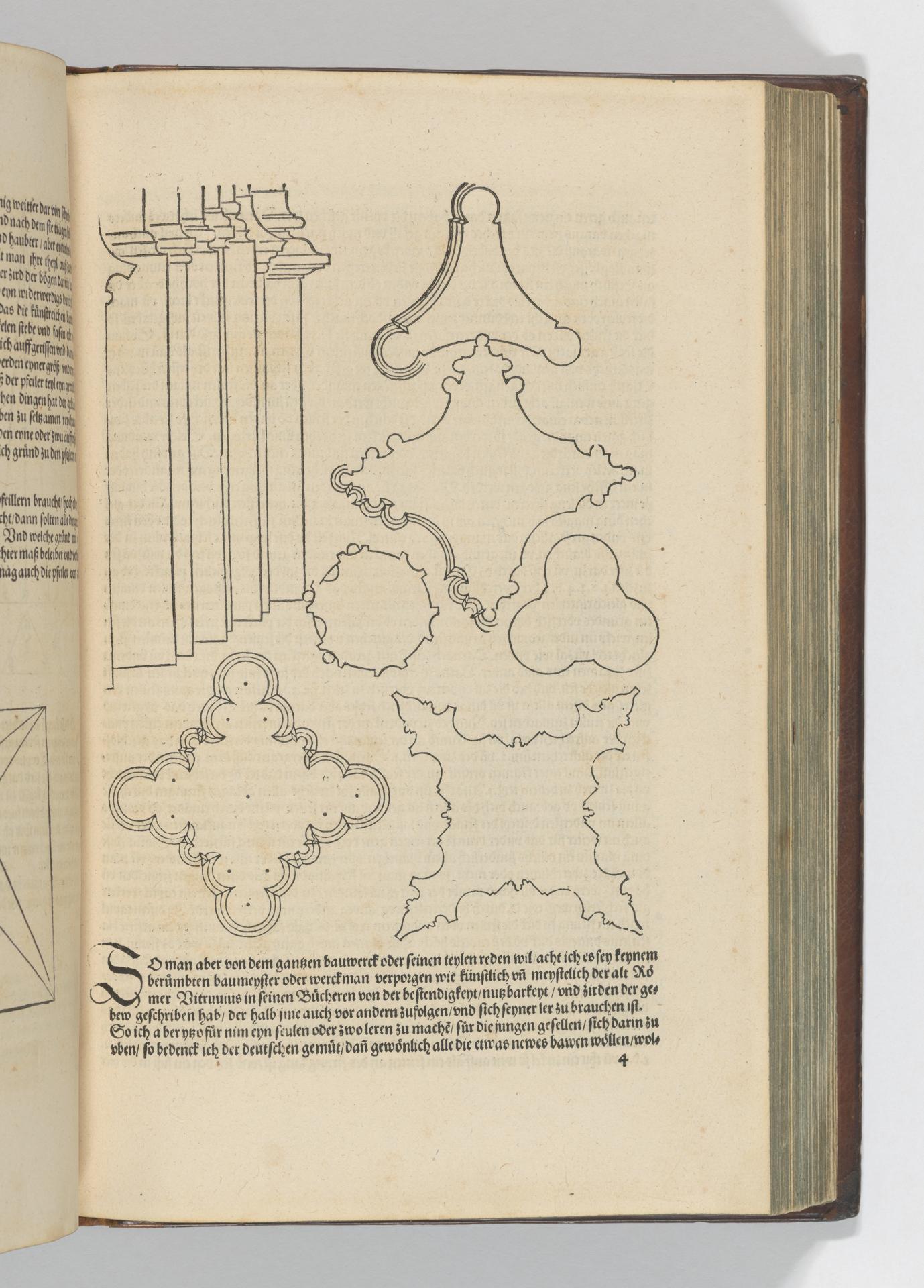
This woodcut page from Albrecht Dürer's 1525 treatise 'Underweysung der messung mit dem zirckel un richt scheyt' (Instruction in Measurement with Compass and Straightedge) presents a series of geometric and architectural designs. The page combines columns, beams, and ornamental forms, illustrating principles of proportion and construction.
Description
The page is divided into two main sections: on the left, a row of columns and beams are arranged in a linear sequence, while on the right, abstract, ornamental shapes suggest designs for architectural or furniture decoration. Below these figures, a block of Latin text runs along the bottom edge, anchoring the visual elements. The composition is dense but orderly, with each element clearly delineated by the bold black lines of the woodcut. The overall effect is a systematic layout that balances practical instruction with aesthetic variety.
Context
Published in 1525 in Nuremberg, this treatise was Dürer's attempt to provide German artisans with a comprehensive guide to geometry, perspective, and proportion. It was among the first scientific works written in German rather than Latin, making it accessible to a wider audience. Dürer, already renowned for his paintings and prints, aimed to elevate the status of craftsmanship by grounding it in mathematical principles. The book reflects the Renaissance interest in the intersection of art, science, and engineering.
Impact
The page conveys a sense of intellectual rigor and creative possibility, as the precise geometric figures invite careful study. The contrast between the structured columns and the more fanciful ornaments suggests a balance between utility and imagination. Viewers may feel encouraged to see mathematics as a foundation for artistic creation, a notion that was revolutionary for its time.
Technique
The woodcut technique involves carving the design into a wooden block, inking the raised surfaces, and pressing them onto paper. This process produces bold, clear lines with high contrast, ideal for reproducing detailed diagrams and text. Dürer's mastery of the medium is evident in the precision of the geometric shapes and the crispness of the lettering.
AI-generated description text
Source: Metropolitan Museum of Art · Public domain (CC0)