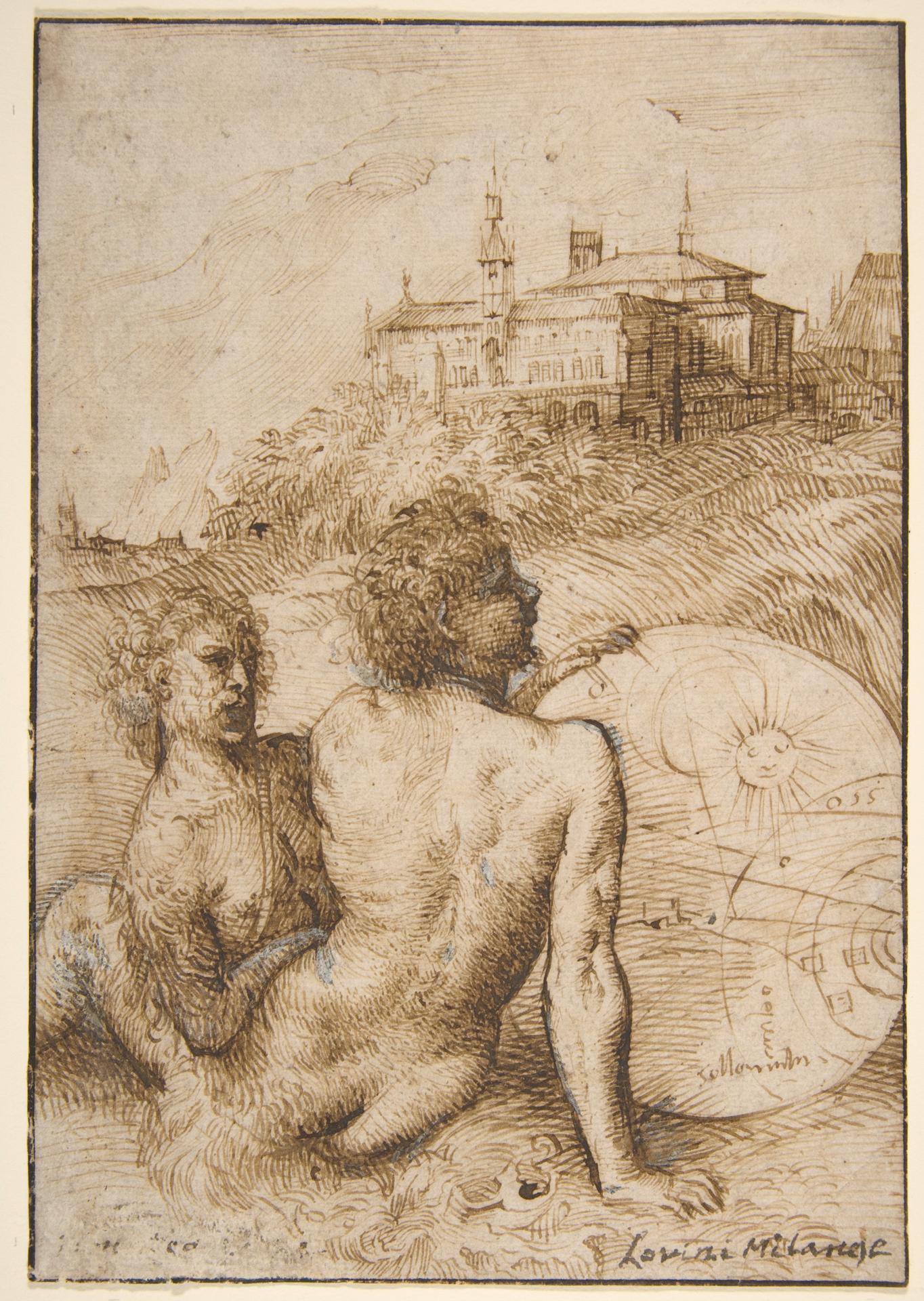
Two Satyrs in a Landscape
Original title: Two Satyrs in a Landscape
kurzbeschreibung
Two naked satyrs sit in a landscape, their gaze fixed on a building in the distance. Titian (Tiziano Vecellio) made this drawing around 1505–10. The sheet is executed in pen and brown ink, with some areas heightened in white gouache, on fine, off-white laid paper.
Description
In the foreground the two satyrs recline on the ground, their bodies detailed with muscles and hair. One of them holds a large round object that resembles a shield with a sun motif and other signs. On a hill in the background stands an extensive building with several towers and windows, surrounded by further structures. Grass and earth are suggested by delicate linework. Light is distributed evenly, without strong shadows or harsh contrasts; brown and beige tones predominate, with white accents.
Context
The drawing dates from Titian's early period, when he was still strongly influenced by Giorgione and Venetian painting. Satyrs were a popular mythological motif in the Renaissance, one that negotiated the relationship between humans and nature. Nothing is known about the sheet's exact function; it could have been a preparatory study for a painting or an independent work for collectors. The name "Lorenzo Melangio" noted at the lower edge points to later ownership or attribution.
Impact
A calm, contemplative mood emanates from the sheet, arising from the seated posture of the satyrs and the even light. The precise linework and white heightening give the figures plastic presence and draw the viewer into the Arcadian landscape.
Technique
Titian used pen and brown ink to set contours and hatching; white gouache served to highlight individual areas and achieve light effects. The paper is fine, off-white laid paper, typical of Renaissance drawings. Together, ink and gouache allowed both precise details and the emphasis of volume.
AI-generated description text
Source: Metropolitan Museum of Art · Public Domain (CC0 1.0)