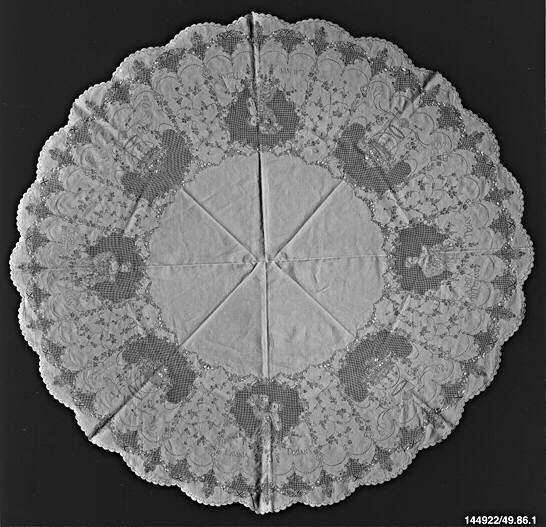
Tablecloth and napkin
Original title: Tablecloth and napkin
kurzbeschreibung
A round tablecloth with a matching napkin, attributed to Titian (Tiziano Vecellio) and said to date from around 1900: silk on linen, 152.4 cm in diameter. Unlike many comparable pieces, this one weaves floral and geometric motifs into a single, continuously symmetrical repeat.
Description
A dense ornament of blossom and edge forms spreads across the surface. Along the hem these elements repeat in concentric rings, while six rays running from the middle to the outer edge divide the central area into equal fields. The colouring stays restrained: greys predominate, letting the silk and linen stand out clearly. Even light falls on the fabric and brings the fine detail of the pattern into view.
Context
The cloth is attributed to Titian, one of the leading masters of the Renaissance, yet the date of around 1900 points to a considerably later origin. Textiles of this kind served as decorative furnishings in prosperous households. How the connection to Titian arose, whether through an old collection or a handed-down attribution, cannot be settled from the available sources.
Impact
The regularity of the repeat and the muted palette produce a calm, orderly impression. The carefully placed details and the symmetrical layout suggest solid handwork without any showiness.
Technique
Silk on linen was a common pairing for finer textiles of the period. Whether the patterns were applied by embroidery or weaving is not recorded; the exact circles and crisp dividing lines presume very precise execution in any case.
AI-generated description text
Source: Metropolitan Museum of Art · Public Domain (CC0 1.0)