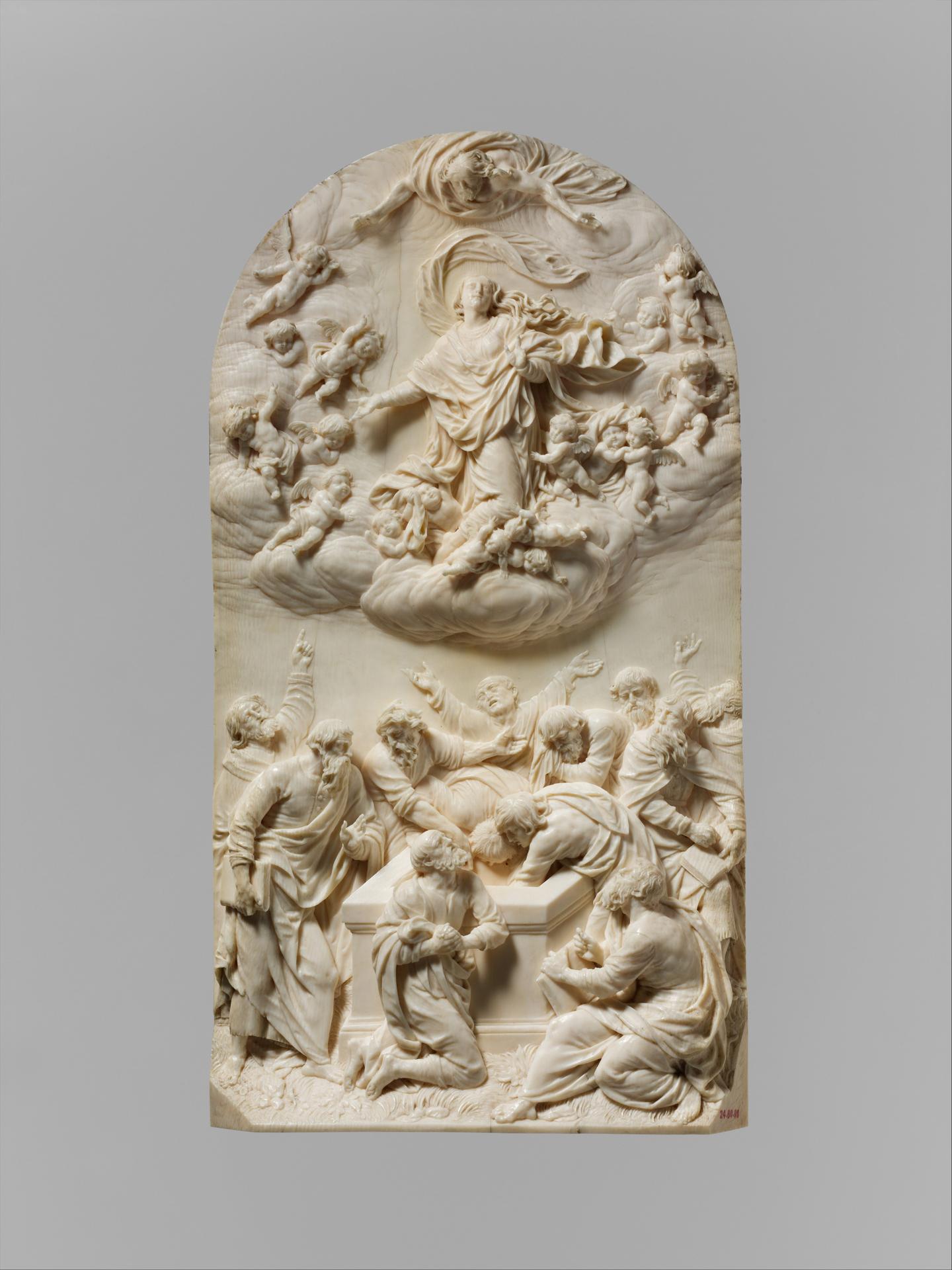
Assumption of the Virgin (1632)
Original title: Assumption of the Virgin
kurzbeschreibung
Adam Lenckhart carved this ivory sculpture in 1632, taking as its subject Mary's assumption into heaven. Measuring 27.6 × 14.6 cm, the single carving sets the celestial sphere above the grieving earthly community of apostles below.
Description
Above, Mary floats in a luminous robe, surrounded by angels who envelop her in swirling motion. Beneath, a group of men presses together—some kneeling, others standing with raised hands—in a scene of farewell. The figures are richly detailed with folds of drapery. The ivory appears uniformly white, and the light falls evenly without harsh shadows. The style is baroque, with a strong emphasis on movement and emotion.
Context
Lenckhart, a German sculptor of the early 17th century, was known for his ivory works. This piece was created in 1632, at a time when ivory was prized as a material for small sculptures in princely art cabinets. Such works served private devotion and at the same time displayed the artist's technical virtuosity. The Assumption of Mary was a common motif in Catholic Baroque art.
Impact
The delicate execution and lively sense of movement speak directly to the viewer. Heavenly dynamism and earthly grief meet, creating an emotional tension that draws one into the scene.
Technique
The work is made of ivory, a material that demands the utmost precision and patience. The figures are modeled in full relief; drapery folds and facial features were created through careful carving. The smooth surface of the ivory gives the sculpture a noble, even sheen.
AI-generated description text
Source: Metropolitan Museum of Art · Public Domain (CC0 1.0)