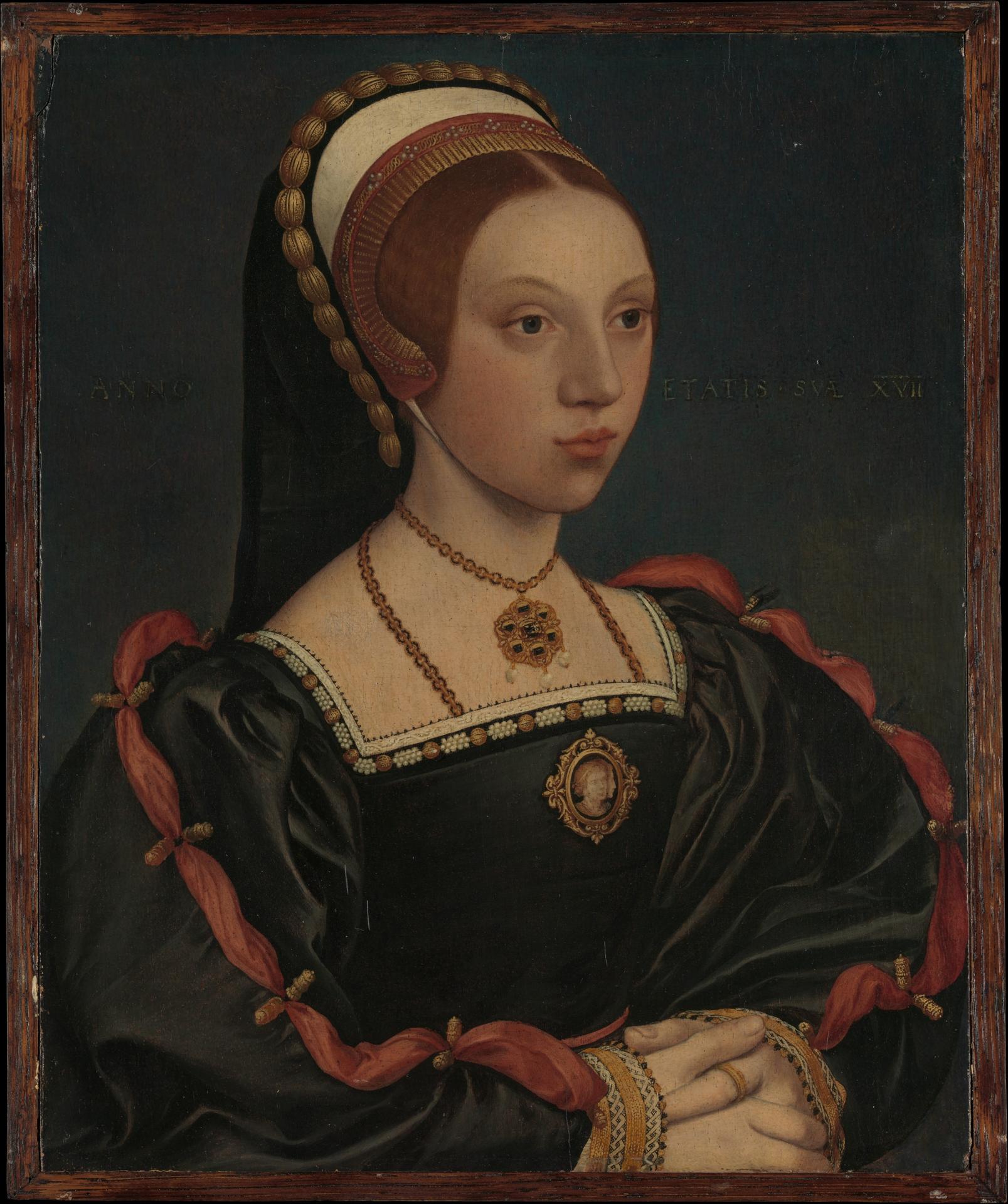
Portrait of a Young Woman (ca. 1540–45)
Original title: Portrait of a Young Woman
kurzbeschreibung
A young girl of seventeen gazes out from this small-format portrait, painted by Hans Holbein the Younger between 1540 and 1545 in oil and gold on oak. Measuring 28.3 by 23.2 cm, the unknown sitter appears in costly, meticulously detailed clothing and rich jewelry—signs of elevated social standing.
Description
Layers of fabric and strings of pearls form her headdress: a white cap threaded with gold beads and red ribbons, beneath which long dark hair emerges. The black dress carries red and gold accents, rows of pearls, and a central brooch. A heavy gold chain with a large pendant hangs around her neck, a gold bracelet encircles her wrist, and several gold rings adorn her folded hands. Against the dark ground the figure stands out clearly, and along the bottom edge runs the inscription 'ANNO ETATIS SVA XVII' (At the age of 17).
Context
Holbein the Younger was among the leading portraitists of the Renaissance and worked chiefly at the English court of Henry VIII. This picture dates from his final years—the painter died in 1543. The inscription gives the sitter's age as seventeen, but who she was cannot be established with certainty. Small-scale portraits of this kind often served as personal mementos or engagement gifts.
Impact
Dark tones and the exact rendering of every detail lend the portrait intimacy and intensity. The contrast between the somber ground and the gleaming jewelry gives the young woman a dignified, almost ceremonial presence. Her pose remains calm, and the careful handling of paint creates a mood of seriousness and nobility.
Technique
The picture is executed in oil and gold on oak—a combination familiar to Holbein. The gold in particular, which makes the jewels shine, gives the portrait its distinctive shimmer. Precise brushwork and fine glazes allow fabrics, ornaments, and facial features to be reproduced down to the smallest detail.
AI-generated description text
Source: Metropolitan Museum of Art · Public Domain (CC0 1.0)