The Selling of Indulgences
Original title: The Selling of Indulgences
kurzbeschreibung
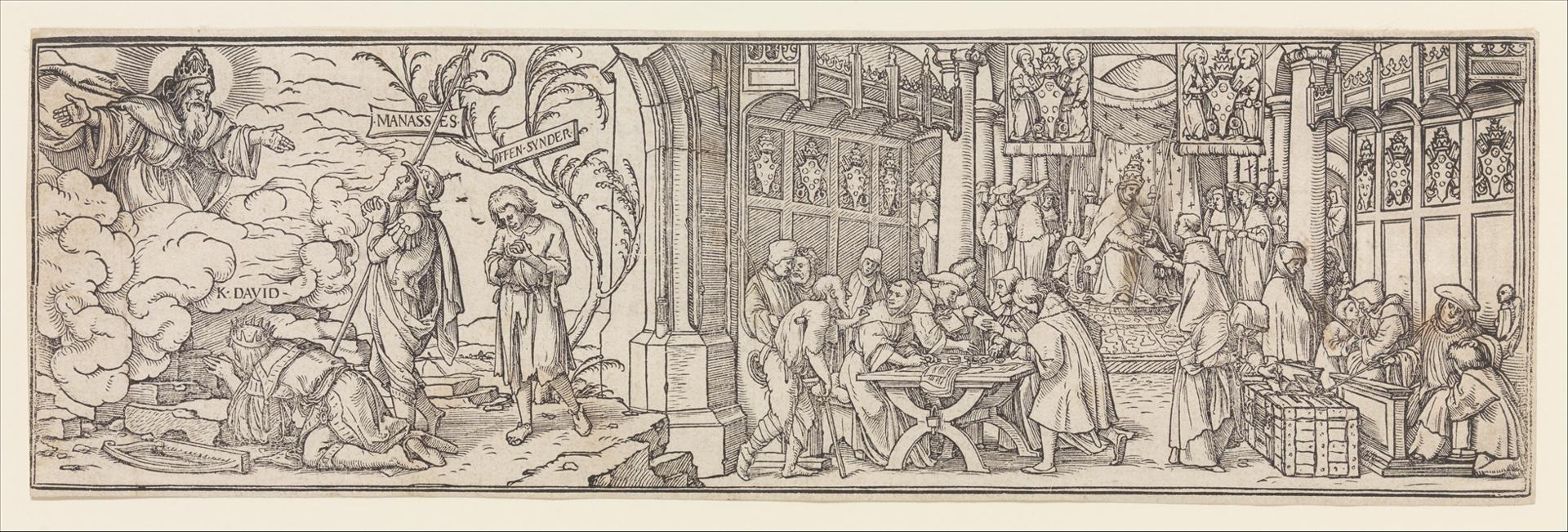
Unlike many other depictions of indulgences from the period, this sixteenth-century woodcut by Hans Holbein the Younger sets a satirical view of indulgence selling alongside biblical authorities: King David and King Manasseh appear in the foreground, while a stall for letters of indulgence can be seen behind them.
Description
Several figures in ordinary dress stand at the front, among them King David, who is surrounded by a cloud, and a figure identified as King Manasseh, supported by a column. A meticulously detailed market scene, in which people hand over money for letters of indulgence, fills the background. Columns and arches divide the architecture. The image remains in shades of grey, with clear lines and strong contrasts typical of the woodcut.
Context
Holbein the Younger made this print in the sixteenth century, when the Catholic Church's trade in indulgences was widespread and fiercely contested. It belongs to the context of the Reformation, during which critics such as Martin Luther sharply attacked indulgences. Holbein, known for precise and often satirical images, thus took up a pressing social problem of his time.
Impact
The crowded, finely observed layout draws the eye and exposes the absurdity of indulgence selling. The biblical figures stand in tension with the profane trading scene, creating an ironic effect that prompts reflection.
Technique
This is a woodcut: the design is cut into a woodblock and then printed on paper. The various shades of grey arise from lines of different depth and density, which take up more or less ink when printed.
AI-generated description text
Source: Metropolitan Museum of Art · Public Domain (CC0 1.0)