Anonymous portrait (ca. 1794–1802, Met-Objekt 2109)
Original title: Anonymous portrait
kurzbeschreibung
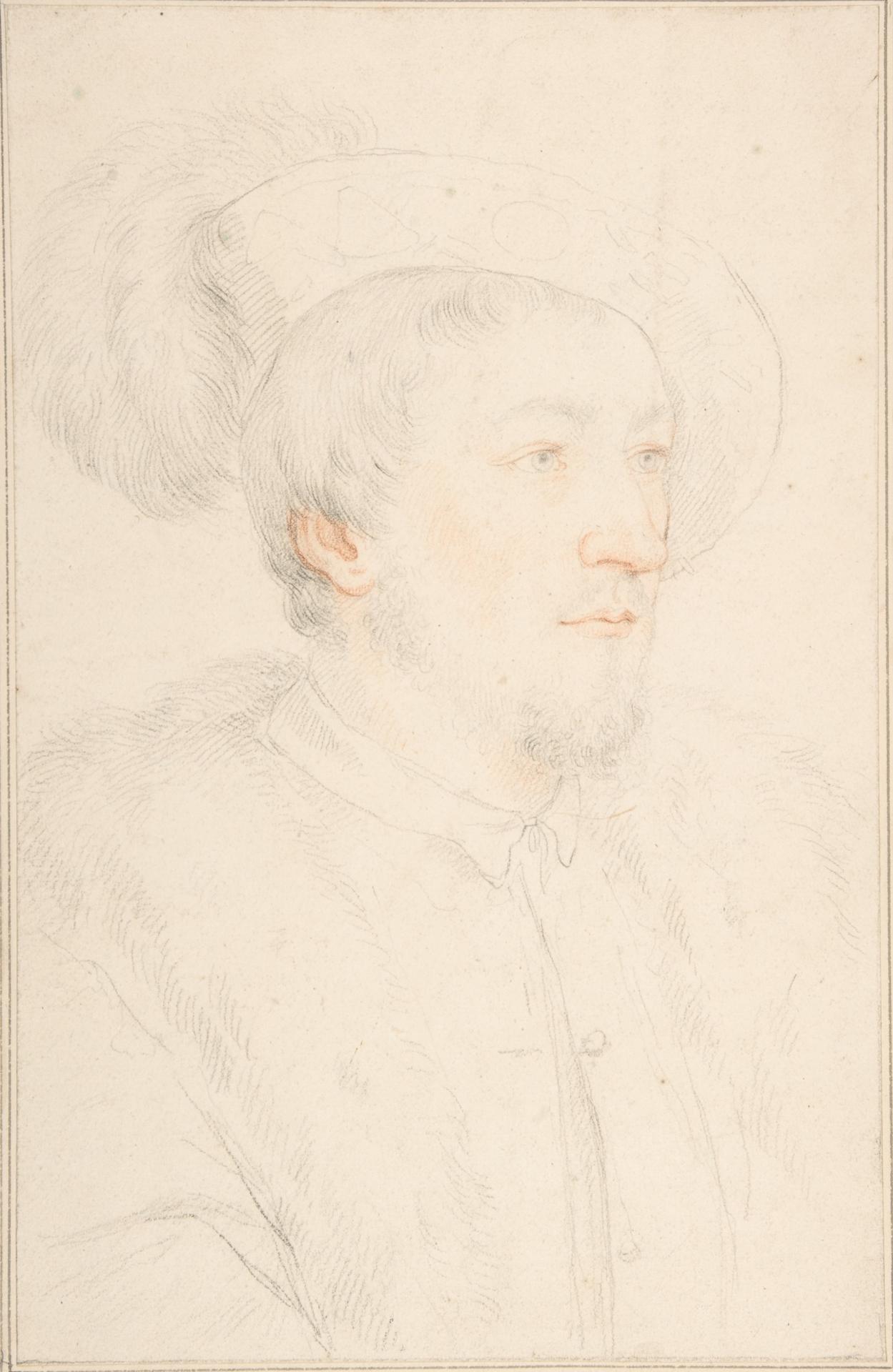
Red chalk and graphite on paper, drawn by Francesco Bartolozzi around 1794–1802: a man in profile, wearing a hat, with curly hair, a beard and a shirt with a bow. The drawing stays realistic and focuses mainly on facial features and clothing; the sitter's name has not come down to us.
Description
Turned from right to left, the head appears in profile, the hat tilted slightly back, curly hair spilling out beneath it. A short beard and a finely drawn moustache outline the face, while a collar and shirt bow sit at the neck. The background remains empty, so nothing distracts from the person. Light falls evenly across the face without harsh shadows, while lines and hatching precisely capture the structure of face and clothing.
Context
Bartolozzi, an Italian engraver and draughtsman, worked in London in the second half of the eighteenth century and became known above all for reproductive engravings and for works in red chalk and graphite. Portrait drawings of this period served as models for prints as well as independent sheets. Since the sitter is unidentified, this is likely a study or a commissioned work with no documented person.
Impact
The sheet stands out clearly and soberly, carried by precise linework and calm, even light. The realistic rendering of face and clothing gives the portrait a quiet dignity. Because the background stays empty, all attention rests on the person, creating an immediate, almost intimate impression.
Technique
Red chalk and graphite on paper come together here: the warm chalk drawing joins with the exact stroke of the graphite. Careful shading and fine lines reproduce the structure of face and clothing in detail. Both materials were common for portrait studies in the eighteenth century, as they allowed quick sketches as well as a fully worked-out execution.
AI-generated description text
Source: Metropolitan Museum of Art · Public Domain (CC0 1.0)