Daggars and Scabbards
Original title: Daggars and scabbards
kurzbeschreibung
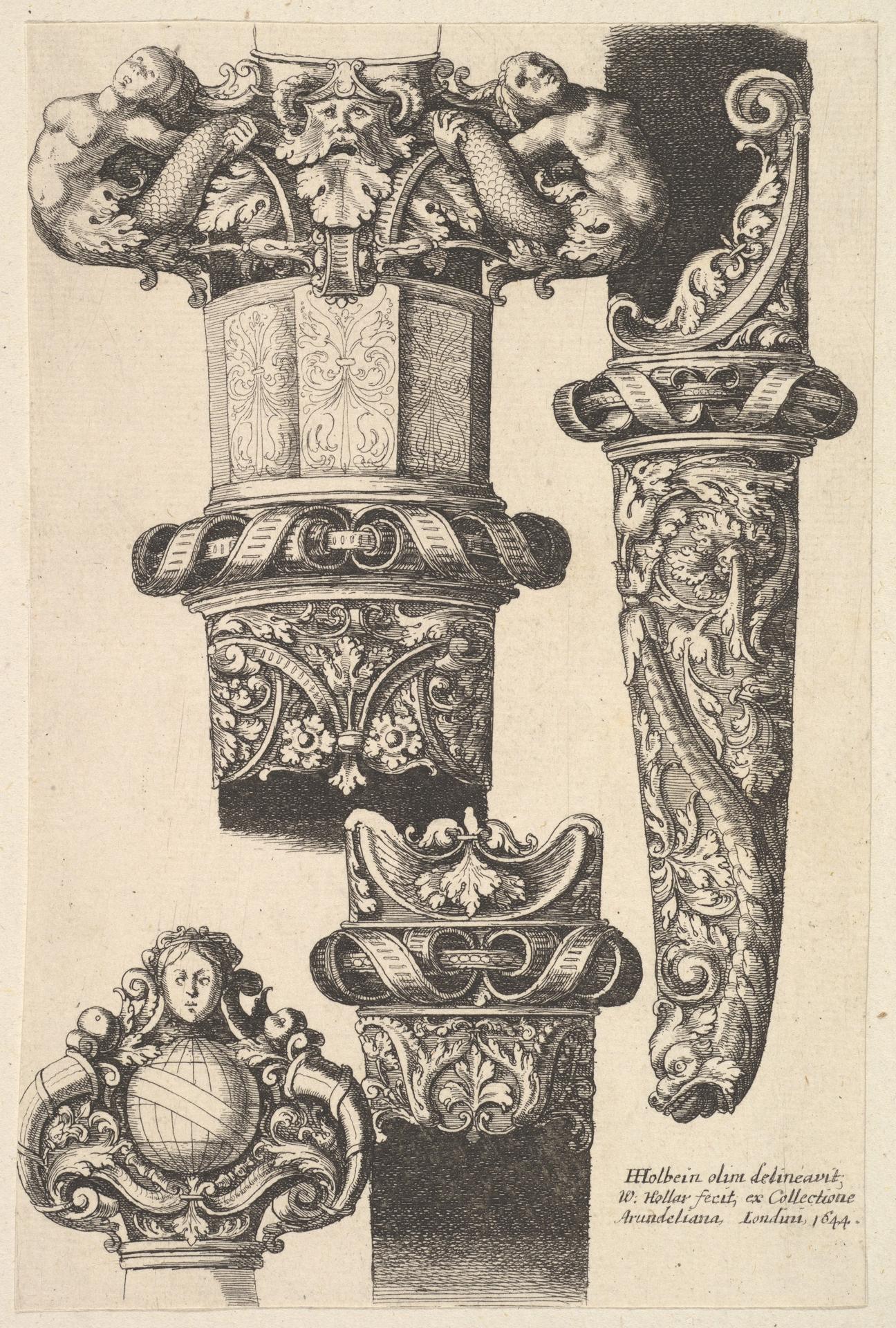
In 1644, while working in London, Wenceslaus Hollar produced an etching that presents two richly decorated daggers with their matching scabbards. The print follows a drawing by Hans Holbein and is known in its first of two states. The two weapons are arranged as mirror images of each other and are covered with an abundance of ornamental and figural motifs.
Description
Two ornamented daggers and their scabbards stand side by side in parallel. On the left object, near the top, a figure moves in a lively pose; the right one carries a stylized dragon as decoration. Foliage scrolls and geometric bands cover both surfaces. The lower end of the left dagger is formed by a spherical fruit surrounded by a figure, while the right piece tapers into a pointed, decorated finial. The layout is symmetrical, black and white remains the foundation, and fine hatching brings out the details.
Context
Hollar made the etching in London in 1644. His model was a drawing by Hans Holbein, as the inscription “H. Holbein olim delincavit” indicates. The sheet belongs to the collection of the Earl of Arundel, in whose service Hollar worked as an engraver. Weapons and armor were common motifs in seventeenth-century art and linked craftsmanship with courtly culture.
Impact
What the print conveys is a very precise, almost chiseled rendering of detail, ordered by the mirror-like pairing of the two weapons. The thin strokes and hatching give the forms body and let the ornamental richness of the daggers come forward. Anyone looking closely can discover the intertwined decorations step by step.
Technique
For the etching, the lines were incised into an etched plate. Varying line weights and hatching allow shadows and contours to be rendered precisely. The sheet measures about 15 × 10 cm, was printed on paper, and is trimmed at the plate mark.
AI-generated description text
Source: Metropolitan Museum of Art · Public Domain (CC0 1.0)