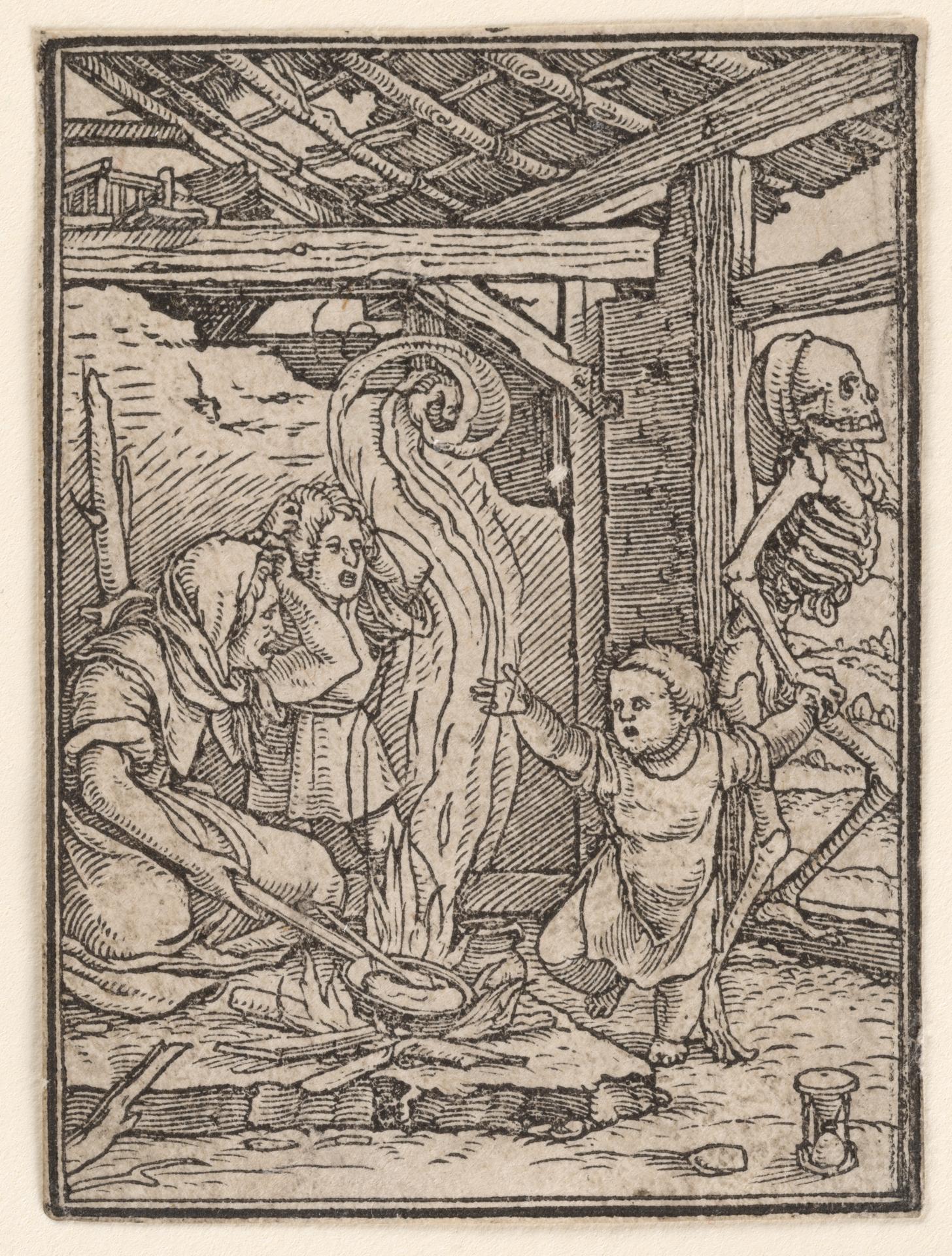
The Child, from "The Dance of Death"
Original title: The Child, from "The Dance of Death"
kurzbeschreibung
Made around 1526 and first published in 1538, this sheet belongs to Hans Holbein the Younger's cycle 'The Dance of Death'. It shows a child pointing at a skeletal figure, while a kneeling woman watches from the side. The scene is executed as a woodcut measuring 6.6 x 4.9 cm.
Description
A child steps forward and extends a hand, finger pointing at a bone figure with a long staff. Facing it, a woman kneels on the right; she holds a bowl and has her other hand to her forehead. The space, defined by wooden beams and plain construction, is closed by another figure in a cloak, topped by a small horn. Finely cut lines and regular hatching shape the print and bring out the wood's texture.
Context
The Dance of Death emerged in an era of religious upheaval and social tension. Holbein probably worked in Basel, where he absorbed Reformation currents. In 1538 the series was first published as a print in Lyon and quickly spread. That a child is included in the sequence underscores the ubiquity of death, to which every age falls prey.
Impact
Clearly guided lines and the calm grouping of figures give the view something insistent yet matter-of-fact. The juxtaposition of child and death holds a quiet melancholy that does without pathetic gestures. Through its monochrome, the sheet gains a serious, timeless quality.
Technique
For printing, the drawing was transferred to the woodblock and cut out; then ink was applied to the paper. Holbein's precise cutting is evident in the thin lines and hatching. The small format of about 6.6 x 4.9 cm suggests a series intended as book decoration or for individual sale.
AI-generated description text
Source: Metropolitan Museum of Art · Public Domain (CC0 1.0)