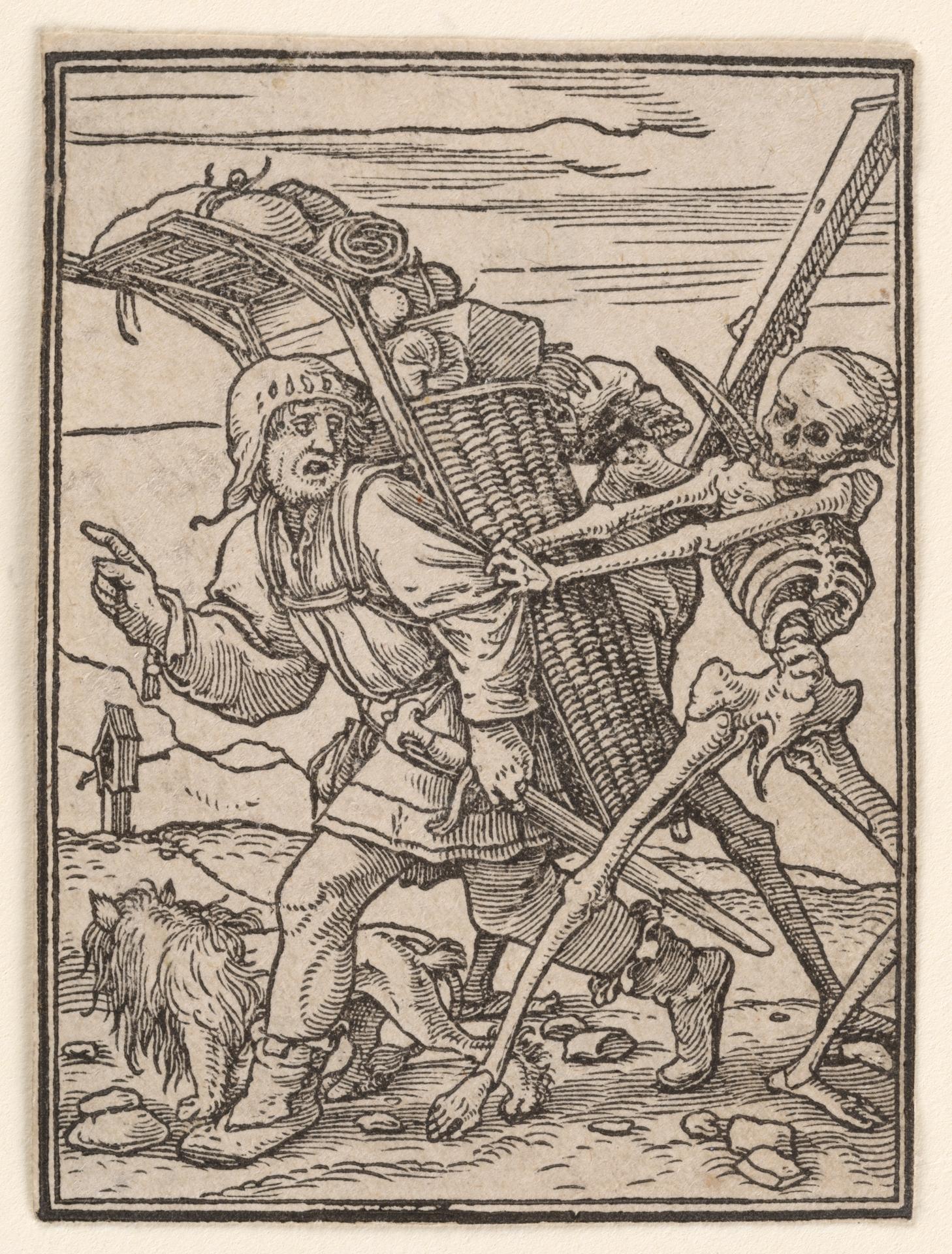
The Shop-keeper, from "The Dance of Death"
Original title: The Shop-keeper, from "The Dance of Death"
kurzbeschreibung
A startled man recoils as a skeleton steps toward him, armed with a shield and staff. This scene belongs to Hans Holbein the Younger's Dance of Death cycle, made around 1526 and published in 1538. A cow, a house and trees set the rural backdrop.
Description
Up front, a bearded man throws up his arms, his face gripped by terror at the skeleton standing opposite. The figure levels a long staff at him and carries a shield inscribed FOSS. Behind the pair sit a cow, a small house, and trees with hills beyond. A leaden sky sharpens the sense of menace. Man and skeleton are placed symmetrically at the center of the image.
Context
Drawn around 1526 but not printed until 1538, this sheet forms part of Holbein's celebrated Dance of Death. It captures the unease of its era and the ever-present shadow of death in sixteenth-century Europe. By casting a shopkeeper in the role, the motif joins the series of estates and trades that present death as the great leveller.
Impact
The blunt encounter between the living and the dead leaves a suffocating mood. Delicately graded lines and the woodcut's wealth of detail give the picture a nearly narrative force that speaks straight to the viewer.
Technique
To make the woodcut, the design was cut into a wooden block and afterwards printed onto paper. Varying line weights and directions create the shading, as was typical of Renaissance woodcut technique. Monochrome coloring and crisp contours define Holbein's precise style.
AI-generated description text
Source: Metropolitan Museum of Art · Public Domain (CC0 1.0)