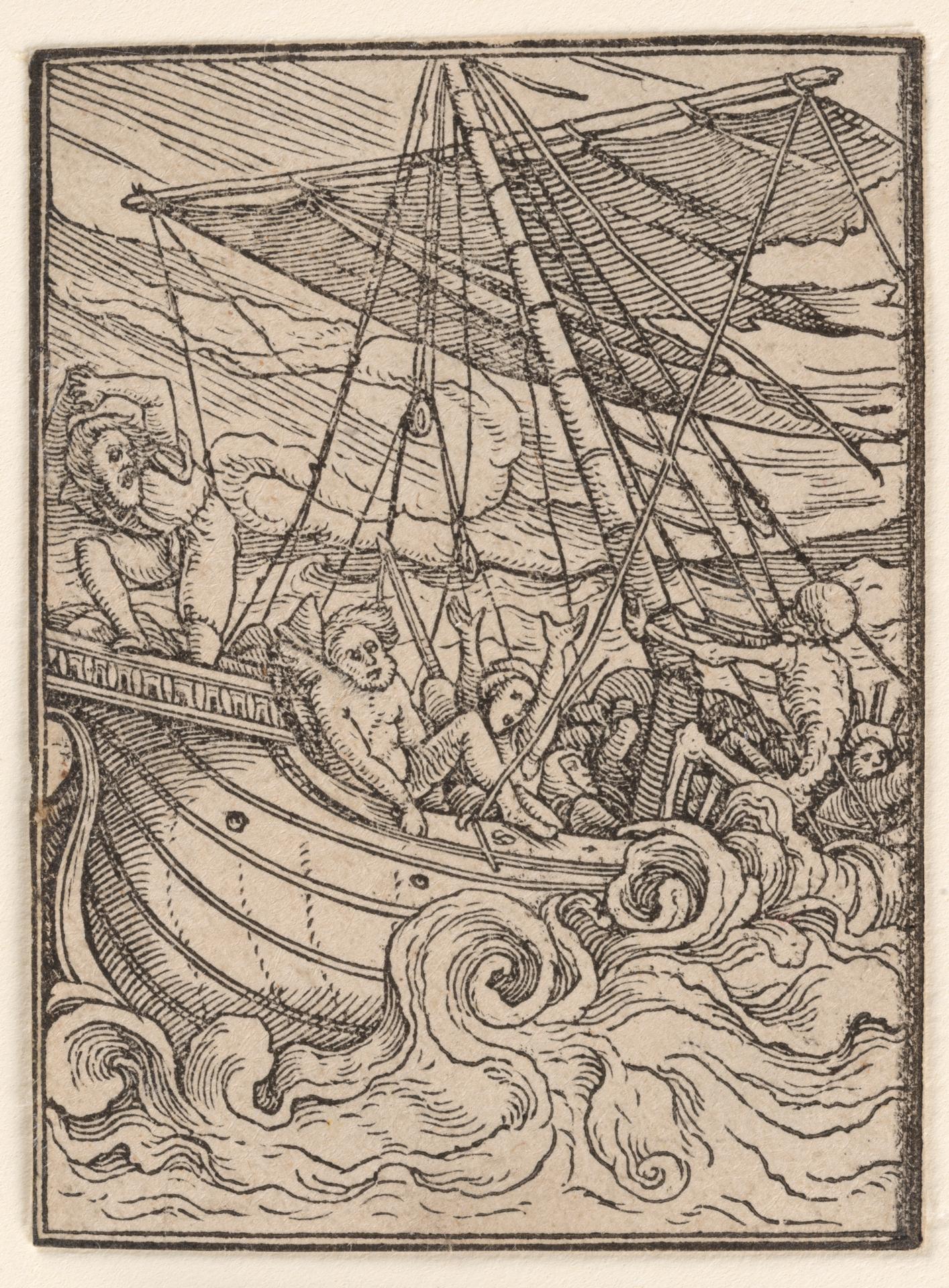
The Skipper (or Sailor), from "The Dance of Death"
Original title: The Skipper (or Sailor), from "The Dance of Death"
kurzbeschreibung
Hans Holbein the Younger made this woodcut around 1526, though it did not reach print until 1538, when it appeared as part of his Dance of Death series. Out on the open sea a ship runs into a heavy swell: waves pile up, the figures on board fall into confusion, and a sailor struggles to hold the helm.
Description
A vessel with swollen sails labours through surging, rolling water. Across the deck several figures are scattered in sharply different attitudes, some plainly seized by terror, others straining at the course and the rigging. Crisp, hard contours define the print, and the ground behind is left bare, so that ship and crew hold every bit of attention.
Context
The Dance of Death belongs to an age of religious and social upheaval, the Reformation above all. Holbein was working in Basel at the time. The series first came out in print in Lyon in 1538 and soon became widely known, taking up mortality and the equality of all people before death.
Impact
Immediate danger and motion come off this sheet and pull the eye into the action. Precise strokes and expressive waves produce a tangible unrest that supports the message of life's brevity. Clearly ordered and full of figures, the view stays legible down to the smallest detail.
Technique
The method was the woodcut: the image is cut into a wooden block and then printed. Holbein used delicate, exactly placed cuts to work out ship and figures in detail. Black and white with sharp contours are part of the process and allow for great precision.
AI-generated description text
Source: Metropolitan Museum of Art · Public Domain (CC0 1.0)