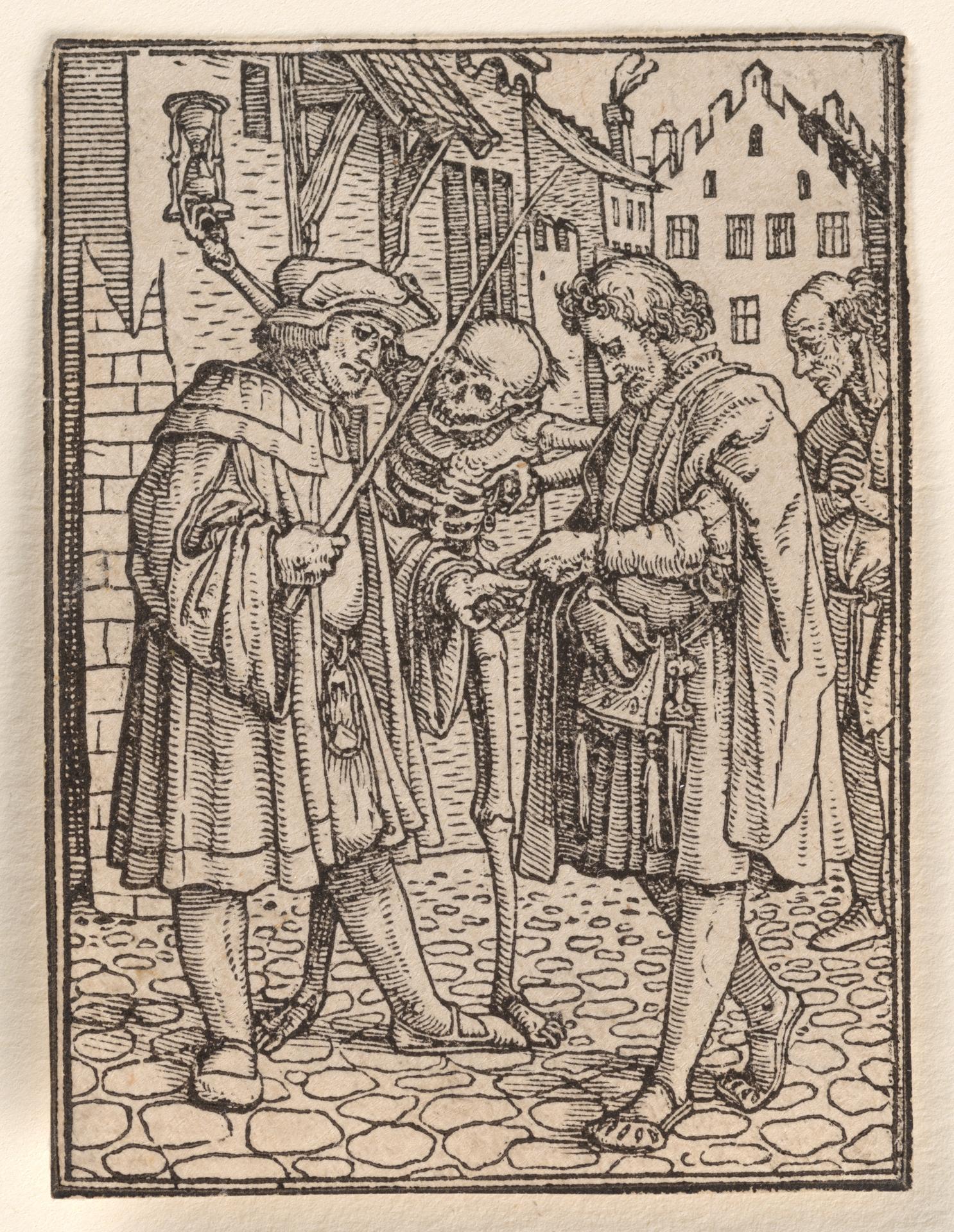
The Lawyer (or Advocate), from "The Dance of Death"
Original title: The Lawyer (or Advocate), from "The Dance of Death"
kurzbeschreibung
Hans Holbein the Younger created the woodcut 'The Lawyer' around 1526 as part of his 'Dance of Death' cycle, which first appeared in print in 1538. In this small sheet, a legal scholar is visited by a skeleton embodying Death.
Description
A skeleton stands between two men in contemporary dress and headgear; the bony figure and one of the men share a long staff. Behind them, more figures in similar attire appear, along with houses with tiled roofs and windows. On a paved path, the figures crowd into a dense group whose arrangement suggests lively interaction.
Context
Holbein produced the 'Dance of Death' cycle in the 1520s during his stay in Basel, a period marked by the Reformation and social upheaval. The series was first published in Lyon in 1538 and spread quickly. The sheet featuring the lawyer belongs to the estate satires in which Death comes for every level of society.
Impact
The crowded group of figures creates immediate drama and draws the viewer's eye into the middle of the action. Sharp contrasts between the dark lines and the light paper give the sheet an insistent, almost graphic presence that reinforces its moral message.
Technique
For this woodcut, the design was cut into a wooden block and then printed. The monochrome image, with its range of gray tones, results from varying line thickness and direction, which model light and shadow. The format of only 6.5 x 4.8 cm demanded particularly fine carving.
AI-generated description text
Source: Metropolitan Museum of Art · Public Domain (CC0 1.0)