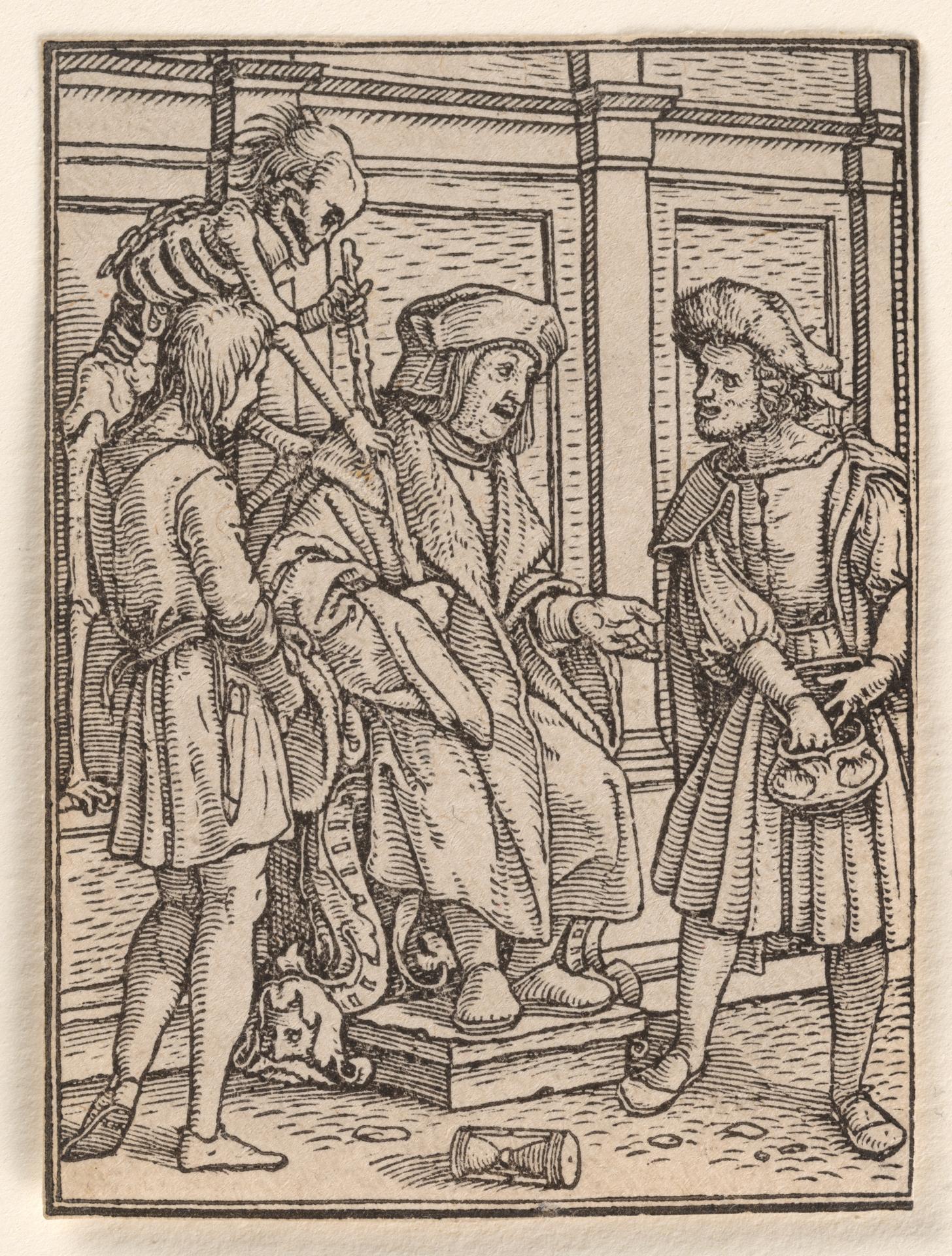
The Judge, from "The Dance of Death"
Original title: The Judge, from "The Dance of Death"
kurzbeschreibung
A skeleton with a staff touches a judge's forehead — this scene from the Dance of Death was captured by Hans Holbein the Younger around 1526 as a woodcut; it first appeared in print in 1538. Other figures populate the action.
Description
Four figures gather in a room with paneled walls. On the left stands a skeleton holding a staff and placing a hand on a forehead. Next to it, a woman in a long gown holds something up in the air with one hand. To her right sits a man in a long coat and cap, one hand extended; before him stands another man in a short coat and cap with a bowl. Coins and a staff lie scattered on the floor. The drawing uses detailed lines and a realistic approach; the coloring remains monochrome, as is usual for woodcuts, and the light is evenly distributed, without strong shadows.
Context
This print belongs to Holbein's famous series 'The Dance of Death', created in the 1520s and first published in Lyon in 1538. The series revolves around the transience of existence and the equality of all estates in the face of death. Holbein made these woodcuts during his stay in Basel, in an era of religious and social upheaval. The pictorial idea of the Dance of Death was widespread in the late Middle Ages and the Renaissance.
Impact
A clear layout and precise linework give the figures liveliness. The calm but emphatic scene carries a memento mori message and encourages viewers to reflect on their own mortality. The even distribution of light and the detailed execution lend the print a timeless aesthetic quality.
Technique
Woodcut: in this printing process, the design is cut into a wooden block and then printed on paper. The finest lines and hatching testify to Holbein's confident handling of the medium. The monochrome coloring corresponds to the woodcut practice of the time.
AI-generated description text
Source: Metropolitan Museum of Art · Public Domain (CC0 1.0)