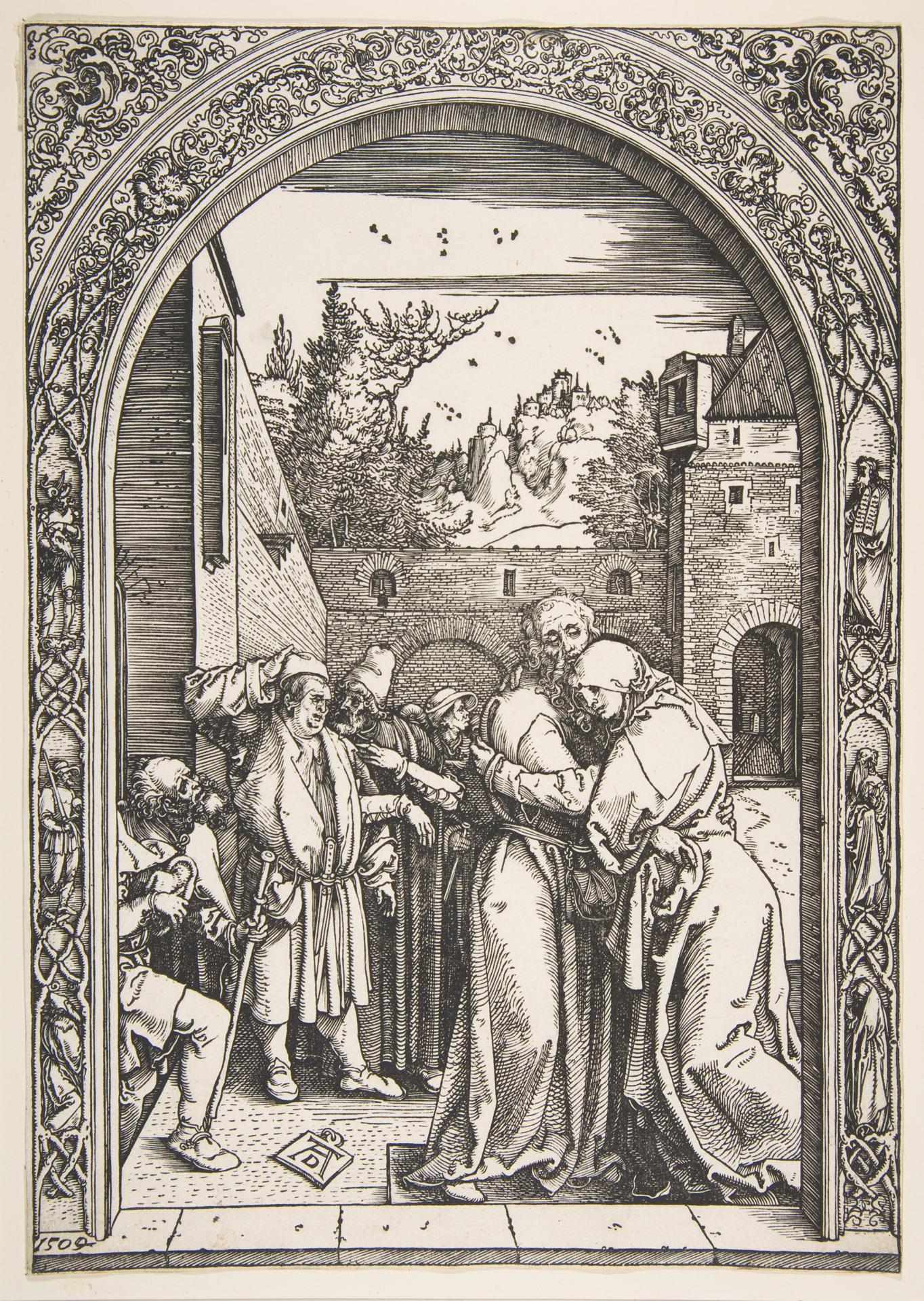
Joachim and Anna at the Golden Gate, from "The Life of the Virgin"
Original title: Joachim and Anna at the Golden Gate, from "The Life of the Virgin"
kurzbeschreibung
This woodcut by Albrecht Dürer, dated 1504, depicts the meeting of Joachim and Anna at the Golden Gate of Jerusalem. It is part of his series "The Life of the Virgin," which illustrates episodes from the lives of Mary and her parents. The scene is rendered in a detailed, monochromatic style typical of Dürer's graphic work.
Description
The composition centers on a group of figures beneath a grand archway, with two men in the middle engaged in an exchange while others stand or observe around them. The figures are dressed in traditional, flowing garments, suggesting a biblical or historical setting. In the background, trees, buildings, and birds fill the sky above the arch. The scene is symmetrical, with the main action at the center and figures distributed to both sides. The monochrome palette and even lighting are characteristic of woodcut prints, and the intricate linework reveals a Renaissance attention to detail in clothing and architecture.
Context
Dürer created this woodcut as part of his series "The Life of the Virgin," which was first published in 1504 and became widely popular across Europe. The series reflects the late medieval and early Renaissance devotion to the Virgin Mary, emphasizing her parents, Joachim and Anna, who are venerated in apocryphal texts. Dürer's prints were instrumental in spreading Renaissance artistic ideas north of the Alps, and this work demonstrates his mastery of the woodcut medium.
Impact
The woodcut impresses with its intricate detail and balanced, harmonious composition. The careful rendering of the figures and setting draws the viewer into the sacred narrative, evoking a sense of solemnity and devotion. Dürer's fine lines and varied textures give the monochrome image a remarkable depth and liveliness.
Technique
This work is a woodcut, a relief printing technique where the image is carved into a wooden block, inked, and transferred to paper. Dürer's skill lies in his ability to create fine, expressive lines and subtle tonal variations through cross-hatching and careful carving. The print is part of a series, indicating that it was produced in multiple copies for distribution.
AI-generated description text
Source: Metropolitan Museum of Art · Public domain (CC0)