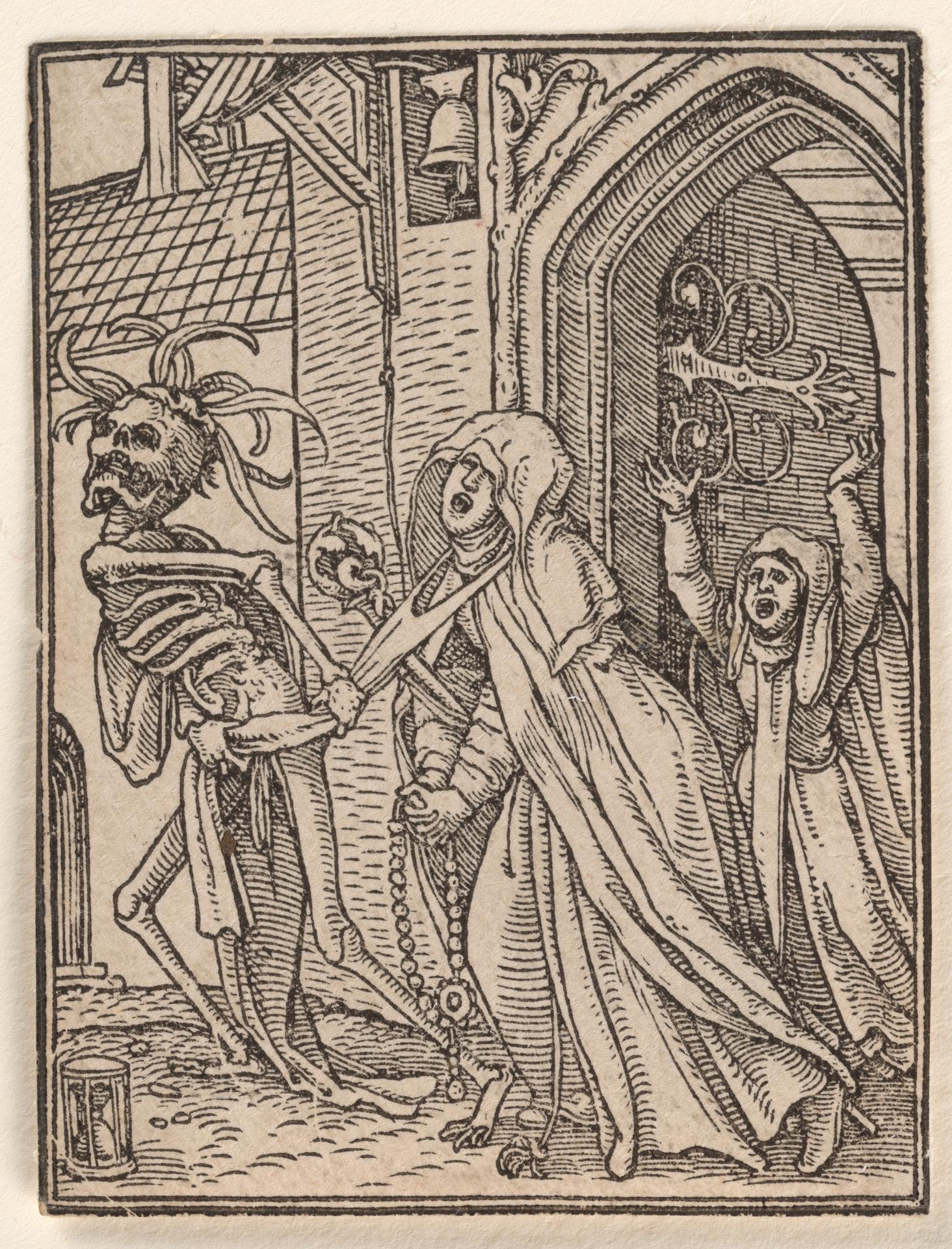
The Abbess, from "The Dance of Death"
Original title: The Abbess, from "The Dance of Death"
kurzbeschreibung
An abbess stands at the heart of this woodcut from Hans Holbein the Younger's celebrated Dance of Death series (c. 1526, published 1538). A skeleton threatens her with a stick. The print belongs to a sequence that presents death as the great leveller across every rank of society. It is small in scale and rendered in monochrome woodcut.
Description
An abbess in full ceremonial habit, rosary in hand, occupies the centre. From the right, a skeleton charges forward, brandishing a long staff or rod. Two further figures in long robes flank the abbess, their arms raised in fear or despair. A church portal with cross and bell signals the religious setting. The layout feels balanced, the tonal range stays monochrome, with evenly distributed light built up through hatching and line.
Context
Holbein created the Dance of Death cycle around 1526; the woodcuts first appeared in print in 1538 in Lyon. The series emerged during the Reformation and a period of profound social change in the sixteenth century. Holbein worked for the publisher Johann Froben in Basel and later at the court of Henry VIII of England. The dance of death motif was widespread in the late Middle Ages, emphasising the transience of life and the equality of all people before death.
Impact
Despite its menacing subject, the print radiates a certain calm and order through its clear lines and balanced arrangement. Yet the gestures of the companions and the presence of the skeleton generate a tension that speaks directly to the viewer. The monochrome palette underlines the serious, memento mori character of the work.
Technique
The woodcut is a relief printing process: the design is cut into a wooden block and then printed onto paper. Holbein used fine lines and hatching to draw out shadows and details. At 6.4 x 4.9 cm, the sheet is very small—a format typical for book illustrations of the period.
AI-generated description text
Source: Metropolitan Museum of Art · Public Domain (CC0 1.0)