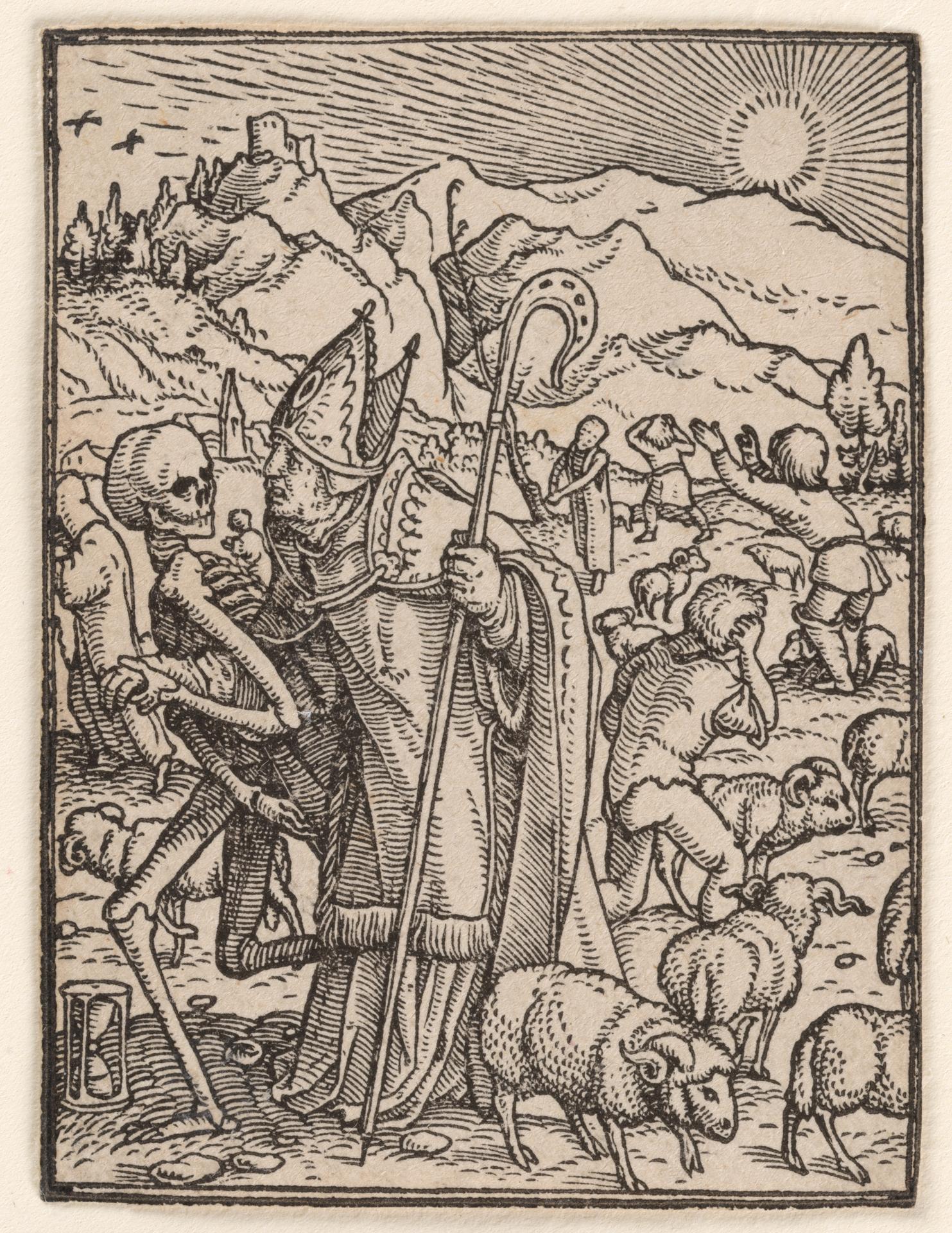
The Bishop, from "The Dance of Death"
Original title: The Bishop, from "The Dance of Death"
kurzbeschreibung
Hans Holbein the Younger made this woodcut around 1526, and it first appeared in print in 1538 as part of the Dance of Death series. It shows a bishop caught in a skeleton's embrace, set within a landscape that holds further figures.
Description
A bishop in full vestments, his staff in hand, is clasped by a skeleton. People appear all around him: some turn to flee, others stay fixed in prayer. Sheep graze at the right, and at the lower left an hourglass reminds the viewer of mortality. Mountains rise up, and a burst of rays breaks through the sky. The layout feels balanced, the lines clear and precise in black on white.
Context
The Dance of Death series took shape in the early sixteenth century, an age of religious tension and social criticism. Holbein built on the idea that death levels every rank, a motif already widespread at the time. First published in Lyon in 1538, the woodcuts soon circulated very widely.
Impact
The tight embrace of the living man and the skeleton creates an oppressive mood. The calm landscape stands against the inescapable presence of death, and so underlines the transience of all earthly things.
Technique
To make the print, the drawing was cut into a wooden block and transferred to paper in black ink. Delicate lines and hatching testify to the high quality of Renaissance woodcut art.
AI-generated description text
Source: Metropolitan Museum of Art · Public Domain (CC0 1.0)