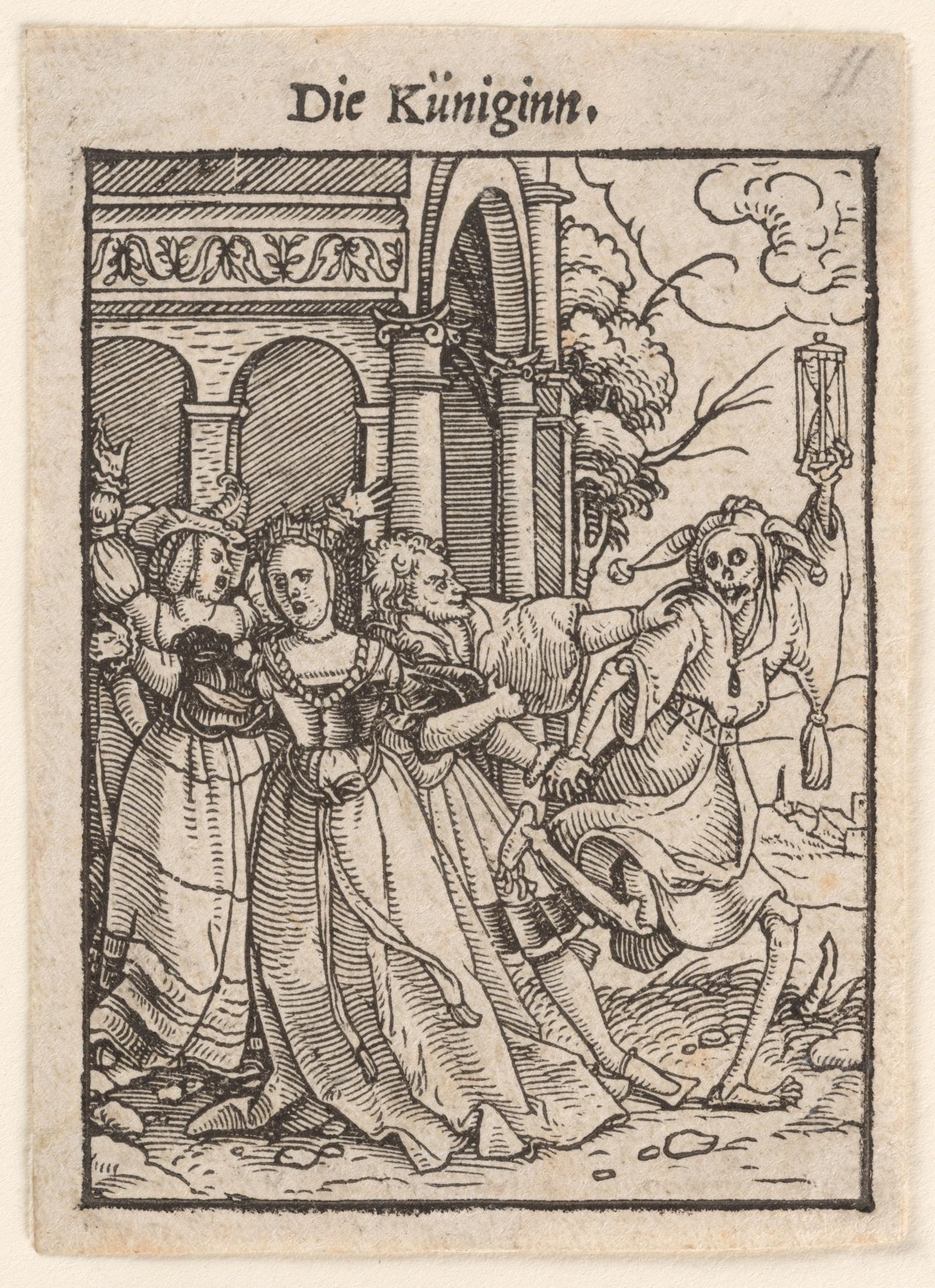
The Queen, from "The Dance of Death"
Original title: The Queen, from "The Dance of Death"
kurzbeschreibung
This woodcut from Hans Holbein the Younger's Dance of Death cycle, made around 1526 and published in 1538, presents a queen in sumptuous regalia confronted by Death as a skeleton.
Description
A queen in rich attire dominates the field, surrounded by other figures assailed by Death. At the right, the skeleton appears holding a torch in its right hand. Columns and arches in the background suggest a building or ruin. The black-and-white woodcut manner typical of the Renaissance pervades the entire view.
Context
Cut around 1526 but not published until 1538, this sheet belongs to a series of 41 images on the equality of all ranks before death. Holbein worked on it during his first Basel period, an era marked by the Reformation and social tensions. That the queen herself is among the victims makes the moral message of the time clear: death spares no one.
Impact
The clear, essential linework gives the scene something insistent and grave. A magnificently adorned ruler and a bare skeleton face each other, and from this contrast arises a strong tension that brings the transience of earthly power before our eyes.
Technique
The woodcut as a printing process works with lines and hatching cut into the block and then printed. Here they serve to render garments and architecture in detail and to draw out tonal values. Holbein's precise cutting reveals his assurance in this printmaking technique.
AI-generated description text
Source: Metropolitan Museum of Art · Public Domain (CC0 1.0)