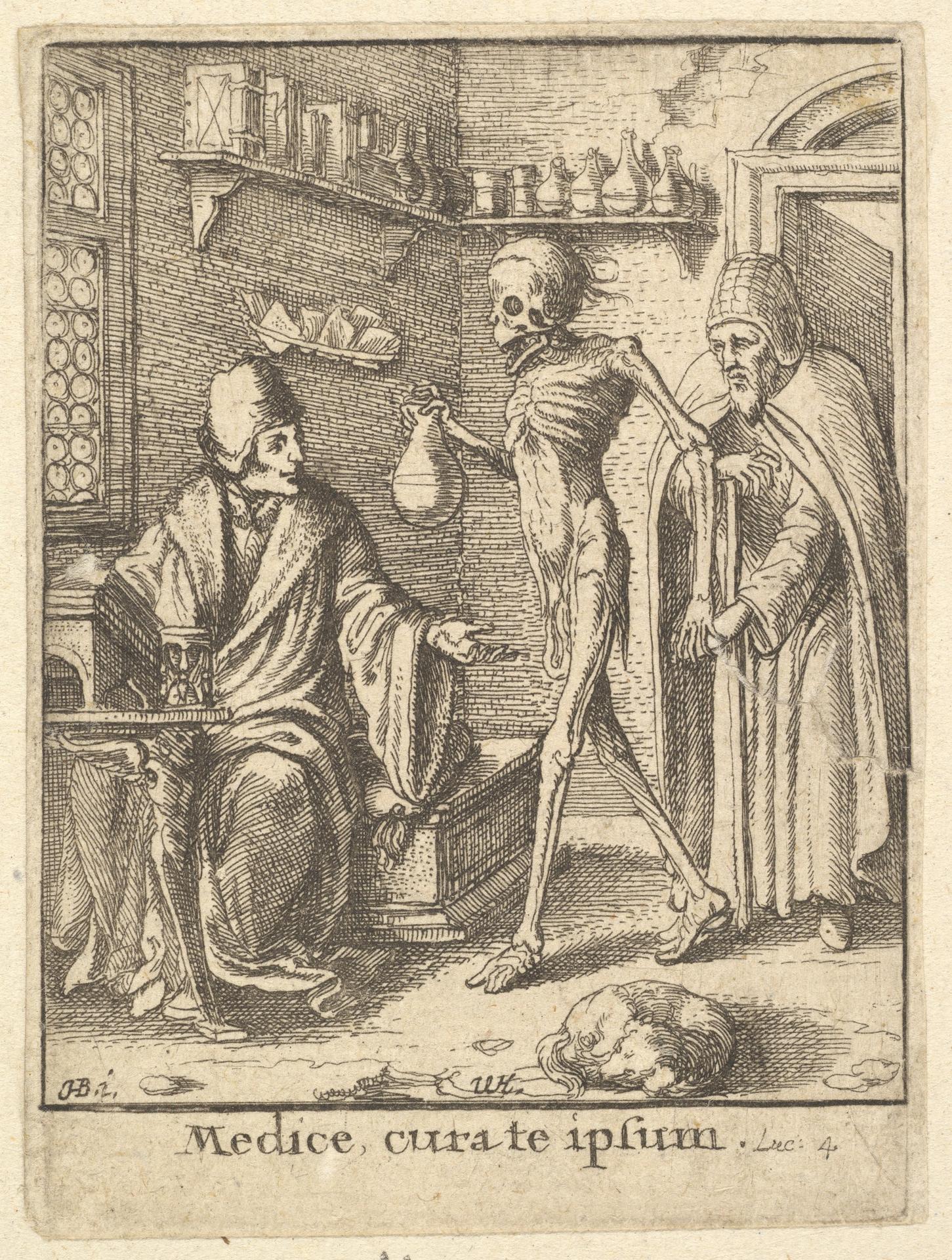
Doctor, from the Dance of Death
Original title: Doctor, from the Dance of Death
kurzbeschreibung
Unlike related Dance of Death sheets, Wenceslaus Hollar's etching "Der Doktor" centers not on dancing but on a handover: a physician offers a bottle to a skeleton. The motif originated in 1651; a late 18th-century impression survives. The sheet measures 7.6 × 5.7 cm and is in the second of four states.
Description
A skeleton anchors the layout, while from the left the doctor holds out a medicine bottle. To the right a cleric watches the exchange, and at the figures' feet lies a deceased person. Shelves crowded with bottles and vessels root the action in a medical setting. The figures are arranged symmetrically; the image remains monochrome, with light falling evenly.
Context
Hollar, a Bohemian-born engraver active in London and Antwerp and known for his detailed graphics, made this etching in 1651 as part of a Dance of Death series. The series draws on the medieval tradition of the Danse Macabre. That the second of four printing states comes from a late 18th-century impression attests to the series' later reception and continued circulation.
Impact
The symmetrical arrangement and calmly distributed light give the scene a matter-of-fact, almost clinical detachment. Living and dead stand side by side without the view tipping into pathos; instead, a reflective mood arises. The clear linework focuses the gaze on the doctor's gesture as he hands the bottle to the skeleton.
Technique
The sheet was made as an etching: lines were incised into an etched plate and then printed on paper. Compared with the first state, the second shows reworkings that refine, among other things, the shelves in the background. The small format of 7.6 × 5.7 cm demanded precise needlework and demonstrates Hollar's craftsmanship.
AI-generated description text
Source: Metropolitan Museum of Art · Public Domain (CC0 1.0)