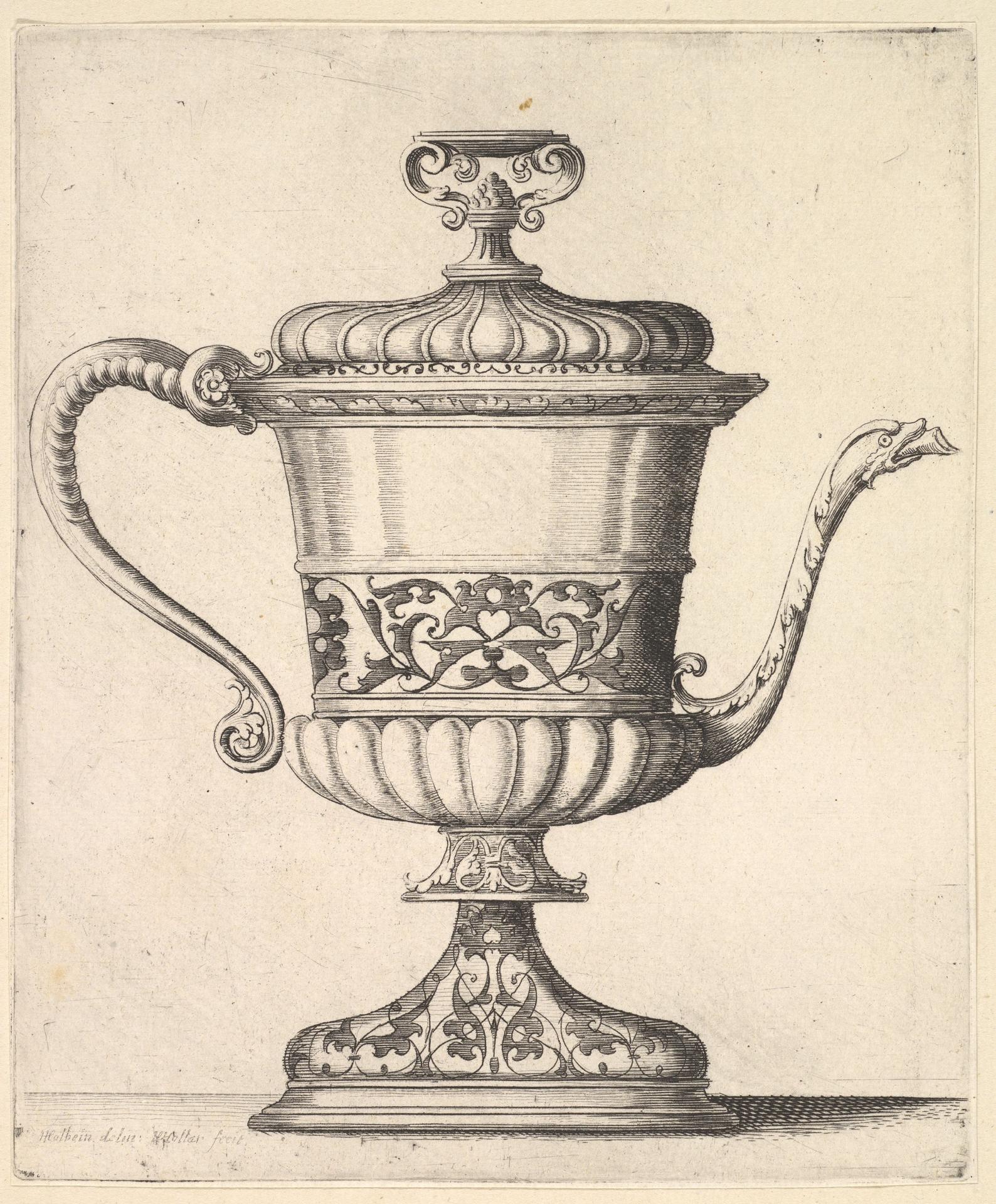
Jug with lid, engraved with arabesque pattern, the narrow spout to right ending in snake's head, handle to left
Original title: Jug with lid, engraved with arabesque pattern, the narrow spout to right ending in snake's head, handle to left.
kurzbeschreibung
Wenceslaus Hollar etched and drypointed this lidded jug in 1649. A single, slender vessel appears, its long spout reaching to the right and ending in a snake's head; a curved handle sits on the left. The image stays monochrome and follows the linear logic typical of printmaking.
Description
Centered on the sheet, the jug rises in a tall, elegant silhouette. The narrow spout stretches far to the right and tapers into a carefully worked snake's head. On the lid, intricate arabesques spread out to the edge, while a band of symmetrical ornament divides the body. On the left, a long, serpentine handle winds upward and closes with a decorative flourish. The foot, too, carries a multi-part pattern that continues downward.
Context
Hollar made this print in 1649 while working in England, where he was valued for his precise etchings. An ornate vessel as a subject matched the interest of 17th-century Kunstkammern and collectors in crafted objects. Hollar often worked from other artists' designs; whether a specific model existed here is not known. The print is known in only one state and was printed with plate tone, suggesting careful production.
Impact
The clear, focused layout and finely differentiated linework give the jug an almost sculptural presence. The interplay of symmetrical patterns and the elongated silhouette creates a calm, ornament-driven aesthetic that rewards close looking. With no color, attention falls entirely on the vessel's form and ornament.
Technique
Etching and drypoint were used in a single state. The plate measures 17.8 × 14.7 cm and was printed with plate tone, which brings out the delicate lines of the ornaments. The combination of both techniques allowed Hollar to render the complex patterns and serpentine details precisely.
AI-generated description text
Source: Metropolitan Museum of Art · Public Domain (CC0 1.0)