Ornate goblet
Original title: Ornate goblet
kurzbeschreibung
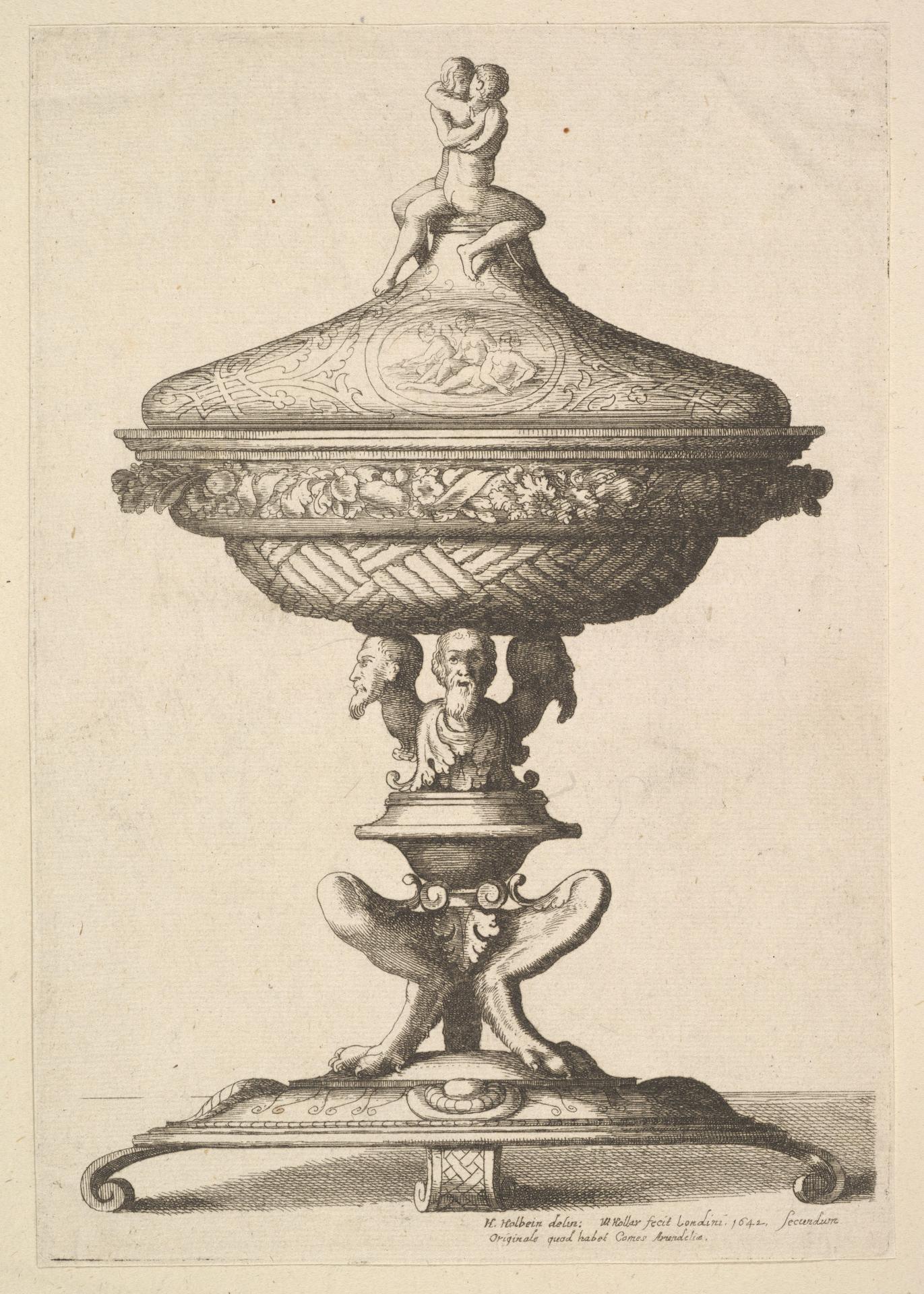
At the heart of this 1642 etching by Wenceslaus Hollar stands a drinking vessel lavishly adorned with figures and ornament. Hollar issued the print as a single sheet in etching, a technique whose fine lines bring out the cup's intricate details.
Description
Two naked, intertwined figures recline on the lid of the cup. Below them, the shaft carries floral and geometric patterns, including a relief with two figures in lively action. At the foot, two human heads meet the eye, joined by further decorative forms such as an animal head. A pedestal with additional ornament completes the downward sequence. Fine lines and shading define the monochrome rendering.
Context
The print comes from Wenceslaus Hollar, a Bohemian graphic artist who worked across much of seventeenth-century Europe. In 1642, the year of this etching, he was active in England. Ornament prints of this kind often served goldsmiths as models and were prized by collectors as well. Hollar was known as a master of detailed reproduction and showed great versatility in printmaking.
Impact
The viewer's gaze is first drawn to the crowned group of figures, then follows the ornaments down the shaft, and finally rests on the heads at the foot. The symmetrical arrangement and precise linework give the vessel a noble yet cheerful presence. Figural scenes and decoration coalesce into a decorative structure that invites close looking.
Technique
The sheet is executed as an etching, printed in a single state. The etching process allows fine, even lines and soft shading that make the cup's details stand out clearly. The print measures 19.5 × 13.5 cm and is on paper.
AI-generated description text
Source: Metropolitan Museum of Art · Public Domain (CC0 1.0)