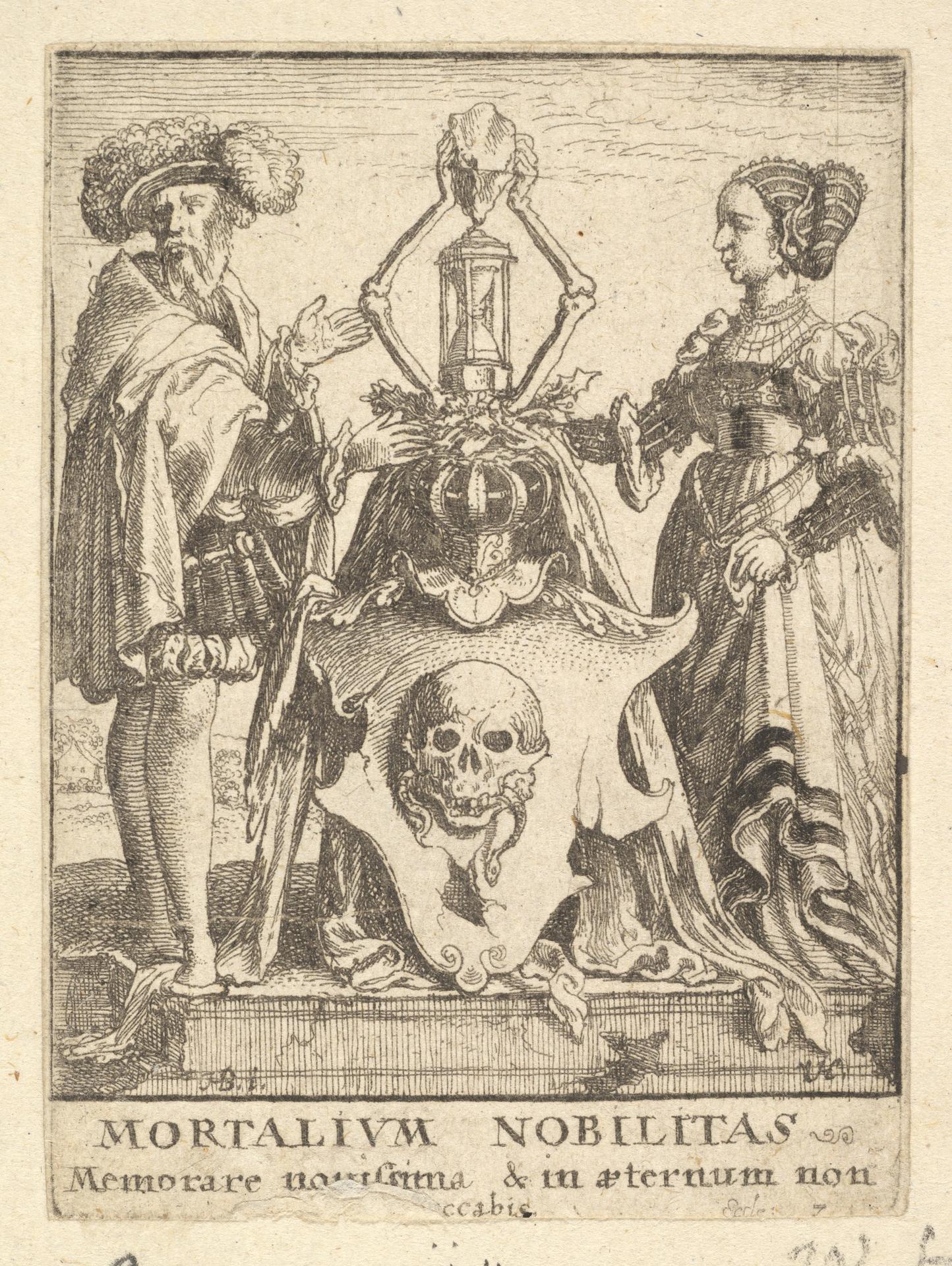
Death's coat of arms, from the Dance of Death
Original title: Death's coat of arms, from the Dance of Death
kurzbeschreibung
Wenceslaus Hollar made the 'Todswappen' (Coat of Arms of Death) in 1651 as part of his 'Dance of Death' series. This etching was printed in the late 18th century. The allegorical scene features a shield with a skull and crown, held by two figures.
Description
A black-and-white drawing rich in detail. A shield dominates the center, topped by a skull and a crown above it. Two figures—a man in a hat and robe, and a woman in a gown and headdress—present the shield. At the top, another figure is hinted at, with only arms and hands visible, holding an hourglass. Below the shield runs a Latin inscription.
Context
Hollar created the etching in 1651 as a contribution to his 'Dance of Death' series, which draws on woodcuts by Hans Holbein the Younger. The late reprint in the 18th century shows that moralizing images of this kind remained in demand. The coat of arms with skull and crown drives home the transience of worldly power and noble lineage.
Impact
The clear linework and strict arrangement give the sheet an almost heraldic gravity. Death symbolism and the shield form combine into a forceful reminder of mortality that speaks directly to the viewer.
Technique
The etching is in the second state. The etching process allows fine lines and precise rendering of the figures and symbols. The small-format sheet (7 × 5.5 cm) was printed on paper.
AI-generated description text
Source: Metropolitan Museum of Art · Public Domain (CC0 1.0)