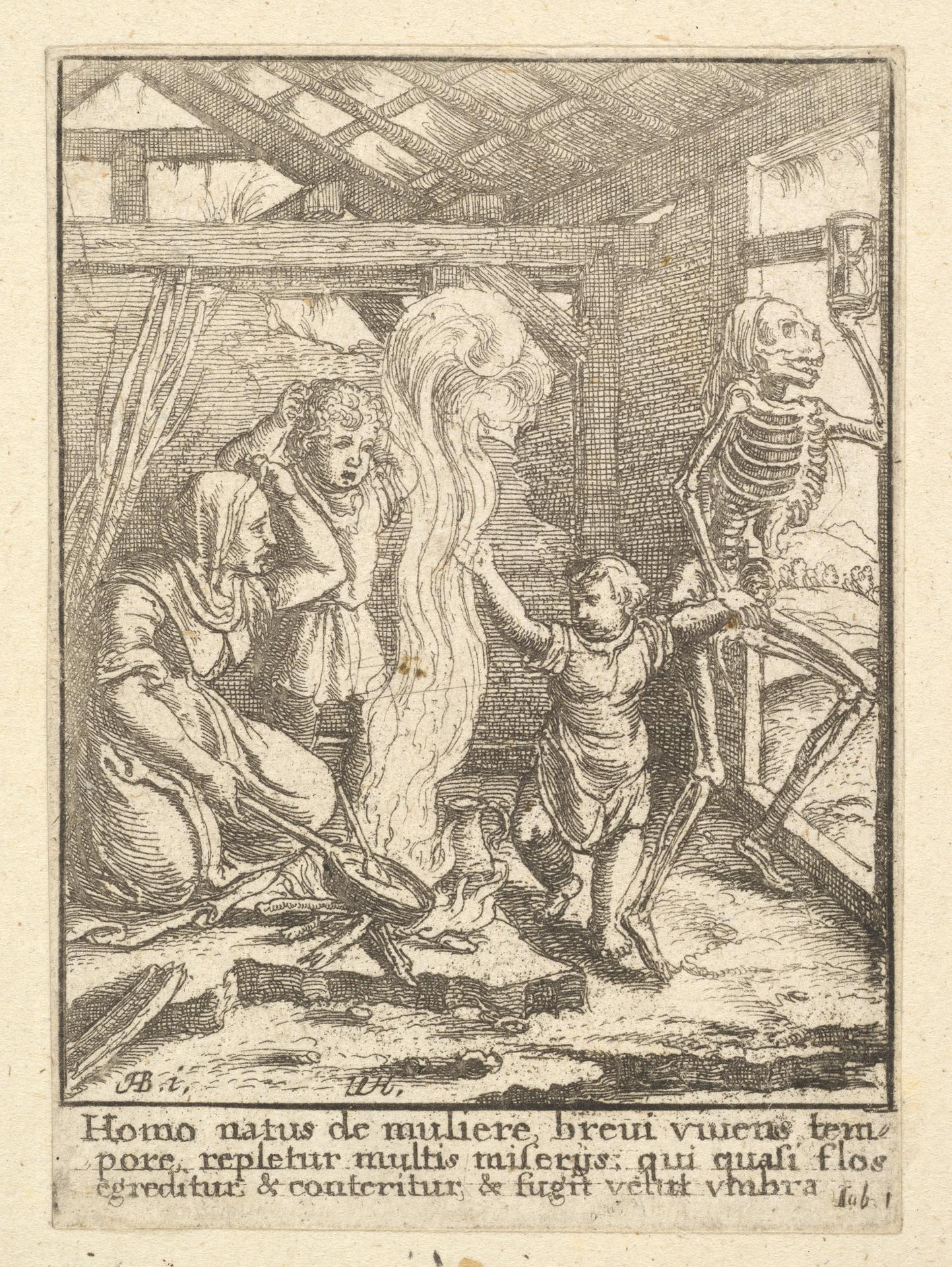
The Child, from the Dance of Death
Original title: The Child, from the Dance of Death
kurzbeschreibung
A skeleton carrying a lantern points toward a woman playing the flute while two children listen nearby. This allegorical motif from the Dance of Death is by Wenceslaus Hollar and dated 1651. The present etching reproduces the second of four states.
Description
A woman sits on the ground, blowing into her flute; one child listens, another looks down at the instrument. To the right, on a small pedestal held up by a child, a skeleton stands with a lantern in its hand and points its finger at the woman. Behind them rises a crumbling wall that recalls a house or a chapel. Dark gray tones and shadowy lines run through the print and give it a somber mood.
Context
Hollar made this etching around 1651 as a contribution to a Dance of Death series, an allegorical theme widespread in the seventeenth century that keeps the transience of all earthly things before the viewer's eyes. The impression shown here was pulled in the late eighteenth century. The Bohemian printmaker, who worked in London and Antwerp, became known for his richly detailed etchings.
Impact
Fine hatching and the dark tonality make the sheet feel eerie and quietly thought-provoking. The symmetrical layout draws the eye to the flute player, while the skeleton keeps mortality present. The pairing of childhood innocence with death produces an oppressive atmosphere.
Technique
As an etching, the print relies on fine lines and hatching to work out details and shadows. It is the second state of four, which points to later reworking of the plate. At roughly 7.5 × 5.5 cm, the sheet is a small, intimate format.
AI-generated description text
Source: Metropolitan Museum of Art · Public Domain (CC0 1.0)