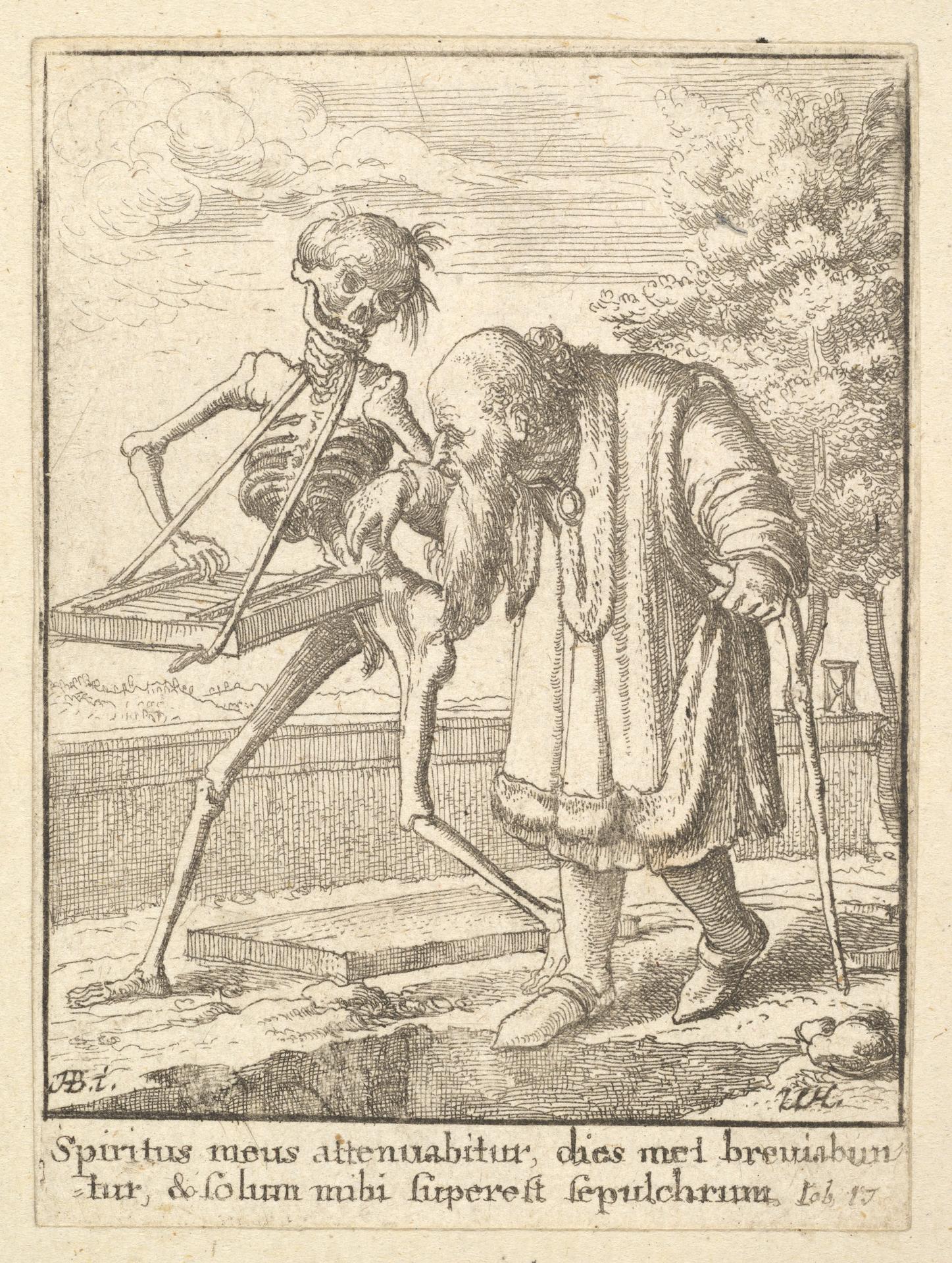
Old man, from the Dance of Death
Original title: Old man, from the Dance of Death
kurzbeschreibung
Etched in 1651 and printed in the late eighteenth century, Wenceslaus Hollar's 'Old Man, from the Dance of Death' presents a bearded elder in a fur-lined coat leaning on a stick. Beside him a skeleton has taken a seat on a coffin, holding a long staff. The design is mirror-reversed and follows Renaissance forms; a Latin inscription runs along the bottom of the sheet.
Description
An old man with a long beard and a fur-trimmed jacket leans on a crutch. Right next to him a skeleton sits on a coffin, a long staff in hand. Trees and a cloudy sky fill the background. Below the figures runs the Latin inscription 'Spiritus meus attenuabitur, dies mei brevis abitur, & solum mibi superest sepulchrum tab. 17'. The layout is symmetrical around the two figures; light falls evenly, without strong shadows.
Context
The model was Hans Baldung Grien's Dance of Death, a Renaissance theme about the transience of life. The Bohemian etcher Wenceslaus Hollar made this etching in 1651 as part of a series. The present impression belongs to a late eighteenth-century edition, suggesting later reuse of Hollar's plates. The Latin text quotes a passage from the Book of Job that emphasizes the brevity of human existence.
Impact
The calm, symmetrical arrangement and even lighting give the print a balanced, contemplative mood. The confrontation between the aged man and the skeleton prompts reflection and invites viewers to think about their own mortality.
Technique
The etching uses fine lines and hatching to bring out forms and surfaces such as the beard and clothing. The print is known in the second state of four, indicating that the plate was reworked. Its monochrome execution and even distribution of light are characteristic of seventeenth-century etching technique.
AI-generated description text
Source: Metropolitan Museum of Art · Public Domain (CC0 1.0)