Waggoner, from the Dance of Death
Original title: Waggoner, from the Dance of Death
kurzbeschreibung
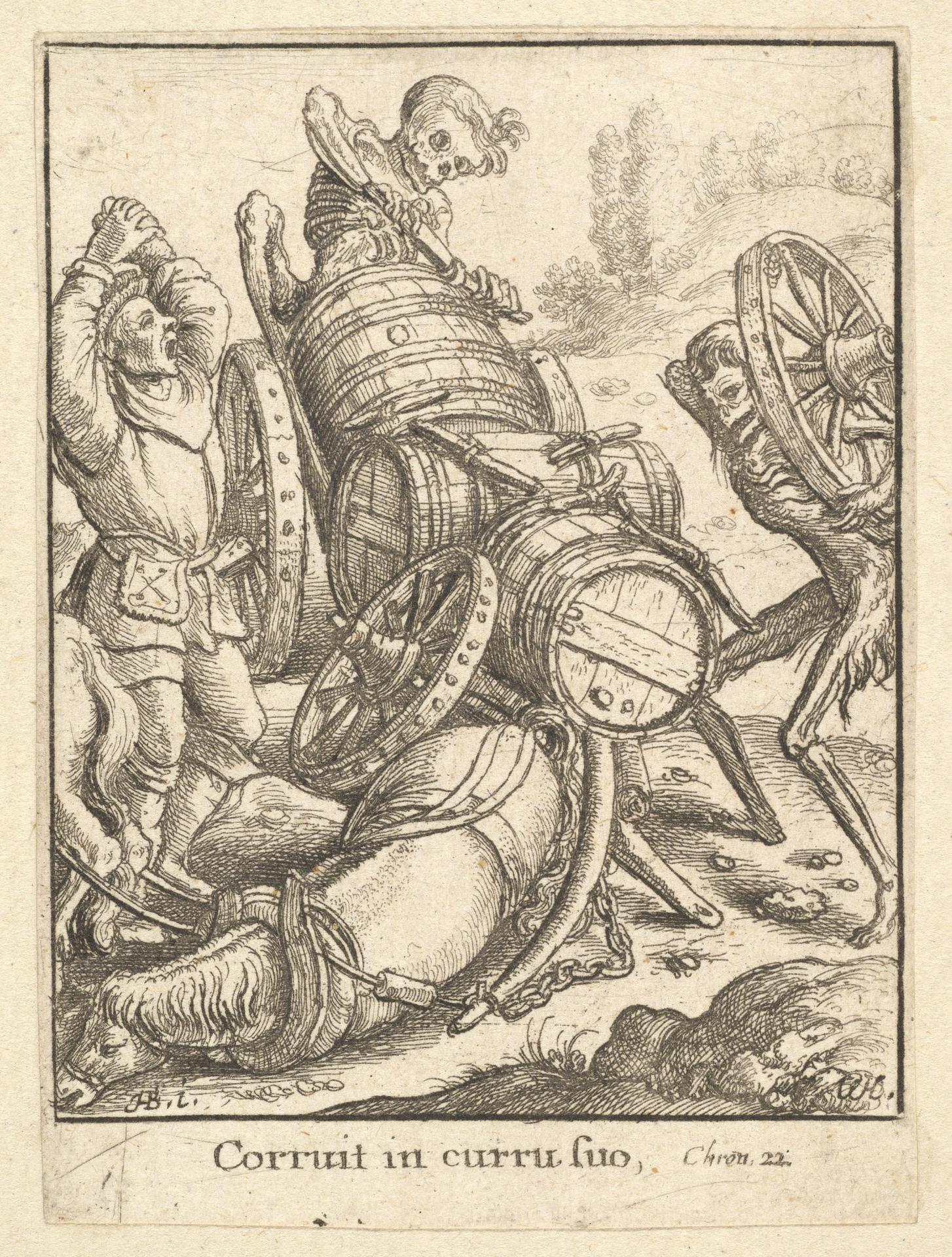
Unlike many Dance of Death sheets, which present the skeleton as a lone actor, Wenceslaus Hollar's 1651 etching puts several skeletons in motion: one sits on a cart, two others haul it, and the wagon is loaded with barrels. Marrying an everyday hauling scene to the allegory of death gives the sheet an idiosyncratic place within the genre.
Description
A third skeleton squats atop the cart drawn by the two others, while yet another drags a barrel toward it to join the load already lying on the bed. Clothing follows traditional forms, yet the bone structure stays plainly visible. Trees and a hill close off the distance, and the staggered placement of the figures lends the vehicle a sense of forward pull.
Context
Hollar, a printmaker of Bohemian origin who worked in England and on the Continent, made this etching in 1651 as part of a Dance of Death series, a motif widespread through the sixteenth and seventeenth centuries. The figure of the wagoner belongs to that allegorical tradition, which keeps the transience of all earthly things before the viewer's eyes. That the plate was printed again in the late eighteenth century speaks to a continuing demand for such images.
Impact
Realistic detail and symbolic heightening meet here in a way that invites pause rather than a shudder. There is something almost playful about the skeletons, and it does not weaken the moral message of the Dance of Death but underpins it. Even light and a single-color impression keep the figures and their labor at the center of attention.
Technique
Four states exist of the plate, and this impression is the second, pointing to repeated reworking. Etching allows the finest lines and hatching, used to pinpoint both the bony passages and the landscape. The print on paper measures 7.3 × 5.5 cm, in keeping with the exacting manner for which Hollar was known.
AI-generated description text
Source: Metropolitan Museum of Art · Public Domain (CC0 1.0)