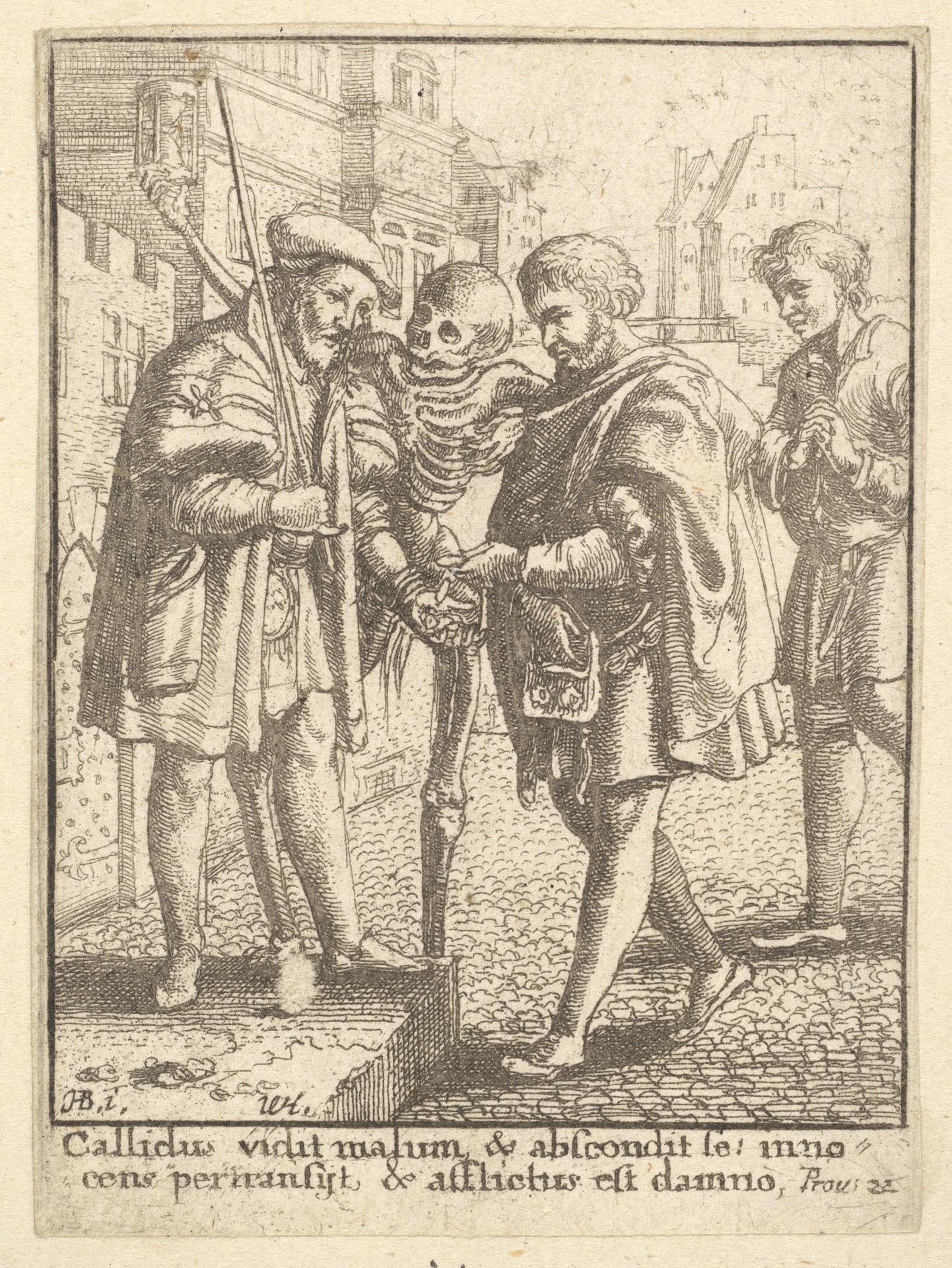
The Advocate and Death, from the Dance of Death
Original title: The Advocate and Death, from the Dance of Death
kurzbeschreibung
Wenceslaus Hollar's etching of around 1651, seen here in a late eighteenth-century printing, takes up the medieval dance of death. Two men meet a skeleton: one holds a sword, the other carries a bag. Hints of a town form the backdrop. The sheet measures 7.5 × 5.5 cm and is the second state of four.
Description
A skeleton stands at the front, flanked by two men. The one on the left grips a sword and reads as a protector or defender of the skeleton; the man on the right, bag in hand, touches or examines it. Behind the figures other people and buildings can be made out, sketching an urban setting. Monochrome with detailed lines, the print keeps its characters forward while the setting stays loosely worked. Light falls evenly, as is usual in etching.
Context
The dance of death spread from the late Middle Ages onward, its theme the transience of life and the equality of every rank before death. The Bohemian engraver Wenceslaus Hollar made this etching in the seventeenth century, presumably as part of a series drawing on older dance-of-death imagery. The small format and the later eighteenth-century printing point to a reproduction made for collectors.
Impact
An oppressive closeness grows between the living and the skeleton; the men's gestures suggest both protection and confrontation. The delicate linework and the pared-back setting draw the eye to the figures and sharpen the allegory of mortality.
Technique
This is an intaglio process: the drawing is scratched through an acid-resistant ground on a copper plate and then bitten. In printing, the lines take up the ink and yield a detailed monochrome image. The present version is the second state of four, which points to later reworking of the plate.
AI-generated description text
Source: Metropolitan Museum of Art · Public Domain (CC0 1.0)