Apocalypsis cum Figuris
Original title: Apocalypsis cu Figuris
kurzbeschreibung
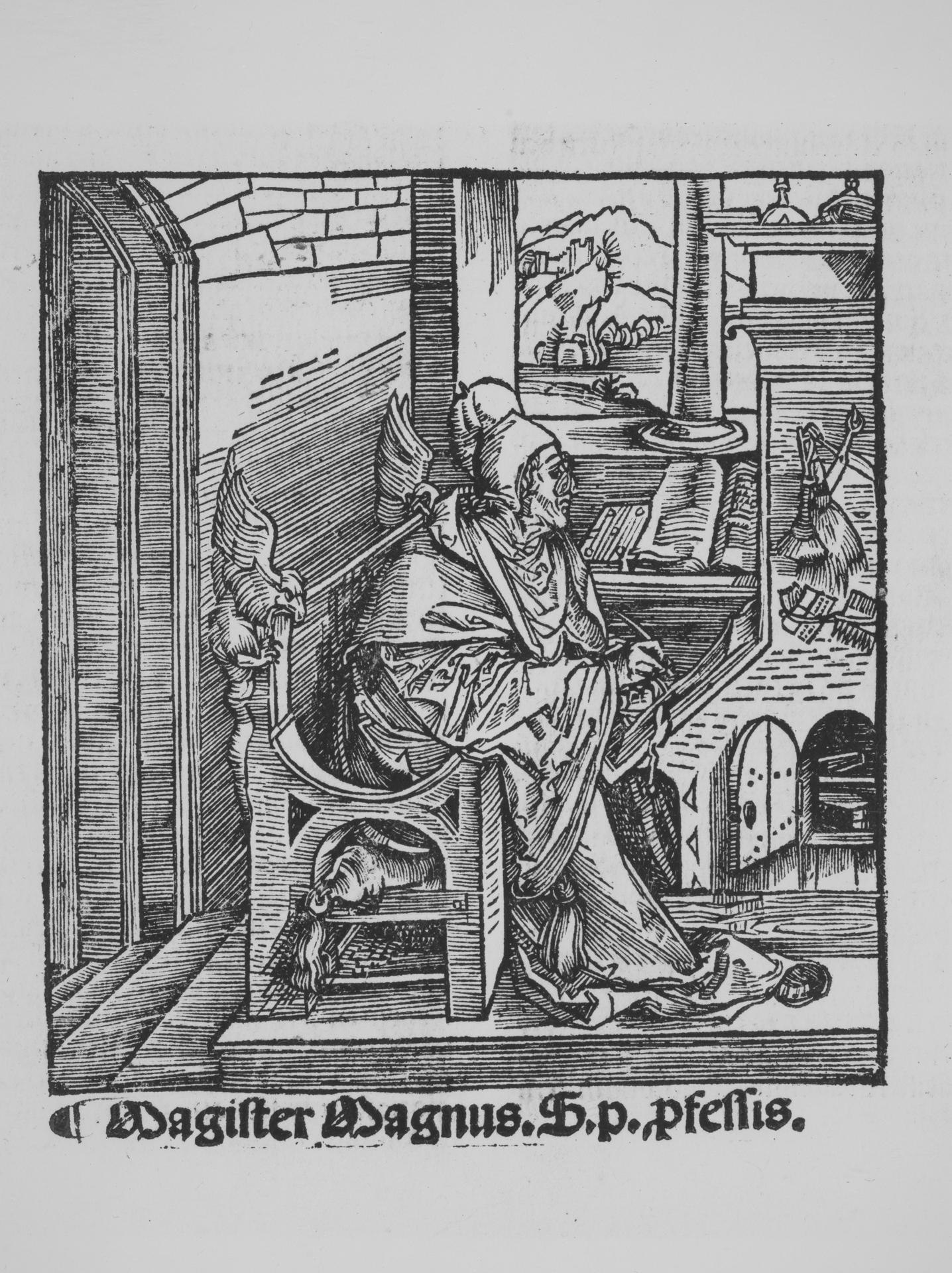
This woodcut by Albrecht Dürer, dated 1511, depicts a scholarly figure in a study, likely a portrait of the artist's friend and humanist, Willibald Pirckheimer, or a symbolic representation of the author of the Apocalypse. The scene includes a book, a desk, and a window revealing a landscape, all rendered in Dürer's distinctive Renaissance style.
Description
The composition centers on a bearded man seated in a chair, dressed in a robe and cap, holding an open book while gesturing toward a table. To the right, a tall window frames a distant view of mountains and a body of water, while a shelf with books and objects occupies the far right. The room is rendered with strong linear perspective, and the monochrome print relies on sharp, precise contours and varied hatching to model form and light. A Latin inscription, 'Magister Magnus S.p. Pfess,' appears at the bottom, likely a printer's or artist's mark.
Context
Dürer published the first edition of his Apocalypse series in 1498, with a second edition issued in 1511, which included this frontispiece. The series was groundbreaking for its ambitious scale and artistic quality, marking Dürer as a master of the woodcut medium. This particular image may serve as a portrait of the humanist scholar Willibald Pirckheimer, a close friend of Dürer, though the identification is not definitive. The work reflects the intellectual and religious climate of early 16th-century Nuremberg, where Dürer was active.
Impact
The print exudes a quiet, contemplative atmosphere, drawing the viewer into the scholar's private world. The contrast between the dark interior and the luminous landscape outside creates a sense of depth and introspection. Dürer's meticulous linework lends the scene a tangible realism, making the figure's expression of concern or thought feel immediate and human.
Technique
This is a woodcut, a relief printing technique where the image is carved into a wooden block, inked, and pressed onto paper. Dürer elevated the medium by using fine, cross-hatched lines to achieve tonal variation and three-dimensional form, as seen in the shading of the drapery and the landscape. The 1511 edition was printed from the original blocks, which Dürer had carefully preserved and reissued with a new Latin text.
AI-generated description text
Source: Metropolitan Museum of Art · Public domain (CC0)