Preacher, from the Dance of Death
Original title: Preacher, from the Dance of Death
kurzbeschreibung
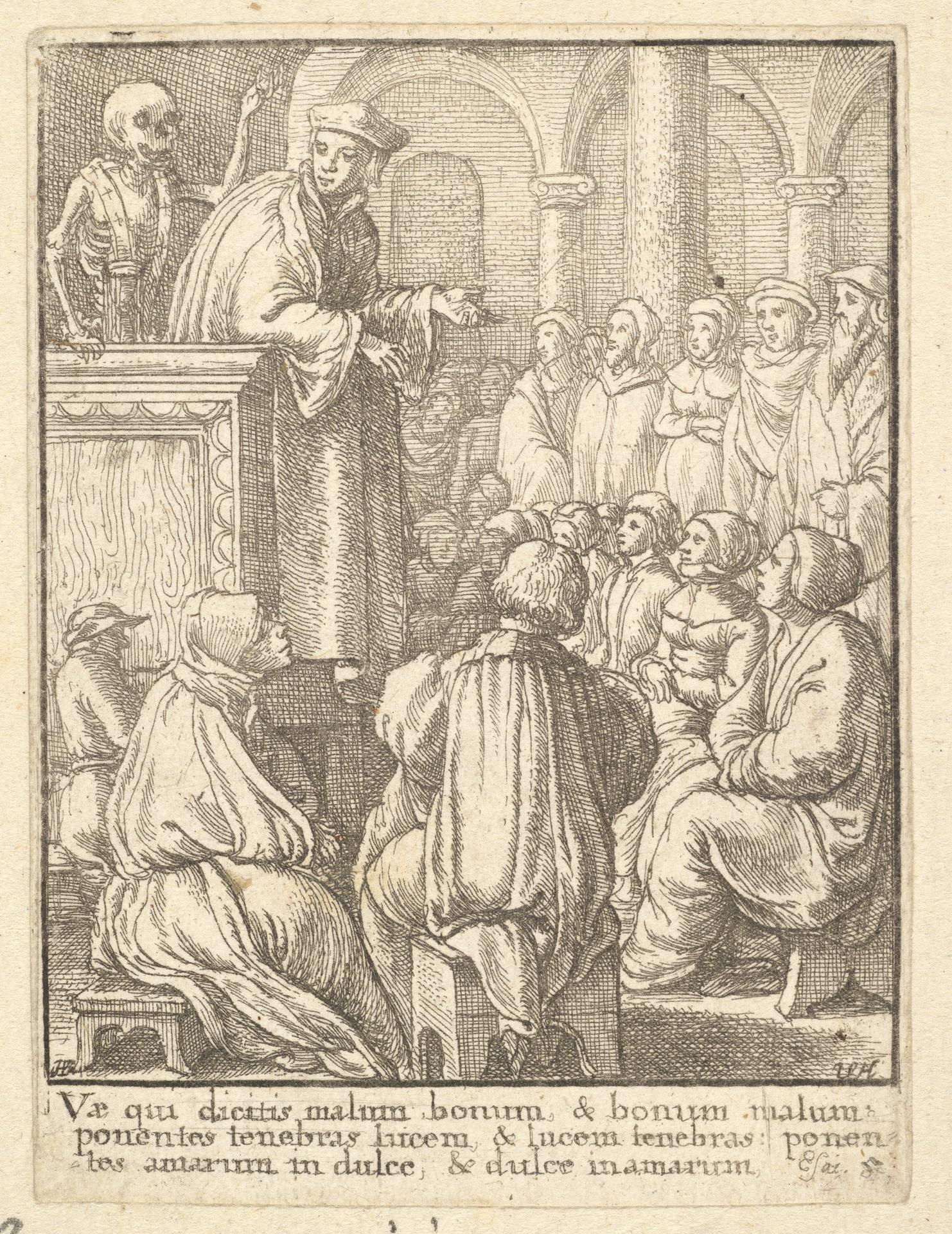
A preaching priest stands in a church, surrounded by listeners and skeletons, in Wenceslaus Hollar's etching 'Prediger, aus dem Totentanz' from 1651, preserved in a late 18th-century printing. The sheet belongs to an allegorical Dance of Death series that explores the transience of all earthly things.
Description
From a pulpit, a priest in a long robe and head covering that underscore his spiritual authority points with his right hand to a figure outside the frame, understood as Death or a skeleton. Around him, people of various ages and genders in simple garments are gathered, sitting or standing, listening attentively. Arches and columns suggest a church interior, and another skeleton appears on the left. Latin text along the bottom edge presumably reproduces a passage from a sermon.
Context
Hollar made the etching in 1651 as part of a Dance of Death sequence, a widespread Baroque allegorical theme that emphasizes the equality of all people before death. That the plate was printed again in the 18th century speaks to continued interest in such moralizing images. The Bohemian engraver worked in England and on the Continent and was known for his detailed graphic work.
Impact
Precise linework and a clear layout give the scene a quiet yet insistent mood. Skeletons appearing right next to the living listeners create an oppressive presence of death and make the transience of earthly things palpable.
Technique
As an etching, an intaglio process in which the drawing is scratched into an acid-resistant layer on a copper plate and then bitten, the sheet displays the fine lines and hatching typical of Hollar. They allow a detailed rendering of textures and shading. Printing was done in monochrome ink on paper.
AI-generated description text
Source: Metropolitan Museum of Art · Public Domain (CC0 1.0)