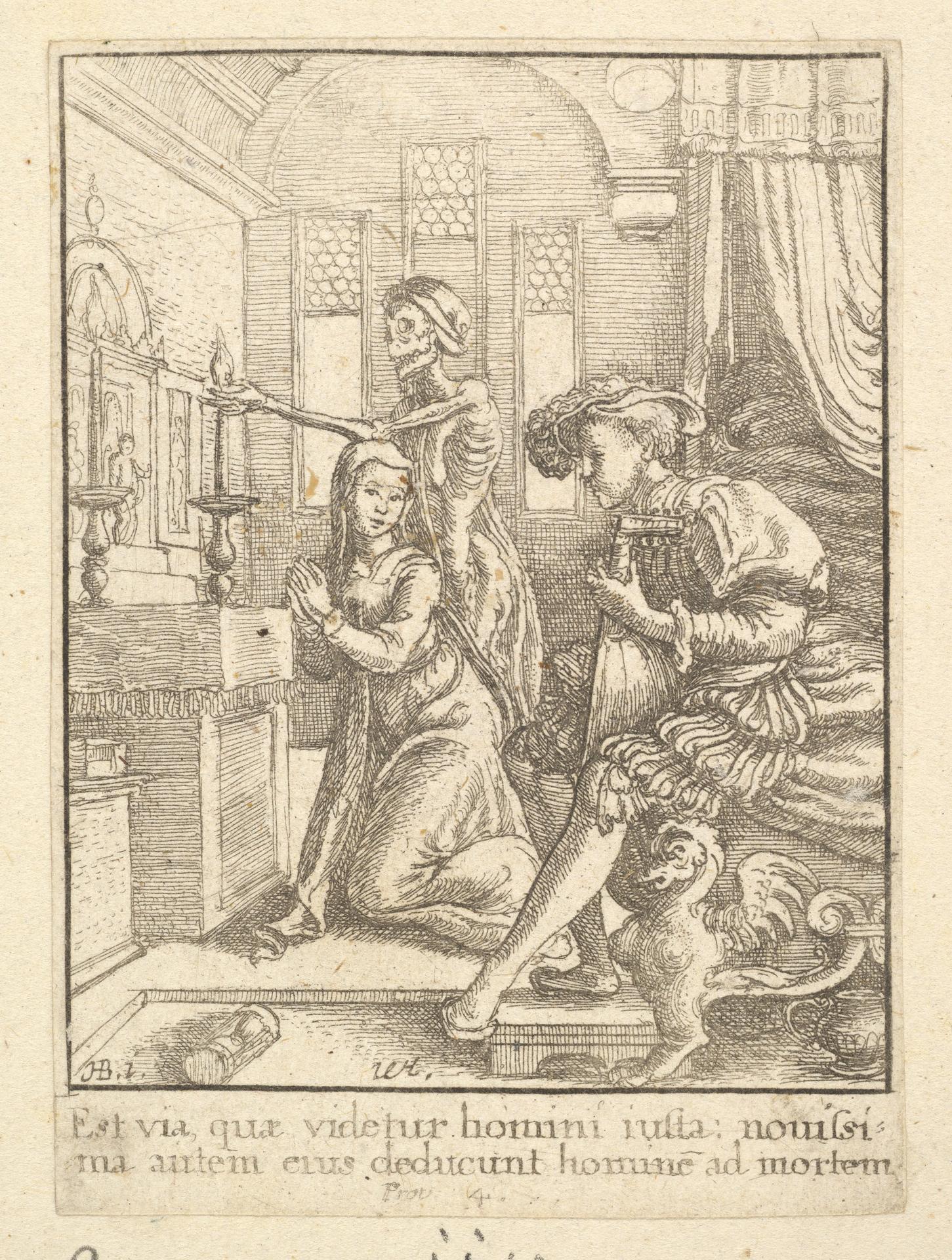
The Nun, from the Dance of Death
Original title: The Nun, from the Dance of Death
kurzbeschreibung
Unlike many Dance of Death scenes, where death arrives suddenly and threateningly, Wenceslaus Hollar's print 'The Nun' shows a woman at prayer as a skeleton quietly steps toward her. The etching was made in the 17th century, but this impression dates from the late 18th century. The motif links religious devotion with the medieval reminder of mortality.
Description
A woman in dark clothing kneels at the center, holding a candle and praying. A skeleton touches her face, while another dark-clad figure leans forward holding a second candle. A window, a mirror, and a statue structure the room. Fine lines and shading recall the Renaissance; candlelight and the window suggest the lighting, and the palette stays within gray tones.
Context
Around 1651 Hollar created this etching as part of a series on the Dance of Death, a widespread pictorial theme that stresses the equality of all ranks in the face of death. The series draws on older models reaching back to 15th-century woodcuts. That the series was still being printed in the 18th century attests to continued demand. Hollar, born in Prague, worked in England and on the Continent and was known for his detailed prints.
Impact
The contrast between the praying nun and the skeleton gives the sheet an insistent calm. The fine linework and the light from candles and window create an intimate, contemplative mood. Death appears as a gentle companion, which evokes melancholy rather than horror.
Technique
For this etching, the drawing was scratched into an acid ground on a copper plate and then etched. The present impression is the second state of four, indicating later reworking of the plate. At 7.5 × 5.5 cm, the sheet is small and kept in gray tones, as is typical for intaglio printing.
AI-generated description text
Source: Metropolitan Museum of Art · Public Domain (CC0 1.0)