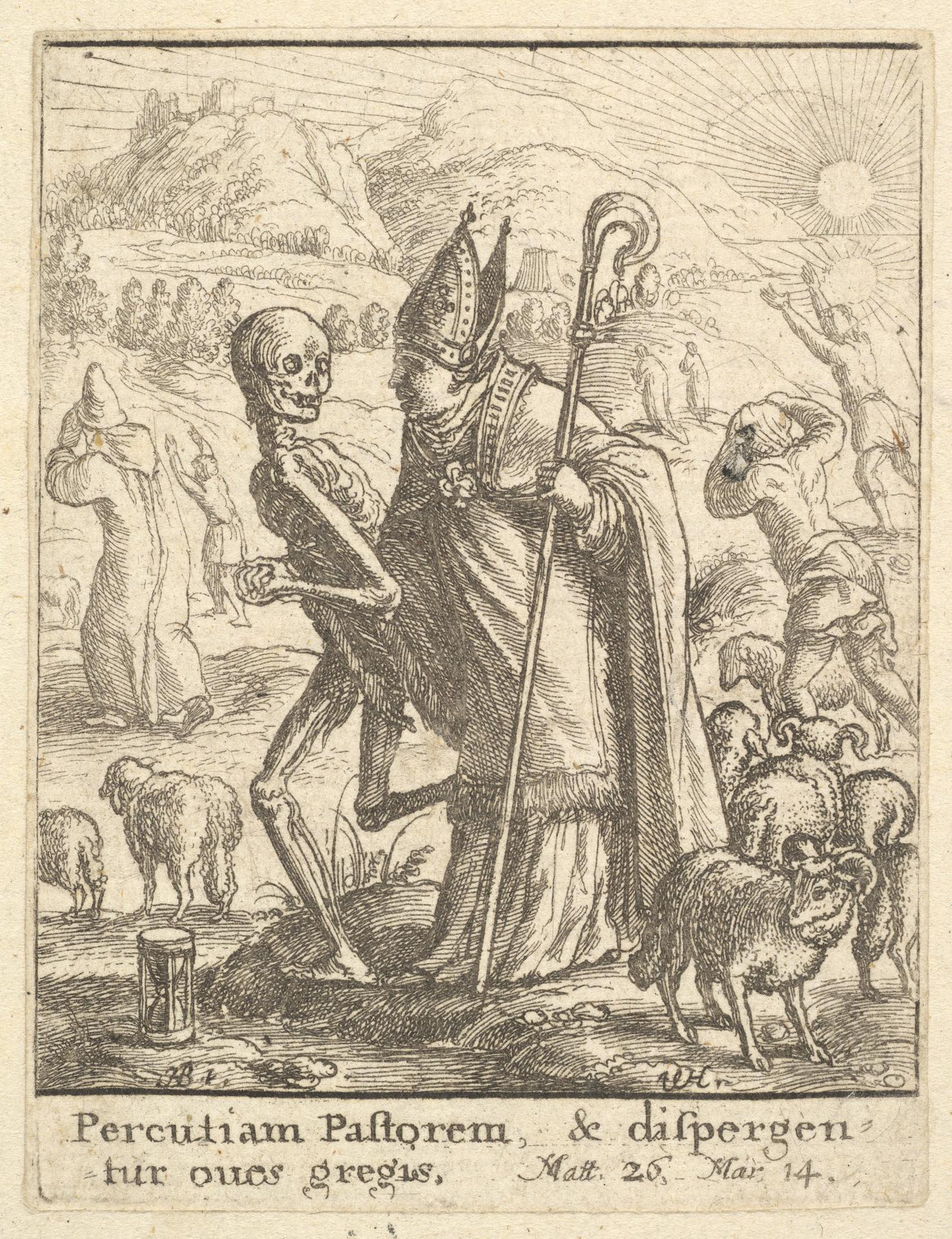
Bishop, from the Dance of Death
Original title: Bishop, from the Dance of Death
kurzbeschreibung
A skeleton leads a bishop by the arm in this 1651 etching by Wenceslaus Hollar. The print takes up the allegorical motif of the Dance of Death: mitre and crozier identify the clergyman, sheep graze around the figures, and mountains and trees form the backdrop. This particular impression is a late 18th-century printing and corresponds to the second state of four.
Description
On a hill, a skeleton and a bishop walk together, the bishop wearing a mitre and holding a crozier that mark him as a spiritual leader. Sheep stand around them, representing the people. Further back, several figures raise their hands, and behind them stretches a landscape of mountains and trees. Along the lower edge of the sheet, a Latin verse from Matthew 26 is engraved. Sharp contours and detailed lines define the image, with light evenly distributed.
Context
The Dance of Death motif brings home the ubiquity of death and the equality of all ranks. Hollar created the etching in 1651; the impression shown here was printed in the late 18th century. Biblical texts served as its basis, especially the quotation from Matthew 26 that addresses the shepherd's responsibility.
Impact
The confrontation between skeleton and bishop acts as a stark reminder of mortality. Clear contours and even light draw the eye to the figures and the engraved text, creating a calm, reflective mood.
Technique
The etching was made by biting lines into a metal plate. Black ink on white paper produces a strong contrast that brings out the details of the figures and landscape. The sheet belongs to the second state of four, suggesting that the plate was reworked.
AI-generated description text
Source: Metropolitan Museum of Art · Public Domain (CC0 1.0)