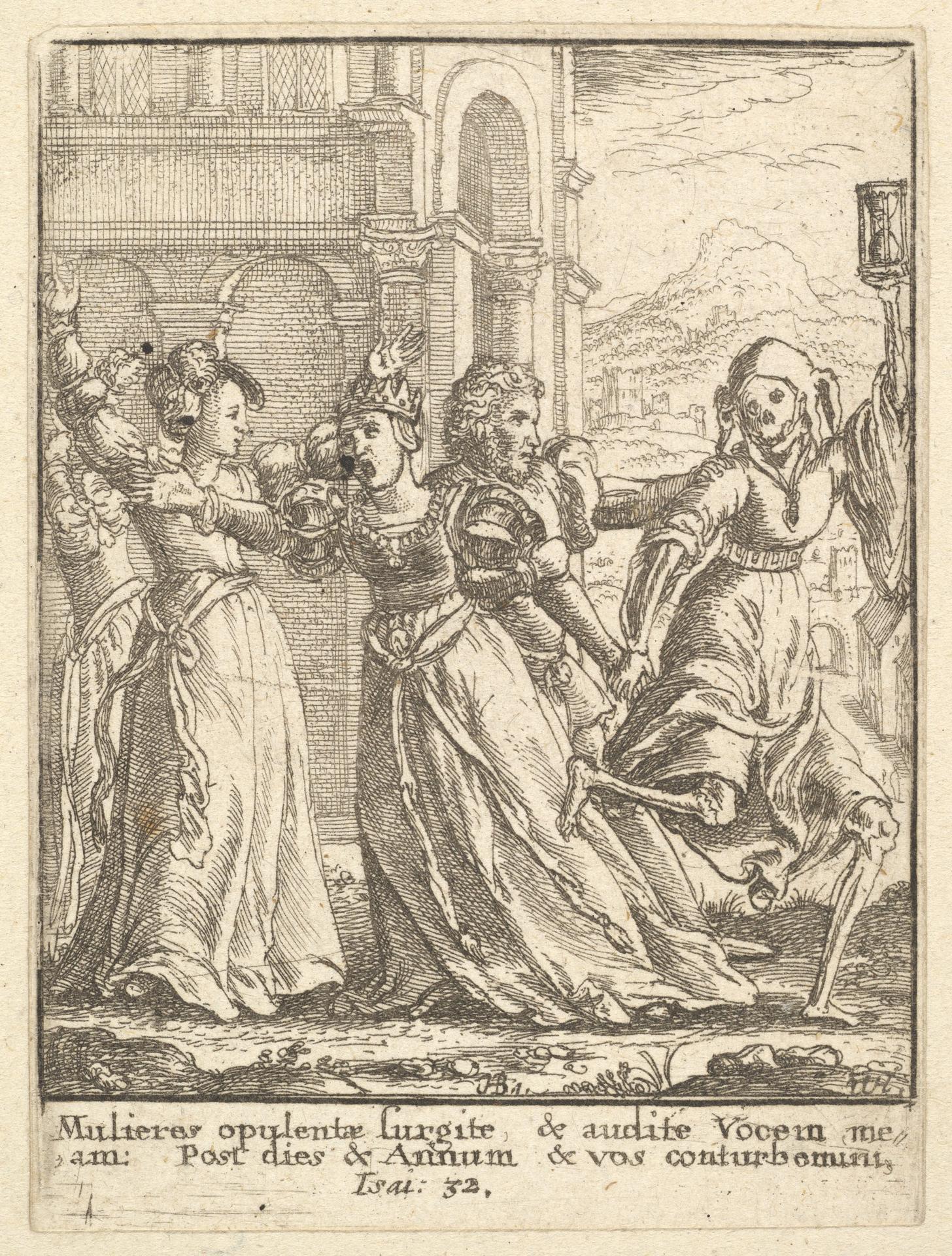
Queen, from the Dance of Death
Original title: Queen, from the Dance of Death
kurzbeschreibung
A crowned queen and a skeleton meet in a dancing step in this etching by Wenceslaus Hollar, dated 1651 and surviving here in a late eighteenth-century impression. The subject belongs to the Dance of Death tradition. Hollar etched the figures in fine lines, with further figures and an architectural setting giving the image life.
Description
Four figures move through the foreground: two richly dressed people, the queen among them, and two skeletons who step toward them in dance. The skeletons confront the living with their mortality, and the figures respond to one another with real energy. A building with columns and an arch rises behind them; at the right a torchbearer stands with a lantern, and a mountainous landscape closes off the view. The central group and the architecture give the arrangement a clear structure.
Context
Hollar made the etching in 1651, when the Dance of Death was a widely circulated motif in European art, a reminder of life's transience. The Bohemian printmaker, who worked in England and on the Continent, included this image in a series on the theme. That the plate was printed again in the late eighteenth century shows how long the motif continued to be received. The second of four states reflects the artist's careful reworking of the plate.
Impact
Delicate linear work gives the figures an elegant, almost dancing lightness. Splendid clothing and bare skeletons face each other, producing a forceful warning about mortality that avoids pathos and relies on clear visual language. The monochrome execution and precise hatching draw the eye to the narrative energy of the scene.
Technique
For this etching the drawing was scratched through a ground on a copper plate and then bitten with acid. The fine lines and hatching match Hollar's precise manner. Printing was done on paper, and the second of four states records a reworked version of the plate.
AI-generated description text
Source: Metropolitan Museum of Art · Public Domain (CC0 1.0)