The Holy Trinity
Original title: The Holy Trinity
kurzbeschreibung
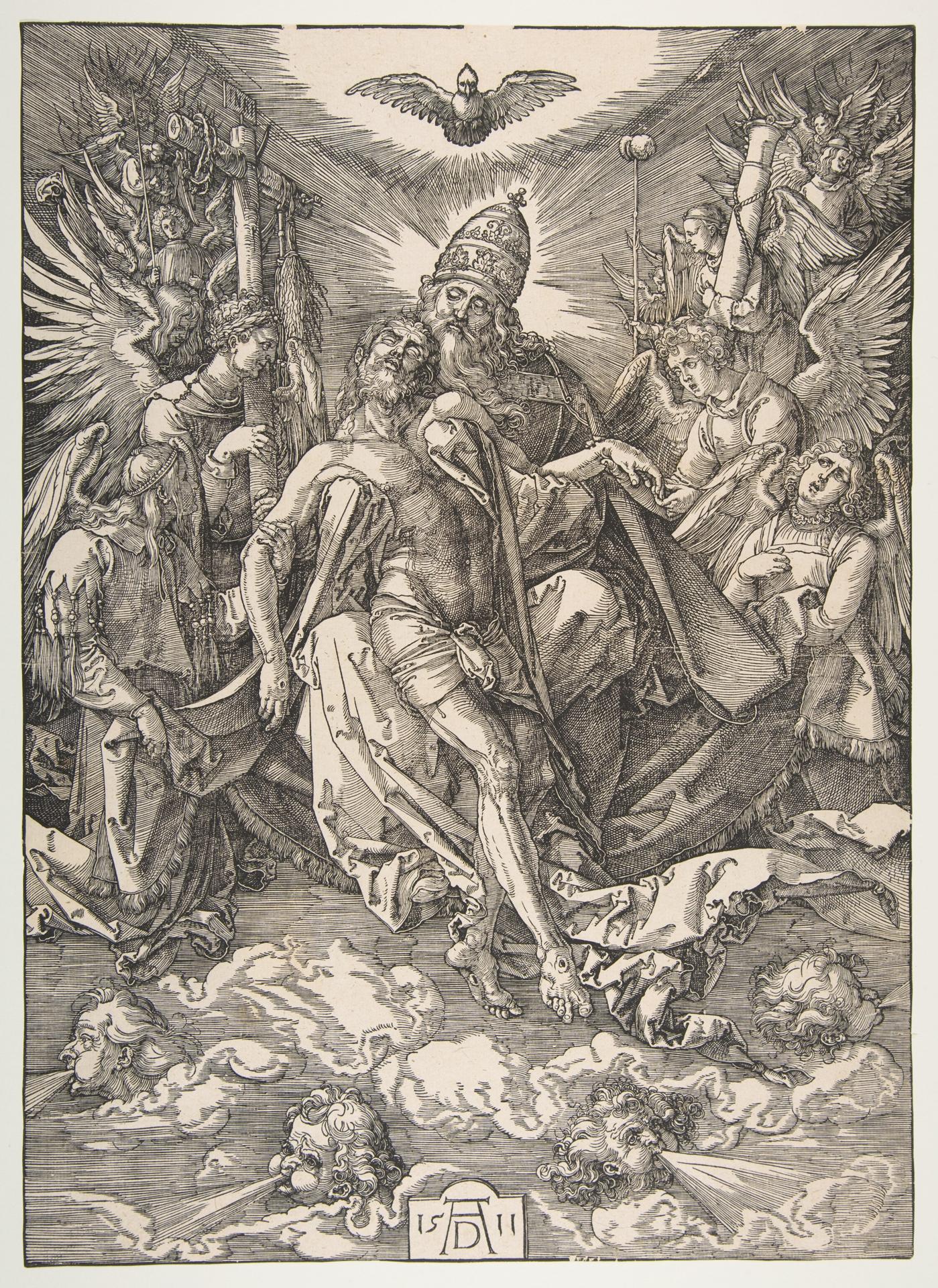
Albrecht Dürer made this woodcut, The Holy Trinity, in 1511, and it stands as a major achievement in his printed oeuvre. Measuring 39.8 by 28.7 cm, the sheet brings together God the Father, Jesus Christ, and the Holy Spirit, surrounded by a host of angels. Dürer's masterful cutting technique is clearly evident here.
Description
Enthroned at the center is God the Father, crowned and in royal robes, with Jesus Christ beside him in simple garments and the Holy Spirit in the form of a dove. A multitude of angels fills the space: some bear weapons and shields, others make music or move about. At the bottom appear lion and other animal heads, read as symbols of the four Evangelists. This monochrome image depends on delicate lines and hatching that give the figures physical presence.
Context
The woodcut was created in 1511 in Nuremberg, a time when Dürer was deeply engaged with religious subjects and printmaking. It belongs to a series of woodcuts intended for a book project that was never realized. The Trinity motif was widespread in late medieval Christian art; Dürer found his own visual language for it.
Impact
A clear structure and the calm majesty of the main figures define this woodcut. The richly varied angels and symbolic animal heads make the sheet a lively narrative world that invites lingering. Because color is absent, the linework and sculptural modeling stand out especially.
Technique
The sheet is monochrome, with black printing ink setting the figures and their surroundings against the light paper. Fine lines and hatching build graded tonal values, giving the densely populated scene depth and keeping each figure legible. Lion heads and animal forms along the lower edge remain clearly articulated within this restricted tonal range.
AI-generated description text
Source: Metropolitan Museum of Art · Public Domain (CC0 1.0)