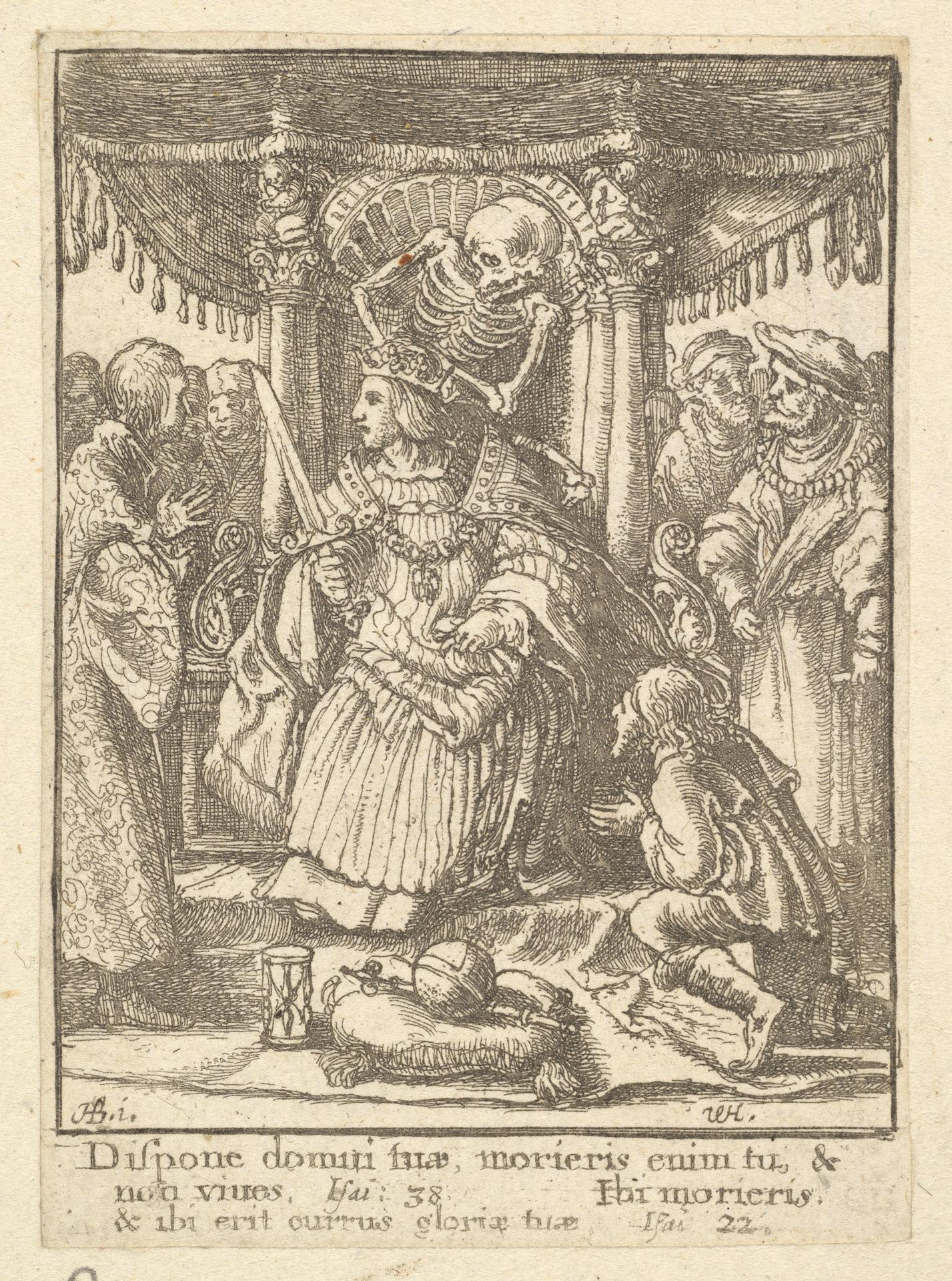
The Emperor, from the Dance of Death
Original title: The Emperor, from the Dance of Death
kurzbeschreibung
The Emperor, a central figure from Wenceslaus Hollar's Dance of Death series, appears in an etching of 1651 preserved in a late eighteenth-century printing. The sheet sets earthly mortality before the viewer: a king sits in sumptuous armor and crown, while behind him a skeleton has taken its place on the throne in royal robes.
Description
A king is enthroned in full armor, the crown on his head; several figures stand around him, their bearing wavering between anxiety and prayer. Behind the ruler a skeleton dressed as royalty has settled, partly hidden by a fringed curtain. At the emperor's feet lie a cloth, an hourglass and a skull — signs of time and finitude. The arrangement is built symmetrically around emperor and skeleton. Monochrome throughout, the etching shows the precise linework typical of the medium.
Context
The Dance of Death motif dates from the late Middle Ages and presses home the inevitability of death for every rank of society. Wenceslaus Hollar, a Bohemian etcher, made this series in 1651 during his years in England. That the plate was printed again in the late eighteenth century attests to lasting interest in such moralizing images. Hollar was known for his detailed prints and often worked after designs by other artists.
Impact
Setting earthly power against death gives the sheet a somber, reflective mood. The symmetrical layout and finely graded linework produce a quiet but insistent aesthetic. Hourglass and skull drive home the memento mori message.
Technique
In etching, lines are bitten into a copper plate previously coated with an acid-resistant ground, after which the image is printed on paper. Monochrome ink gives an even distribution of light and shadow. Hollar's precise linework testifies to his command of printmaking.
AI-generated description text
Source: Metropolitan Museum of Art · Public Domain (CC0 1.0)