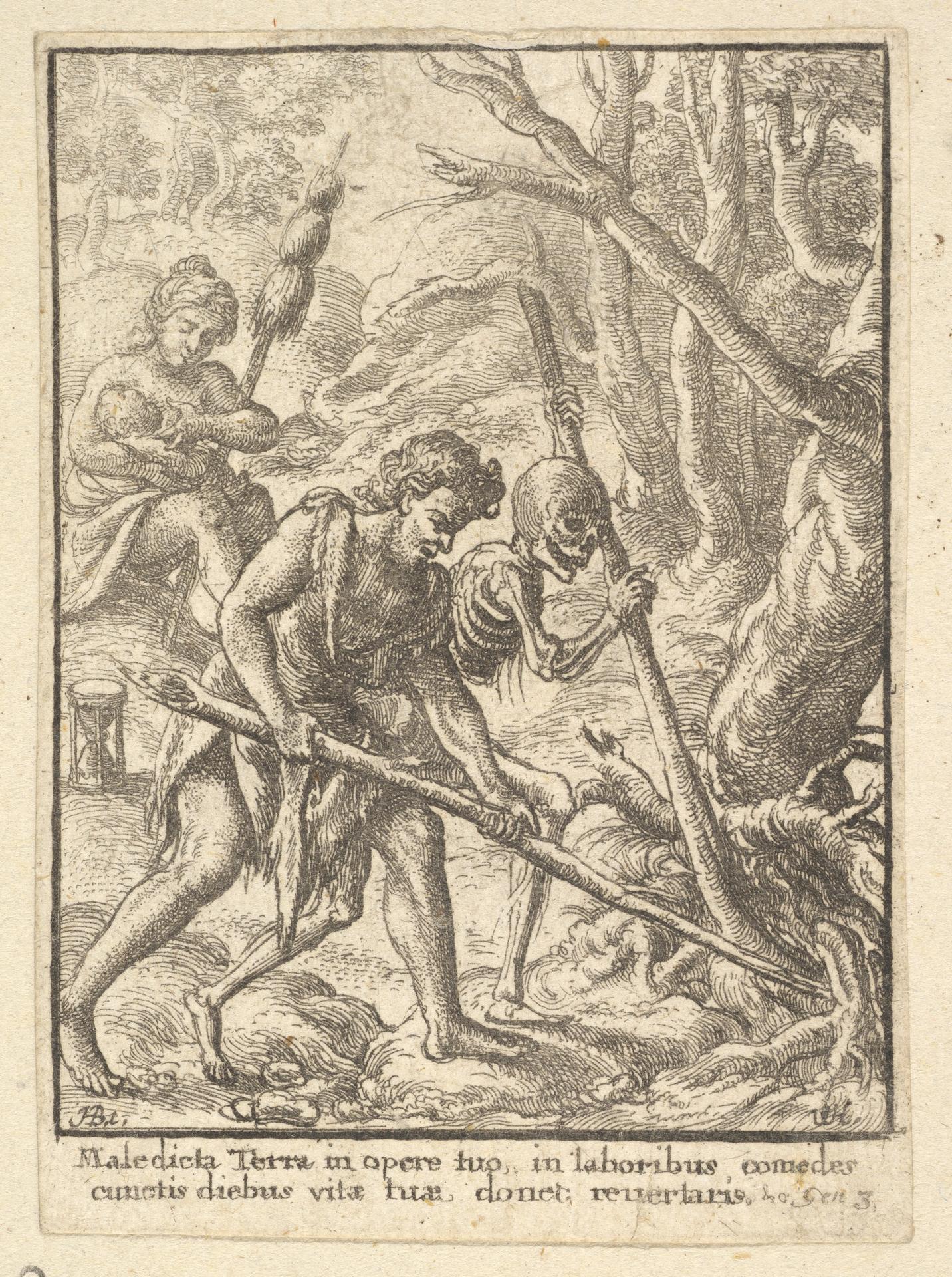
Adam Ploughing from the Dance of Death
Original title: Adam Ploughing from the Dance of Death
kurzbeschreibung
Wenceslaus Hollar made this etching in 1651; the present sheet is a late 18th-century printing. It depicts Adam at field labor while a skeleton steers the plow alongside him. The print belongs to the Dance of Death tradition and links the biblical story of work after the Fall with the allegory of death.
Description
In the foreground Adam guides the plow, and at his side a skeleton keeps a hand on it. The two figures are closely bound together, making the connection between life and death palpable. Behind them appears a woman with a child on her arm; she carries a shield with an arrow. Trees and shrubs frame the action and fill the background. The layout is asymmetrical, with the emphasis on the group of Adam and the skeleton. The etching remains monochrome; the light is diffuse and arises from the line work.
Context
Hollar created this sheet as part of a Dance of Death series based on older models, likely after Hans Holbein the Younger. Adam's plowing recalls the biblical curse after the Fall, which ties work to hardship. Dance of Death images were widespread in Europe during the 16th and 17th centuries and served as moral instruction on transience. The small-format print was probably intended for individual sale or a collector's album.
Impact
A pensive mood emerges from the juxtaposition of active life and ever-present death. The delicate line drawing gives the scene a detailed yet plain elegance that supports its allegorical content. The arrangement draws the eye to the shared labor of Adam and the skeleton, thus emphasizing the transience of human endeavor.
Technique
The etching was printed in four states; this is the second state. The process allows fine, linear hatching to model light and shadow. The sheet measures 7.5 × 5.5 cm and required a precise printing plate and careful execution.
AI-generated description text
Source: Metropolitan Museum of Art · Public Domain (CC0 1.0)