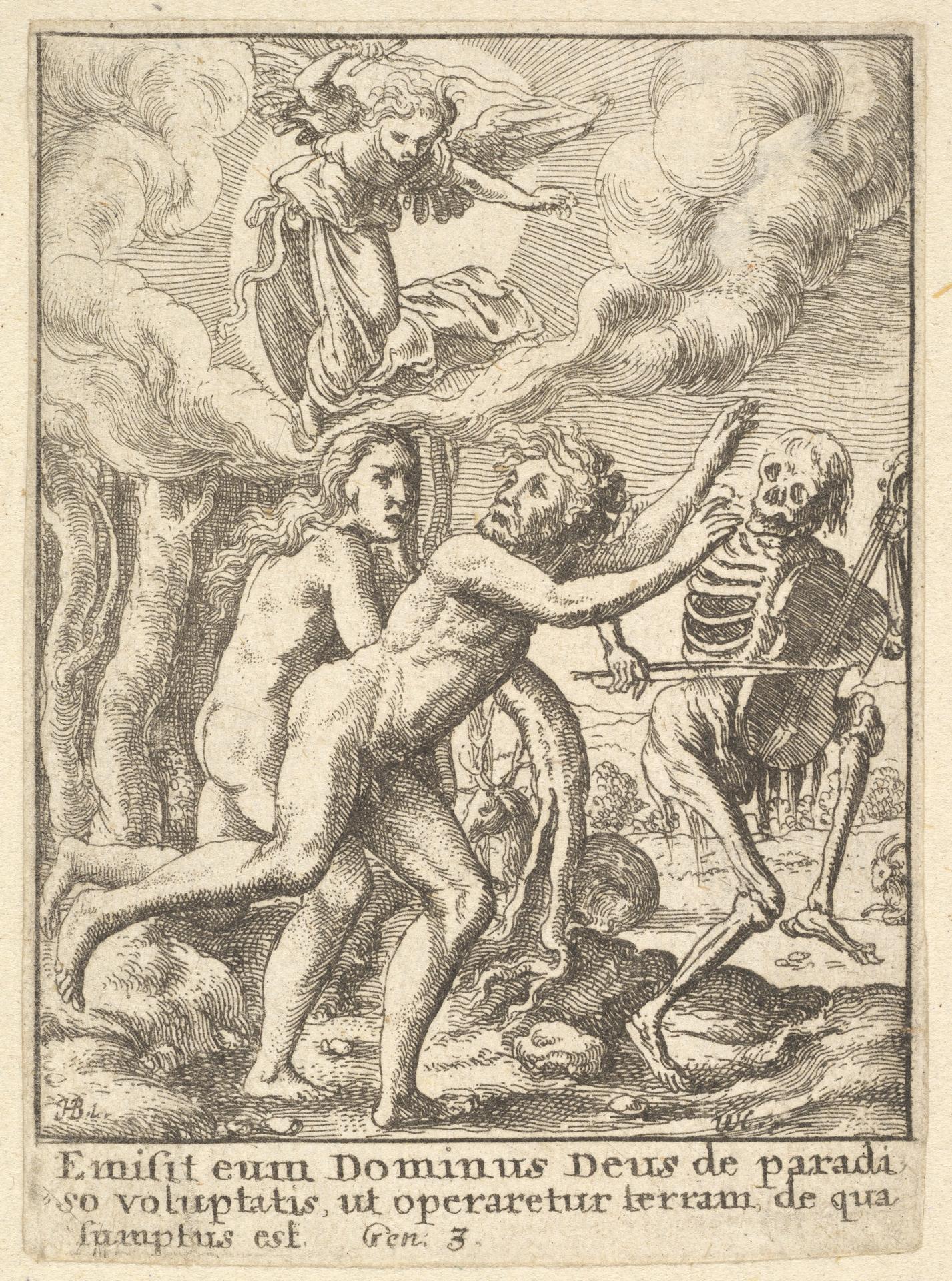
Paradise Lost, from the Dance of Death
Original title: Paradise Lost, from the Dance of Death
kurzbeschreibung
Adam and Eve leave Paradise in a small etching by Wenceslaus Hollar, made around 1651, with this impression dating from the late 18th century. The pair are caught in vigorous motion, accompanied by an angel and a skeleton that stand for the heavenly and earthly realms.
Description
Two figures, recognizable as Adam and Eve by posture and attributes, anchor the layout. Adam carries a staff or tool and seems to shield or warn Eve, who is shown in a swaying, dance-like pose that conveys both flight and departure. An angel plays a flute behind them; above hovers a cloud as a sign of divine presence. On the right appears a skeleton with a shield, an embodiment of death. Trees and bushes form a simple landscape; the lines are sharp and precise, and the sheet remains monochrome.
Context
The Bohemian etcher Wenceslaus Hollar created this print within a Dance of Death series based on designs by Hans Holbein the Younger. The series was made around 1651, while Hollar was working in London. This late impression belongs to an edition of the late 18th century and shows that the Holbein tradition was still being received over a long period. Hollar was known as a master of precise reproduction and could realize complex inventions even in a small format.
Impact
Fine lines and a clear arrangement of the figures sustain a quiet yet animated narrative. The confrontation between the heavenly angel and the earthly skeleton prompts reflection on transience and loss. Despite the small format, the print gains depth and reveals considerable detail.
Technique
Hollar worked in etching, an intaglio process: the drawing is scratched into a wax layer on a copper plate and then etched. Fine lines and hatching create shadows and textures. Printing was done in black on paper, which gives the monochrome effect.
AI-generated description text
Source: Metropolitan Museum of Art · Public Domain (CC0 1.0)