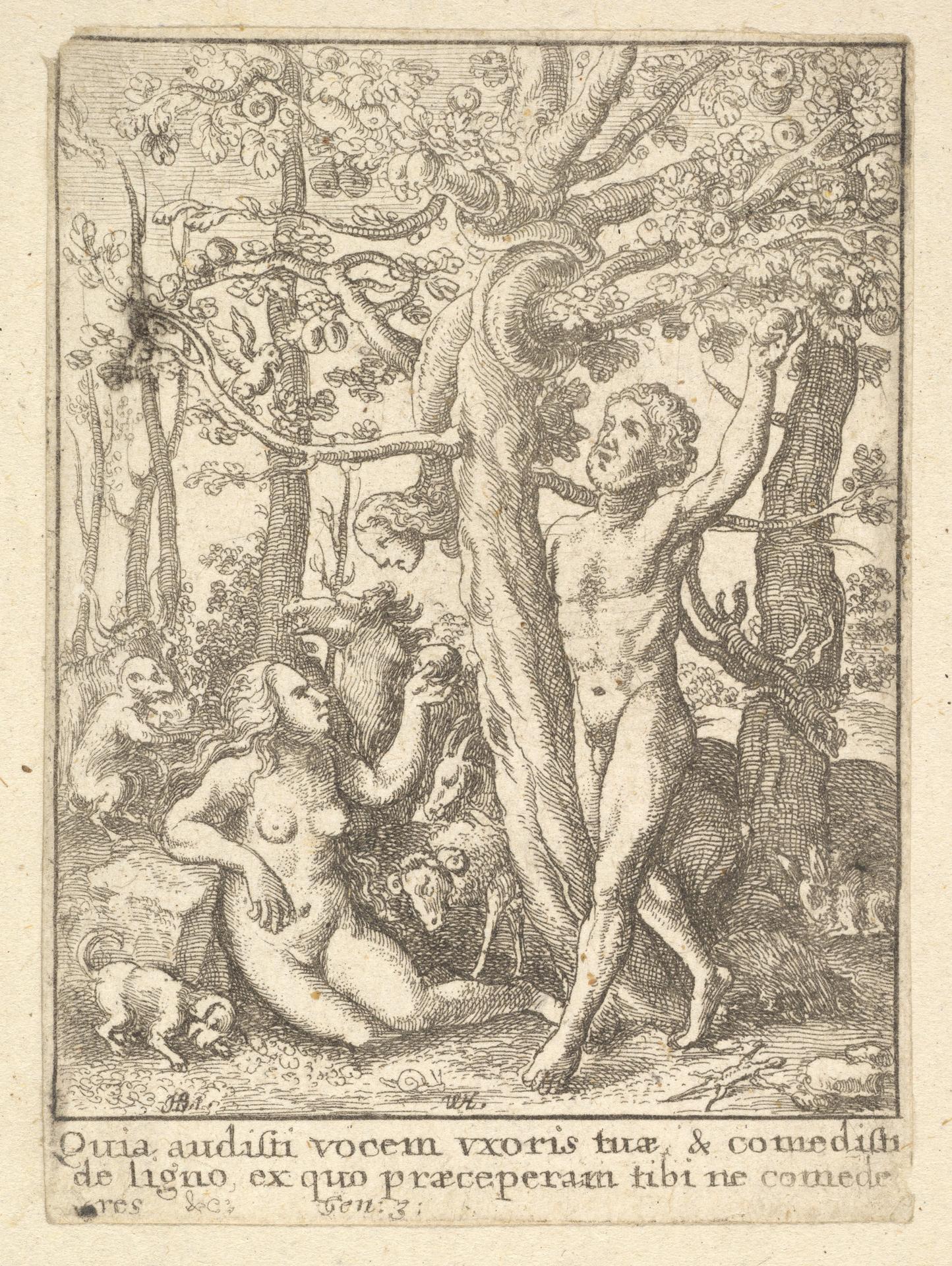
Garden of Eden, from the Dance of Death
Original title: Garden of Eden, from the Dance of Death
kurzbeschreibung
Wenceslaus Hollar's etching 'Garden of Eden' from 1651, in the second of four states, presents Adam and Eve in paradise. This small sheet belongs to the 'Dance of Death' series and is here a late impression from the late 18th century. Biblical motif and Hollar's characteristic fine linework combine in it.
Description
The eye is first drawn to the two naked figures: Adam upright with arms wide open, Eve seated, her arms also spread. Around them are scattered chickens and hares. Behind them, trees, including apple trees, bear their fruit. Grass and flowers cover the ground; along the lower edge runs a Latin inscription, likely a biblical quote. The dense lines and hatching give the image a precise, almost ornamental character.
Context
In 1651 the Bohemian engraver Wenceslaus Hollar created this etching as part of his 'Dance of Death' series, which deals with transience and death. The Garden of Eden stands within it as the origin scene contrasting with humanity's later mortality. The present impression comes from a late printing of the late 18th century and shows that Hollar's work was appreciated over a long period. Hollar was known for his precise topographical and figurative works.
Impact
From the bright bodies in the foreground emanates a calm presence that lets the gaze glide slowly across the surface. The symmetrical arrangement of the figures and the fine shading create an idyllic mood of almost graphic clarity. The Latin text at the bottom edge gives the sheet a learned, thoughtful touch. Despite the small format, the depiction appears delicate and detailed without being dainty.
Technique
An etching printed on paper, it is here in the second of four states. With the needle on the etched plate Hollar worked with extreme control, which allowed fine lines and subtle shading; he thus renders plants and figures precisely. The format of about 7.5 × 5.5 cm demanded particularly careful work.
AI-generated description text
Source: Metropolitan Museum of Art · Public Domain (CC0 1.0)